

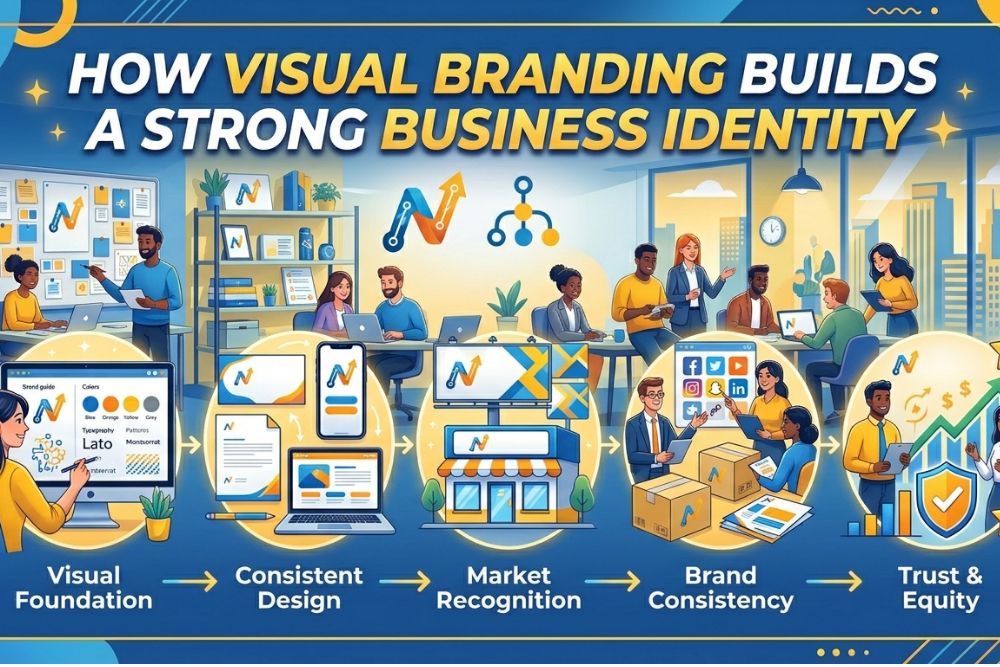
How Visual Branding Builds a Strong Business Identity
Before a customer reads a single word about your business, they have already formed an impression. Research shows that people make subconscious judgements about a brand within the first 50 milliseconds of seeing it. That split-second response is driven almost entirely by visual design — and that is precisely why visual branding is not a nice-to-have; it is the very foundation of every strong business identity.
What Is Visual Branding — And Why Does It Matter?
Visual branding is the strategic use of visual elements — logos, colours, typography, imagery, and design patterns — to communicate who a business is, what it stands for, and why customers should choose it over competitors. Simply put, it is the face of your brand.
More importantly, visual branding does something that no tagline or pitch deck can do alone: it communicates instantly, emotionally, and without language. A warm amber palette signals warmth and craft. Clean white space signals precision and professionalism. A hand-drawn logo signals authenticity and personality. These signals are absorbed in milliseconds — long before the rational mind kicks in.
A brand is no longer what we tell the consumer it is — it is what consumers tell each other it is.
— Scott Cook, Co-founder of Intuit
Therefore, investing in visual branding is not about aesthetics for its own sake. It is about engineering the right perception in the right audience, consistently, across every touchpoint.
The Core Elements of Visual Branding
To begin with, it helps to understand what visual branding is actually made of. Each element plays a distinct role — and together, they create a system far greater than the sum of its parts.
Logo Design
The anchor of your visual identity. A great logo is memorable, scalable, and meaningful — it works on a business card and a billboard alike.
Colour Palette
Colour drives emotion and recall. A deliberate palette of 2–4 colours creates instant recognition and sets the emotional tone of your brand.
Typography
Your typeface communicates personality before anyone reads a word. Serif fonts feel authoritative; sans-serif fonts feel modern; script fonts feel personal.
Imagery & Photography
The style, subjects, and mood of your images signal taste, audience, and brand values in a way that text simply cannot replicate.
Layout & Grid System
A consistent spatial rhythm across your website, packaging, and materials creates a sense of order and professional quality.
Icons & Graphic Elements
Supporting shapes, patterns, and iconography extend your visual language into every corner of your communications.
Colour Psychology: The Science Behind Brand Perception
Of all visual branding elements, colour is arguably the most powerful — and the most misunderstood. Specifically, different colours trigger measurable emotional and psychological responses in viewers, which is why colour choice in branding is never arbitrary.
For instance, blue communicates trust, reliability, and calm — which is why it dominates banking, healthcare, and technology brands. Red signals urgency, energy, and appetite, making it a favourite in food and retail. Green evokes nature, health, and growth. Black suggests luxury, precision, and authority.
However, colour psychology is not a simple formula. Cultural context, industry norms, and your specific audience all influence how colour lands. That is why a skilled branding partner does not just pick colours that "look good" — they select colours that align with your positioning and resonate with your target market.
Practical Colour Branding Principles
- 1Limit your core palette to 2–3 primary colours with 1–2 accents. Fewer colours create stronger recall.
- 2Define exact HEX, RGB, and CMYK values for every brand colour and use them consistently across all channels.
- 3Test your palette in both light and dark contexts — on white backgrounds, dark packaging, and on screen.
- 4Ensure sufficient contrast ratios so your brand is readable for all users, including those with visual impairments.
- 5Choose a colour your direct competitors are not using — differentiation is as important as psychology.
Your Logo Is Not Just a Symbol — It Is a Strategy
Contrary to popular belief, a great logo is not great because it is beautiful. It is great because it works — across contexts, at every size, in black and white, and in the minds of your customers long after they have closed your website.
Consider the logos that have stood the test of time: the Nike swoosh, the Apple silhouette, the Mercedes star. Each is simple, distinctive, and infinitely scalable. None requires text to be recognised. As a result, they have become some of the most valuable pieces of intellectual property in the world.
When designing your logo, the key questions are not "does it look good?" but rather: Does it communicate the right values? Is it distinct from competitors? Will it remain relevant in five years? Can it be reproduced clearly at 16 pixels and at 16 metres?
Design is not just what it looks like and feels like. Design is how it works.
— Steve Jobs
Why Consistency Is the Most Underrated Branding Decision
Here is a truth many businesses learn the hard way: a brilliant logo and a beautiful colour palette mean very little if applied inconsistently. In other words, inconsistency does not just look unprofessional — it actively erodes trust.
Think about it from a customer's perspective. If your Instagram uses warm, earthy tones but your website is cold and corporate, your business card uses one font while your emails use three others, and your packaging looks like it belongs to a different company — customers sense the disconnection, even if they cannot name it. Consequently, they trust you less.
Create a Brand Style Guide
Document logo rules, colour values, typography, image guidelines, and tone of voice in one reference document.
Audit Every Touchpoint
List every place your brand appears — website, social, email, print — and ensure visual alignment across all of them.
Build Templates
Pre-built, on-brand templates for posts and documents remove guesswork and protect your identity at scale.
Furthermore, consistency compounds over time. Every touchpoint where your brand looks and feels the same reinforces recognition. Over time, recognition becomes familiarity, and familiarity becomes trust — the single most important asset any business can build.
Typography: The Silent Communicator
Typography is one of the most overlooked elements of brand identity — and one of the most powerful. In fact, the font you choose communicates personality and values before a single word is read.
For example, a law firm using a bold geometric sans-serif sends a very different signal than one using a classic elegant serif — even if the words are identical. Ultimately, typography shapes the emotional experience of reading your brand's communications.
A strong typographic system typically includes a display font for headlines, a body font for long-form reading, and clear rules for sizing, weight, and spacing. As a result, every piece of communication feels coherent and intentional.
How Visual Branding Directly Drives Business Growth
At this point, you may be wondering: does this actually translate to business outcomes? The answer is a clear yes — and the evidence is substantial.
First and foremost, strong visual branding increases perceived value. Research consistently shows that consumers assign higher value to well-branded products, even when the underlying product is identical to an unbranded alternative. In other words, great branding is a pricing strategy in disguise.
Beyond that, visual branding reduces customer acquisition costs. When your brand is distinctive and memorable, word-of-mouth increases, ad creative performs better, and customers seek you out rather than being paid to find you.
Additionally, consistent branding builds employee pride and internal alignment. Teams that feel proud of their brand sell more effectively and stay longer. Your brand is not just an external asset — it shapes company culture from the inside out.
How to Get Started with Strategic Visual Branding
If you are ready to build or refresh your visual brand, the process does not have to be overwhelming. Here is a clear starting point:
Your Visual Branding Roadmap
- 1Define your brand positioning first. Clarity on your audience, values, and unique difference informs every design decision that follows.
- 2Research your competitive landscape. Understand visual conventions in your industry — then decide which to follow and which to disrupt.
- 3Develop a cohesive visual identity system. Logo, colour, typography, and imagery should be designed together as a unified system, not as separate projects.
- 4Document everything in a brand style guide. Share it with every team member, agency, and partner.
- 5Apply consistently and audit regularly. Roll out your identity across every touchpoint, then review quarterly to maintain standards.
- 6Partner with specialists who understand strategy, not just design. Great visual branding sits at the intersection of aesthetics, psychology, and business strategy.
Let CreativeKatta Craft a Visual Identity That Works as Hard as You Do
From brand strategy and logo design to complete identity systems and brand guidelines — we help businesses build brands that are seen, remembered, and trusted.
Frequently Asked Questions
What is visual branding in simple terms?
Visual branding is the collection of visual elements — including your logo, colour palette, typography, imagery, and design style — that work together to communicate your business's identity, values, and personality to customers.
How does visual branding help build a strong business identity?
Visual branding creates instant recognition, communicates professionalism, and builds trust through consistent presentation across all customer touchpoints. Strong visual branding makes a business memorable, increases perceived value, and clearly differentiates it from competitors.
What is the difference between a brand and a visual identity?
A brand is the overall perception of a business — including its reputation, values, and the emotional experience it creates. A visual identity is the set of visual tools used to express and reinforce that brand perception.
How long does it take to build a visual brand identity?
A comprehensive visual identity — including brand strategy, logo design, colour palette, typography system, and brand guidelines — typically takes 4 to 12 weeks depending on scope. Rushing the process often leads to generic or inconsistent results.
How much does visual branding cost for a small business in India?
Costs vary based on scope. A basic logo might start from ₹8,000–₹25,000, while a full brand identity system can range from ₹40,000 to ₹2,00,000+. Professional branding typically delivers strong returns through increased credibility and customer conversion.
Can CreativeKatta help my business with visual branding?
Absolutely. CreativeKatta specialises in brand identity design, logo creation, visual brand strategy, and brand guidelines for businesses across India. Visit creativekatta.com to discuss your project and get a free brand consultation.