
A Restaurant Website Is More Than a Digital Menu
When someone searches for a restaurant online, the website can be the difference between a reservation and a lost customer.
Think about the decision-making process.
A customer discovers your restaurant on Google, Instagram, Google Maps or through a recommendation. They visit your website. Within moments, they want answers.
What kind of food do you serve?
Where are you located?
What does the restaurant look like?
What is on the menu?
How much does it cost?
Can I reserve a table?
If your website answers these questions quickly and clearly, the customer has fewer reasons to leave.
If the menu is difficult to find, the website is slow, the photos don’t look appealing or the reservation button is hidden, the customer may simply choose another restaurant.
That is why effective restaurant website design should not focus only on aesthetics.
It should focus on discoverability, trust, experience and conversion.
How Restaurant Website Design Influences Reservations
A well-designed restaurant website works like a digital host.
It welcomes visitors.
It introduces the dining experience.
It showcases the food.
It answers questions.
And, most importantly, it guides visitors towards making a reservation.
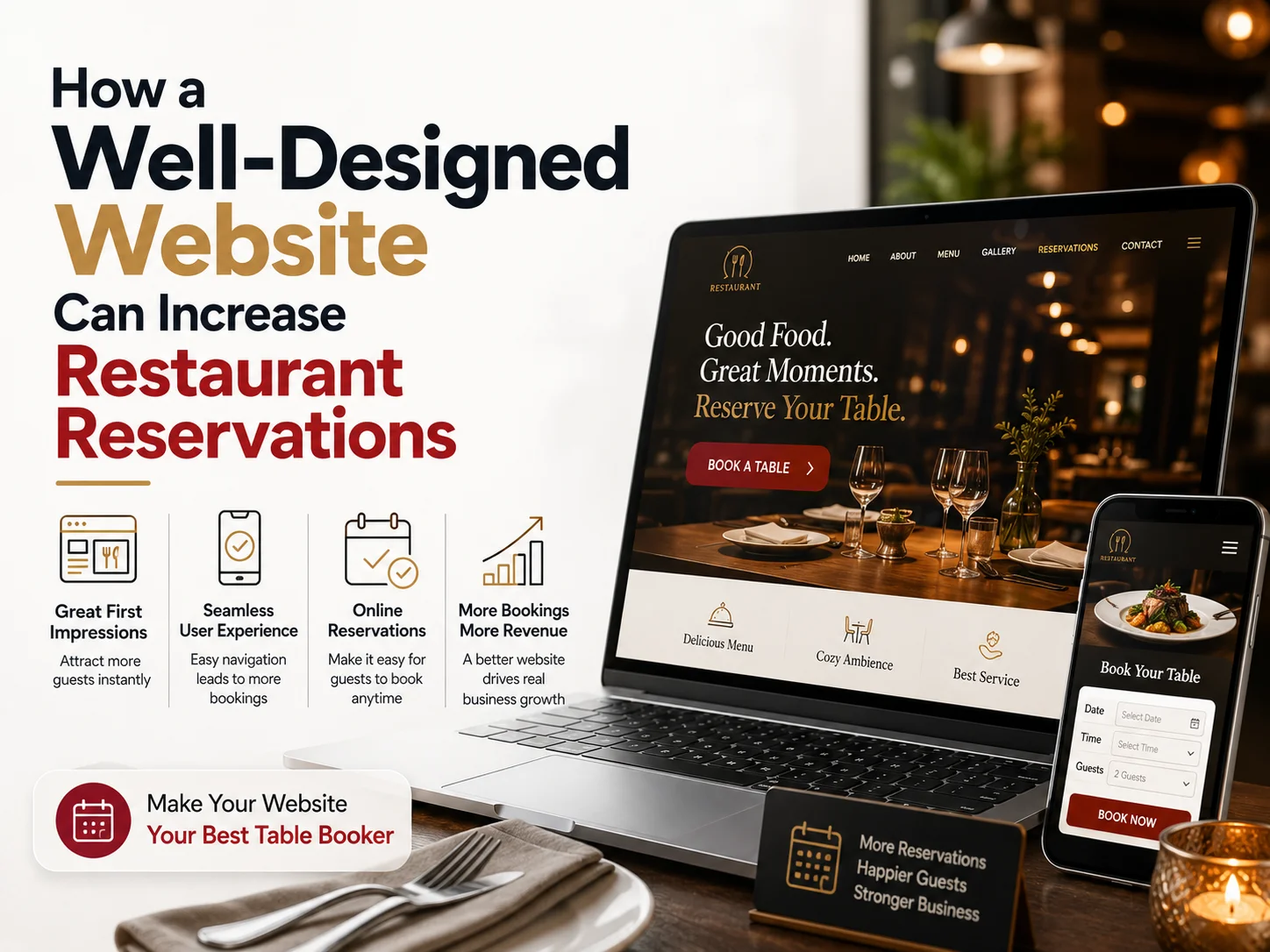
The strongest restaurant websites bring several elements together:
- Attractive food and ambience photography
- Clear restaurant information
- Easy-to-read menus
- Mobile-first design
- Fast loading pages
- Clear reservation calls to action
- Location and contact information
- Customer reviews and trust signals
- Search-friendly content
- Simple navigation
Each element removes a potential barrier between interest and reservation.
1. Your Website Creates the First Impression
Before a customer visits your restaurant, your website may be their first interaction with your brand.
A modern website can communicate quality, professionalism and personality before the customer ever walks through the door.
For example, a premium restaurant should feel premium online.
A family restaurant should feel welcoming.
A modern café can communicate its personality through colour, photography, typography and layout.
The design should therefore reflect the actual dining experience.
A strong restaurant homepage should quickly communicate:
Who you are.
What you serve.
Where you are.
Why customers should choose you.
How they can book.
A visually impressive website is useful.
But a visually impressive website that also makes booking easy is much more valuable.
2. Put the “Reserve a Table” Button Where Customers Can See It
One of the simplest ways to improve a restaurant website is to make the reservation action obvious.
Don’t make visitors search for it.
A “Reserve a Table”, “Book Now” or “Book a Table” button should be easy to find from the homepage and navigation.
It can also appear at relevant points throughout the website.
For example:
Homepage → Reserve a Table
Menu → Reserve a Table
About → Reserve a Table
Gallery → Reserve a Table
Contact → Reserve a Table
The customer shouldn’t have to navigate through several pages before discovering how to book.
The principle is simple:
The shorter the path from interest to booking, the better the user experience.
The actual reservation system can be an integrated booking platform, booking form, WhatsApp flow or another suitable system.
The important thing is that the customer understands what to do next.
3. Mobile-First Design Can Protect Potential Bookings
Restaurant searches often happen when people are away from their computers.
They may be:
- Travelling
- Commuting
- Planning dinner
- Looking for lunch nearby
- Meeting friends
- Choosing a restaurant for an occasion
That means the mobile version of your restaurant website deserves special attention.
A mobile-friendly restaurant website should have:
- Large, tap-friendly buttons
- Simple navigation
- Readable text
- Easy-to-scroll menus
- Click-to-call functionality
- Easy location access
- Fast-loading images
- Simple reservation forms
The customer should not need to pinch, zoom or repeatedly open new pages.
A website that works beautifully on desktop but feels frustrating on a phone is not truly user-friendly.
4. Food Photography Can Create the Desire to Visit
Restaurants have one major advantage over many other businesses.
Food is visual.
A well-photographed dish can create an emotional response before the customer even reads the description.
Your website should therefore showcase the experience through authentic photography.
Consider displaying:
- Signature dishes
- Chef specials
- Desserts
- Drinks
- Restaurant interiors
- Outdoor seating
- Private dining areas
- Dining experiences
- Group dining spaces
But there is an important rule.
Show the real restaurant.
Generic stock photographs may look attractive, but they don’t necessarily represent what the customer will experience.
Authentic photography creates a stronger connection between expectation and reality.
5. Your Online Menu Should Be Easy to Explore
The menu is one of the most important pieces of information for someone considering a restaurant.
Customers want to know what you serve before they decide to visit.
A good online restaurant menu should be:
- Easy to find
- Mobile-friendly
- Clearly organised
- Up to date
- Easy to read
- Search-friendly
- Visually appealing
Organise dishes into logical categories such as:
Starters
Main Course
Desserts
Beverages
Chef Specials
Vegetarian
Vegan
Kids’ Menu
where relevant.
Descriptions can also help customers understand the dish.
Instead of simply writing:
Paneer Tikka
a more useful description could explain the preparation, key ingredients or flavour profile.
This helps customers make decisions with greater confidence.
Should a restaurant menu be only a PDF?
A PDF can still be useful as an additional option.
However, wherever possible, important menu information should also be available as readable website content.
HTML-based menu content can be easier for users to browse on mobile and gives search engines more context about the restaurant’s offerings.
6. Restaurant SEO Helps the Right Customers Find You
A beautiful website cannot generate reservations if potential customers cannot find it.
This is where restaurant SEO becomes important.
People search for restaurants using phrases such as:
- Restaurants near me
- Best restaurants in [location]
- Best Italian restaurant in [location]
- Family restaurants in [location]
- Rooftop restaurants in [location]
- Vegetarian restaurants in [location]
- Restaurants for birthday dinner
- Restaurants for corporate dinner
- Best café in [location]
Your website should naturally address the relevant searches for your restaurant.
This doesn’t mean filling pages with repetitive keywords.
Instead, create useful content that clearly communicates:
- Cuisine
- Location
- Restaurant type
- Dining experience
- Menu
- Special occasions
- Services
- Opening hours
- Reservation options
This gives both users and search engines a clearer understanding of the business.
7. Local SEO Can Bring Nearby Diners to Your Website
For restaurants, local visibility is particularly important.
Someone searching for a restaurant usually cares about where it is.
Therefore, your website should make location information extremely clear.
Include:
- Full restaurant address
- Locality
- City
- Phone number
- Opening hours
- Directions
- Map
- Parking information where relevant
- Nearby landmarks where useful
Your Google Business Profile should also remain accurate and consistent with your website.
This creates a stronger local search presence.
A customer searching for:
“best restaurant in Bangalore”
has a different intent from someone searching:
“best restaurant for private dining in Bangalore.”
Creating useful pages and content around relevant customer intent can help restaurants capture more qualified searches.
8. Create Landing Pages for High-Intent Restaurant Searches
Not every customer is searching simply for “restaurant.”
Some are searching for a specific experience.
For example:
Birthday dinner restaurant
Corporate dining restaurant
Private dining
Family dining
Romantic dinner
Weekend brunch
Wedding dining
Group dining
These searches represent different customer needs.
A restaurant can create dedicated landing pages for its most relevant experiences.
For example:
Private Dining
Explain the space, capacity, menu options and booking process.
Corporate Dining
Highlight group seating, packages and business-friendly facilities.
Birthday Celebrations
Show the ambience, menu options and celebration arrangements.
These pages can serve both SEO and conversion purposes because they address a specific customer intent.
9. Reviews Help Build Confidence
A new customer may not know your restaurant.
Reviews provide social proof.
Including genuine customer feedback on your website can help answer an important question:
“Can I trust this restaurant?”
Relevant trust signals can include:
- Google reviews
- Customer testimonials
- Awards
- Press mentions
- Recognised certifications
- Media features
- User-generated content
However, trust signals should be genuine.
Avoid exaggerated claims or fabricated testimonials.
The goal is to reduce uncertainty.
When customers can see that other people have enjoyed the experience, they may feel more comfortable making a reservation.
10. Website Speed Matters for Restaurant Customers
Imagine a customer searches for a restaurant.
They click your website.
The page starts loading.
And loading.
And loading.
They leave.
The problem is not necessarily your restaurant.
The problem is the website experience.
Restaurant websites often use large food photographs, videos and visual effects. These can make the site attractive, but they can also make it slow.
A better approach is to optimise visual quality and performance together.
Consider:
- Compressing images
- Using modern image formats
- Lazy-loading below-the-fold images
- Reducing unnecessary scripts
- Using reliable hosting
- Minimising heavy plugins
- Optimising mobile performance
- Monitoring Core Web Vitals
A fast website creates a better user experience.
It can also support your broader search performance.
11. Design for Different Types of Restaurant Customers
Not every visitor arrives with the same goal.
Consider three customers.
Customer 1: The Hungry Customer
They want to know:
Menu → Price → Location → Book
Customer 2: The Occasion Planner
They want:
Ambience → Photos → Menu → Reviews → Private/Group Options → Book
Customer 3: The Regular Customer
They may want:
Opening Hours → Menu → Contact → Directions
A good restaurant website should accommodate all three.
This is why user experience matters so much.
The website should make it easy for different visitors to find the information relevant to them.
12. Make Your Restaurant Website AI and Search Friendly
Search is changing.
People are increasingly discovering information through traditional search engines, social platforms and AI-powered search experiences.
That means restaurant websites should provide clear, structured and factual information.
For example, clearly communicate:
Restaurant name
Cuisine
Location
Opening hours
Menu
Price range
Dining options
Reservation method
Special dining experiences
Contact information
This makes the restaurant’s digital presence easier to understand.
It also supports LLM-friendly content because AI systems work better when information is clear, consistent and well organised.
Instead of writing vague marketing statements such as:
“Experience an unforgettable culinary journey.”
also provide useful information:
“A contemporary Indian restaurant in Bangalore serving North Indian and regional specialities, with indoor seating and private dining options.”
The second statement provides much more context.
13. Connect Your Website With Social Media
Your restaurant website should not exist separately from your social media presence.
Instagram, YouTube and other platforms can generate discovery.
The website can provide deeper information and facilitate reservations.
For example:
Instagram Reel → Restaurant Website → Menu → Reservation
or:
Google Search → Website → Instagram → Reviews → Reservation
Make it easy for visitors to move between these channels.
Your website can showcase selected social content, while social profiles can direct visitors to the website for menus, reservations and detailed information.
This creates a connected digital customer journey.
14. Track What Actually Generates Reservations
Website traffic is useful.
But restaurant owners should look beyond traffic.
The most important question is:
What happens after someone visits the website?
Track actions such as:
- Reservation button clicks
- Completed bookings
- Phone calls
- WhatsApp enquiries
- Menu views
- Location clicks
- Contact form submissions
- Traffic sources
- Mobile vs desktop behaviour
For example, you may discover that Instagram generates many visitors but Google generates more reservation enquiries.
That insight can help you allocate your marketing budget more effectively.
A well-designed restaurant website should therefore be connected to appropriate analytics and conversion tracking.
15. Common Restaurant Website Mistakes That Can Cost Reservations
Even attractive restaurant websites can lose potential customers.
Here are some common problems.
Hidden reservation buttons
Customers should not have to search for the booking option.
Outdated menus
An old menu can immediately reduce trust.
Poor-quality photographs
Unappealing images can reduce desire to visit.
Slow mobile experience
Customers are unlikely to wait for a slow website.
Missing location information
Make it easy to find the restaurant.
Difficult navigation
Important information should be accessible quickly.
Too many pop-ups
Don’t interrupt customers while they are trying to make a decision.
No clear call to action
Tell visitors what to do next.
Generic stock photography
Show the actual restaurant and food wherever possible.
What Does a High-Converting Restaurant Website Look Like?
A strong restaurant website doesn’t necessarily need to be complicated.
It needs to be intentional.
A simple customer journey could look like:
Discover
↓
Explore
↓
View Food & Ambience
↓
Check Menu
↓
Build Trust
↓
Reserve
The website should support this journey without unnecessary distractions.
The best restaurant web design combines visual storytelling with practical information.
A Restaurant Website Should Sell the Experience
Customers don’t simply buy food.
They choose an experience.
They may be looking for:
- A romantic evening
- A family meal
- A business lunch
- A birthday celebration
- A weekend outing
- A special occasion
- A casual coffee
- A memorable dinner
Your website should communicate that experience.
Photography creates desire.
Content provides information.
Reviews create confidence.
UX removes friction.
SEO creates visibility.
And the reservation system turns interest into action.
Together, these elements create a website that works as a digital growth tool for the restaurant.
How CreativeKatta Can Help Restaurants Build Better Digital Experiences
At CreativeKatta, we understand that restaurant websites need to combine creativity with performance.
A restaurant website should look good, but it should also help customers discover the brand, understand the dining experience and take action.
From website design and development to SEO, branding, graphic design and digital marketing, CreativeKatta can help restaurants build a stronger online presence.
The goal is not simply to create another website.
It is to create a digital experience that helps turn:
Searches into visits.
Visits into interest.
Interest into reservations.
Reservations into returning customers.
Frequently Asked Questions
How can a restaurant website increase reservations?
A restaurant website can increase reservations by making it easy for visitors to view the menu, explore the ambience, find important information and book a table. Clear calls to action, mobile-first design, fast loading pages, authentic photography and trust signals can reduce friction during the booking journey.
What should a restaurant website include?
A restaurant website should generally include the menu, restaurant information, location, opening hours, contact details, food and ambience photographs, reservation options, reviews and relevant information about special dining experiences.
Why is mobile-friendly restaurant web design important?
Many restaurant customers research dining options while using smartphones. A mobile-friendly website makes it easier to view menus, call the restaurant, get directions and make reservations without unnecessary steps.
How does restaurant SEO help increase bookings?
Restaurant SEO helps potential customers discover a restaurant when they search for relevant cuisines, locations, dining experiences and services. Better visibility can bring more qualified visitors to the website, where a strong user experience can encourage reservations.
Should restaurants have an online menu?
Yes. An accessible online menu helps customers understand the restaurant’s offerings before visiting. A mobile-friendly, readable menu can also provide useful information to search engines and customers.
Does website speed affect restaurant reservations?
A slow website can create friction for visitors, particularly on mobile devices. Optimising images, scripts, hosting and page performance can create a smoother experience and reduce the chance that potential customers leave before booking.
How can restaurants optimise their websites for AI search?
Restaurants should provide clear and consistent information about their name, cuisine, location, menu, opening hours, services and reservation options. Well-structured content, descriptive headings, FAQs and accurate business information can make the website easier for search engines and AI systems to understand.
Can social media and a restaurant website work together?
Yes. Social media can introduce customers to the restaurant through photos, videos and recommendations, while the website can provide detailed information, menus, locations and reservation options. Connecting the two creates a stronger customer journey.
Final Takeaway
A restaurant website should do more than display beautiful photographs.
It should help customers make a decision.
When someone arrives on your website, they should quickly understand:
What you serve.
Where you are.
What the experience feels like.
Why they should choose you.
And how they can book.
That is the difference between a website that simply exists and a website that actively supports restaurant growth.
In today’s digital-first dining journey, great restaurant website design can become one of your most valuable reservation tools.
The goal is simple:
Make it easy to discover.
Make it easy to trust.
Make it easy to book.