3s
Time visitors take to judge your website
60%
Restaurant searches happen on mobile
7%
Conversion drop per 1s load delay
01
First Impressions Happen in Under 3 Seconds
Whether you like it or not, visitors form an opinion about your restaurant website in less than three seconds. If your site looks outdated, loads slowly, or feels confusing, potential diners leave — and they rarely come back.
A visually appealing, modern website immediately signals that your restaurant is professional, trustworthy, and worth their time. On the other hand, a poorly designed site sends the opposite message, no matter how incredible your food actually is.
What a strong first impression includes:
clean, uncluttered homepage that highlights your brand personality
High-quality food and ambience photography that makes mouths water
Fast page load speeds — ideally under 3 seconds
A clear, easy-to-find reservation button above the fold
02
Mobile-First Design Is Non-Negotiable
Here is a striking reality: over 60% of restaurant-related searches happen on mobile devices. Moreover, most diners decide where to eat on the go — while commuting, waiting in a queue, or scrolling during a lunch break.
If your website is not optimised for mobile, you are essentially turning away more than half your potential customers before they even read your menu. Furthermore, Google now uses mobile-first indexing — meaning a poor mobile experience also damages your search rankings.
Mobile design essentials:
Tap-friendly buttons that are easy to press with a thumb
Menus that scroll and read perfectly on small screens
Click-to-call functionality for instant contact
A seamless mobile reservation flow under 60 seconds
03
Frictionless Online Reservation System
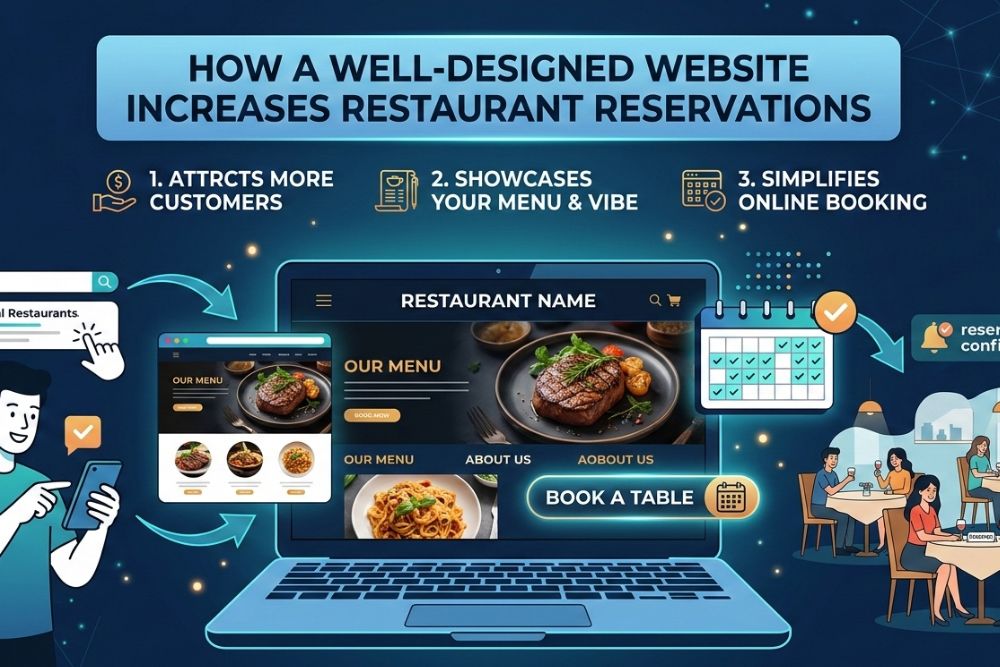
One of the single most powerful things your website can do is make booking a table as effortless as possible. Think of it this way: every extra step in your booking flow is a door that closes on a potential reservation.
Consequently, the best-performing restaurant websites reduce the reservation journey to just three or four simple clicks.
Best practices for reservation UX:
Embed a reservation widget directly on the homepage
Allow instant confirmation — no phone call required
Date, time, and party-size selection in one clean interface
Automated confirmation emails and SMS reminders
Integration with OpenTable, Resy, or a custom booking system
04
Mouth-Watering Visuals Drive Decision-Making
We eat with our eyes first. High-quality food photography is one of the most effective tools a restaurant website can use to convert a casual browser into a confirmed booking. Moreover, stunning imagery of your dining space builds emotional anticipation.
Visual content that boosts reservations:
Professional photography of your signature dishes
Atmospheric shots of your restaurant interior and ambience
Short videos or reels showing the dining experience
A virtual tour or gallery of your space
However, be careful: stock photos are a red flag for savvy diners. Invest in original, authentic photography that truly represents your brand.
05
SEO: Making Sure Hungry Customers Find You
Even the most beautiful website is useless if nobody can find it. Specifically, local SEO is the golden ticket for restaurants. When someone searches "best Italian restaurant near me" or "rooftop dining in Bangalore," you want to appear at the top of those results.
Key local SEO strategies:
Optimise your Google Business Profile with photos and menu links
Use location-specific keywords throughout your content
Create landing pages for occasions: anniversaries, corporate dinners
Consistent Name, Address, Phone (NAP) across all platforms
Earn and respond to Google reviews — they directly influence rankings
06
Clear Menu Presentation Reduces Hesitation
Your online menu is one of the biggest factors that influence whether a potential diner actually makes a reservation. Therefore, your menu should be easy to find, beautifully formatted, and fully readable on all devices.
Menu best practices:
Display menus as HTML text — not PDFs — for mobile and SEO
Include mouth-watering descriptions with key ingredients
Highlight popular dishes, chef specials, and seasonal offerings
Clearly mark dietary options: vegan, gluten-free, Jain, etc.
Keep pricing up-to-date to build trust with guests
07
Trust Signals Turn Browsers Into Bookers
When someone lands on your website, they subconsciously ask: "Can I trust this place?" The right trust signals answer that question immediately — and move visitors closer to clicking "Reserve Now." As a result, restaurants that display social proof experience significantly higher conversion rates.
Trust signals that work:
Google and Zomato ratings displayed prominently
Press mentions and award badges
Customer testimonials with real names and photos
Social media feeds showing authentic guest experiences
Visible contact number, address, and SSL certificate
08
Speed and Performance: Every Second Counts
A one-second delay in page load time can reduce conversions by up to 7%. For a busy restaurant, that translates directly into missed reservations and lost revenue. Consequently, website performance is a business-critical priority — not just a technical one.
Performance optimisation essentials:
Compress and optimise all images without sacrificing quality
Use a reliable hosting provider with fast server response times
Enable browser caching and a Content Delivery Network (CDN)
Minimise unnecessary plugins and heavy scripts
Test regularly with Google PageSpeed Insights
09
Special Pages That Drive More Bookings
Beyond the homepage and menu, strategic landing pages can significantly increase reservation volume. These pages target specific intents — and they convert exceptionally well because they speak directly to what a visitor is searching for.
High-converting pages to build:
Private dining and event booking page
Seasonal promotions: Valentine's Day, New Year's Eve, Diwali
Corporate lunch and group dining packages
Gift vouchers and dining experience pages
Chef's table or tasting menu experiences
10
Analytics: Know What's Working and Double Down
Finally, a well-designed restaurant website is never truly "finished." The best-performing websites are continuously improved based on real data. By understanding how visitors behave on your site, you can identify what is working, what is not, and where you are losing potential reservations.
Key metrics to track:
Reservation page conversion rate
Bounce rate — how quickly people leave
Most visited pages and most-read menu items
Traffic sources: Google, social, direct, referral
Mobile vs desktop visitor split