
SEO vs AI Search:How Businesses Should Adapt
What's Really Changing in Search?
For years, getting found online meant one thing: rank higher on Google. Businesses invested in keywords, backlinks, and page speed — and it worked. Traditional SEO was the undisputed backbone of digital visibility.
But right now, something far bigger is happening beneath the surface. Tools like ChatGPT, Google AI Overviews, Perplexity AI, and Microsoft Copilot are fundamentally changing how people search for information. Instead of scanning a list of blue links, users are now receiving direct, conversational answers — generated by AI, powered by large language models (LLMs).
As a result, businesses are beginning to ask a critical question: Is traditional SEO still enough? And how do you stay visible when an AI answers the question before a user even clicks a single link?
Here's the reality: search has split into two channels. One is the classic algorithm-ranked results page. The other is a new, AI-generated answer layer — and showing up in both now requires distinctly different strategies.
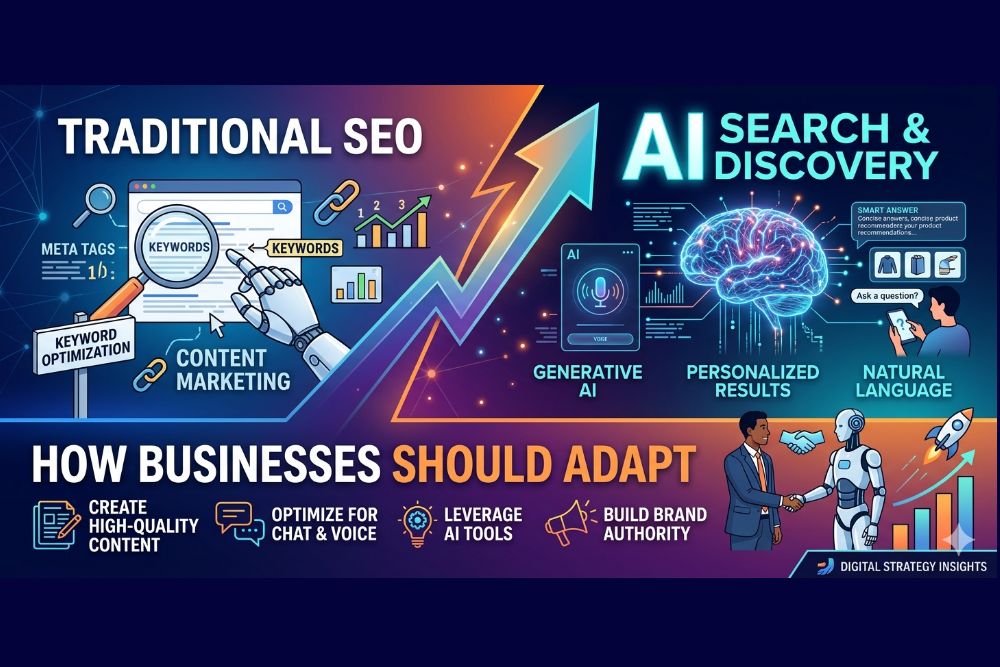
SEO vs AI Search: The Key Differences
Before you can adapt your strategy, it's worth understanding exactly what makes these two channels different. They share some meaningful overlap — but their goals, mechanics, and ranking signals are increasingly pulling apart.
| Factor | Traditional SEO | AI Search (LLM-Based) |
|---|---|---|
| Goal | Rank in a list of results | Be cited inside an AI answer |
| Key Signal | Backlinks, keywords, authority | Topical trust, clarity, structure |
| Content Format | Keyword-dense pages | Concise, factual, well-cited |
| User Behaviour | Clicks through to website | Often stays on the AI platform |
| Measurement | Rankings, organic traffic | Brand mentions, citations, impressions |
| Update Cycle | Algorithm updates (monthly+) | Model training + real-time retrieval |
Importantly, these two channels are not mutually exclusive. In fact, many of the principles that strengthen your traditional SEO also help you appear in AI-generated responses — but only when applied with the right intent and content structure.
Why This Matters for Your Business
Whether you run a local service, an e-commerce store, or a B2B brand, you simply cannot afford to ignore this shift. Here's why it matters right now, more urgently than ever before:
First and foremost, organic click-through rates are declining. When AI Overviews appear at the top of Google, users often get their answer without scrolling down to your listing at all. Multiple studies report that pages previously ranking #1 have seen CTR drops of 15–40% after AI snippets were introduced for their keywords.
Furthermore, brand mentions inside AI answers are the new backlinks. When Perplexity or ChatGPT recommends your business, cites a stat from your blog, or references your product — that is brand-level visibility that builds trust, even without a single click. It's a fundamentally new form of digital authority that most businesses haven't even started measuring.
Equally important, the businesses being cited by AI aren't always the ones with the most backlinks. They're consistently the ones with the clearest, most trustworthy, and most well-structured content. That's a major opportunity — if you're willing to act on it early.
"In the age of AI search, the question is no longer 'how do I rank on page one?' — it's 'how do I become the source an AI trusts to answer for me?'"
7 Ways Businesses Should Adapt Right Now
So, what does adaptation actually look like in practice? Fortunately, you don't need to start from scratch. Instead, the transition requires layering smart new behaviours on top of your existing SEO habits — and doing so before your competitors catch on.
Write for Humans First, Algorithms Second
AI models are trained on high-quality, human-readable content. As a direct consequence, overly keyword-stuffed pages perform worse in AI search. Focus on writing content that is genuinely helpful, clearly structured, and easy to scan. Prioritise plain language, short paragraphs, and logical flow — not just keyword density.
Build Topical Authority, Not Just Page Authority
LLMs evaluate content clusters, not just individual pages. To be recognised as an authoritative source in your niche, you need to cover a topic comprehensively across multiple interconnected pieces of content. Don't publish just one article — build guides, FAQs, comparisons, case studies, and explainers, all connected through a logical internal linking structure.
Optimise for Direct Answers (AEO)
Answer Engine Optimisation (AEO) means structuring your content so that an AI can easily extract a clear, concise answer to a specific question. Use dedicated FAQ sections, define key terms explicitly, and include numbered or bulleted summaries that can be cleanly lifted into an AI response. Think of each H2 heading as a potential AI answer trigger.
Leverage Structured Data and Schema Markup
Schema markup helps both search engines and AI crawlers understand your content's context. Mark up your FAQs, reviews, products, articles, and business information with the appropriate schema types. Beyond featured snippets, this signals credibility and structure to AI systems that retrieve and index your content for their answers.
Get Cited on High-Trust Platforms
AI models are trained on — and often retrieve from — trusted third-party platforms. That means getting your brand mentioned, quoted, or linked from industry publications, Reddit, Quora, Wikipedia, and niche directories significantly increases your chance of appearing inside AI-generated responses. Think of this as "AI PR" — building brand presence well beyond your own website.
Refresh and Maintain Content Regularly
AI systems — especially those with real-time retrieval — consistently prefer fresh, up-to-date content. Audit your existing content quarterly, update statistics, add new examples, and verify accuracy throughout. A well-maintained article from 2022 that's been regularly refreshed will consistently outperform a new post that's never updated after its publish date.
Track Brand Mentions, Not Just Rankings
Traditional SEO tracks keyword positions. In AI search, however, you need to monitor where and how your brand appears inside AI-generated answers. Use tools like Mention or Brand24, or run manual AI prompt tests, to see how ChatGPT and Perplexity describe your business. This is your new visibility metric — and one that most businesses are still completely ignoring.
Should You Choose SEO or AI Search Optimization?
Here's the good news: you don't have to choose. In fact, treating them as entirely separate channels would be a strategic mistake. The smartest approach is what marketers are now calling a dual-channel content strategy.
On one hand, traditional SEO still drives the majority of organic traffic for most businesses. Google's search results remain dominant — particularly for high-intent commercial queries. Neglecting SEO fundamentals like technical health, mobile optimisation, Core Web Vitals, and link building would still significantly damage your visibility.
On the other hand, AI search is growing at an extraordinary pace. ChatGPT alone crossed 200 million weekly users in 2024. Perplexity is doubling its user base year-over-year. Google's AI Overviews are rolling out globally. As a result, the window to establish early authority in AI search is right now — before it becomes just as competitive as traditional SEO took years to become.
Therefore, the businesses that win over the next three to five years will be those that consistently create content that works on both layers simultaneously — authoritative enough for Google's algorithm, and clear and structured enough for AI to trust and cite.
Your Quick-Start Checklist
To bring it all together, here's a practical checklist you can apply to your content strategy starting this week. No massive overhaul required — just a series of intentional improvements that compound into measurable results over time.
- ✓ Audit your top 10 pages for clarity, structure, and direct answers
- ✓ Add a dedicated FAQ section to every major blog post or landing page
- ✓ Implement Article, FAQ, and Organisation schema across your site
- ✓ Map out a topic cluster around your primary service or product area
- ✓ Set up brand mention tracking using a tool like Mention or Brand24
- ✓ Pitch guest posts or expert quotes to 3 high-authority publications this month
- ✓ Test your brand in ChatGPT and Perplexity — see what they say about you
- ✓ Refresh at least 5 high-value older articles with updated data and examples
🚀 Ready to Stay Ahead of the Curve?
Let CreativeKatta Build Your AI-Ready Content Strategy
From in-depth SEO audits to LLM-optimised content creation, CreativeKatta helps businesses get visible where it matters most — on Google and inside AI-generated answers.
Explore CreativeKatta → No commitment. Just a conversation about your growth.