
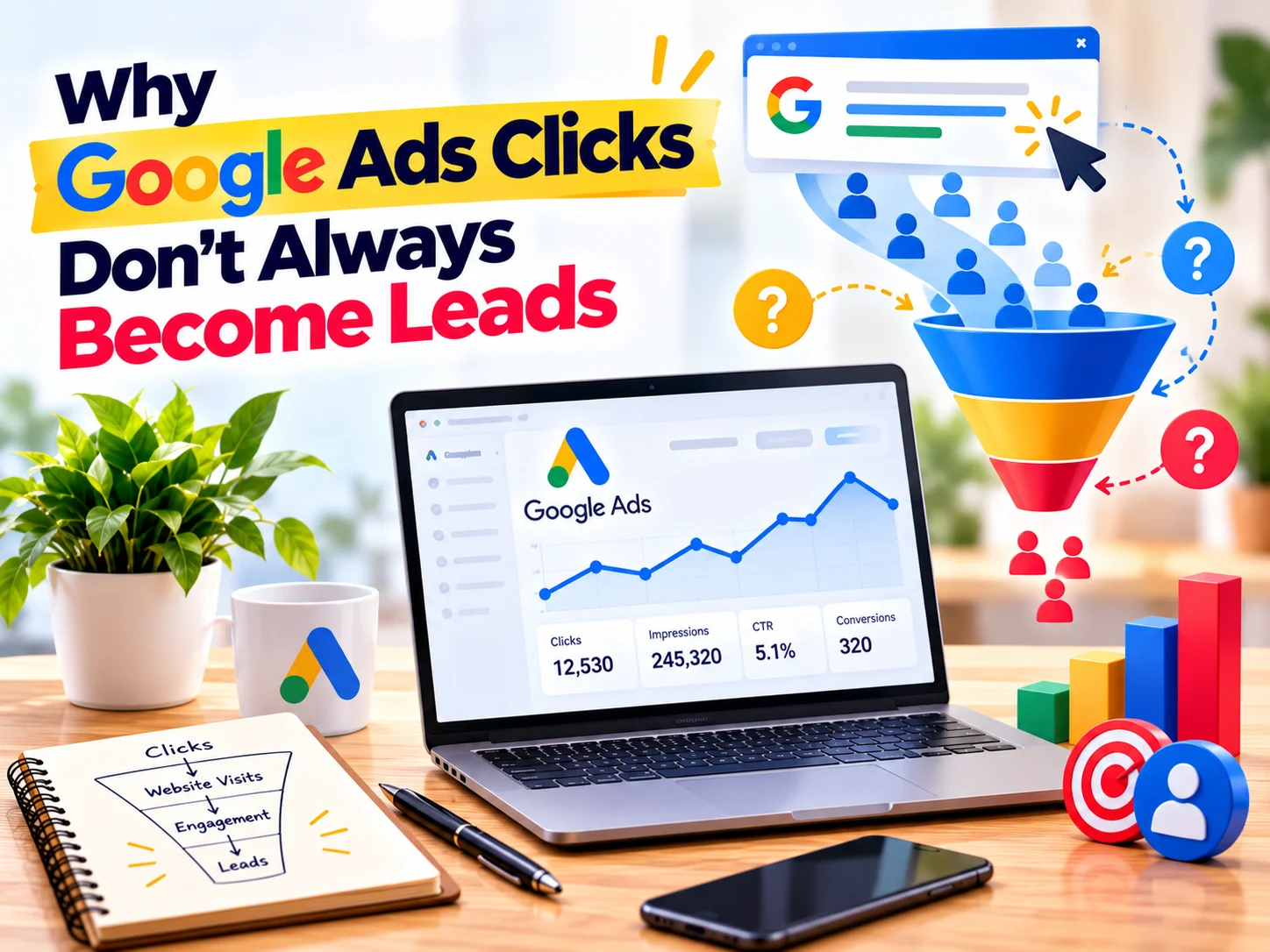
Getting clicks from Google Ads feels like a positive sign. However, clicks alone do not guarantee enquiries, calls, form submissions, or sales.
A campaign can generate hundreds of visitors and still produce very few leads.
So, what causes the gap between Google Ads clicks and leads?
Usually, the problem is not just the advertisement. Your landing page, targeting, offer, website experience, tracking, and follow-up process can all affect conversions.
In this guide, we explain why Google Ads clicks do not always become leads and what businesses can do to improve their conversion rate.
Clicks vs Leads: What's the Difference?
A Google Ads click means someone interacted with your advertisement and visited your website or landing page.
A lead, however, requires another action.
For example, the visitor might:
- Submit an enquiry form
- Call your business
- Request a quotation
- Book a consultation
- Send a WhatsApp message
- Request a demo
- Sign up for a service
- Make a purchase
Therefore, a campaign can have a good click-through rate but still generate few leads.
The important question is not only:
“How many people clicked my ad?”
It is also:
“What happened after they clicked?”
Why Google Ads Clicks Don't Always Become Leads
Several factors can create a gap between traffic and conversions.
1. Your Ad and Landing Page Do Not Match
One of the most common problems is a mismatch between the advertisement and the page visitors reach.
For example, suppose your ad says:
“Website Development Starting at ₹XX,XXX”
But the landing page only talks generally about your company.
The visitor expected information about website pricing. Instead, they have to search for it.
This creates friction.
Your ad, keyword, landing page headline, offer, and CTA should communicate a consistent message.
2. You Are Targeting the Wrong Keywords
Not every search indicates buying intent.
For example:
“What is SEO?”
has a different intent from:
“SEO agency in Bangalore.”
The first search may be informational.
The second may indicate that the person is actively looking for a service provider.
Therefore, keyword selection plays an important role in lead generation.
Focus on search terms that are relevant to your product or service and match the stage of the customer’s buying journey.
3. Your Landing Page Is Not Designed for Conversions
A landing page should have one clear purpose.
If visitors see too many menus, links, services, banners, and unrelated messages, they may not know what to do next.
A conversion-focused landing page should clearly communicate:
- What you offer
- Who it is for
- Why it matters
- What makes your business different
- What the visitor should do next
For example, instead of a generic CTA such as:
Submit
consider a more specific action:
Get My Free Consultation
The CTA should make the next step obvious.
4. Your Offer Is Not Clear Enough
People need a reason to take action.
Simply saying:
“Contact Us Today”
may not provide enough motivation.
Depending on your business, you could offer:
- Free consultation
- Free quote
- Product demo
- Site assessment
- Strategy call
- Downloadable guide
- Custom proposal
- Appointment booking
The offer should be relevant to the visitor’s needs.
5. Your Website Is Too Slow
A visitor who clicks an ad expects the page to load quickly.
If the page takes too long to load, some visitors may leave before they even see the offer.
Therefore, businesses running Google Ads should pay attention to:
- Page loading speed
- Image sizes
- Mobile performance
- Hosting performance
- Unnecessary scripts
- Caching
- Core Web Vitals
Improving the landing page experience can help reduce unnecessary friction.
6. Your Website Is Not Mobile-Friendly
Many users access websites from smartphones.
If your landing page works well on desktop but feels difficult to use on mobile, you may lose potential leads.
Check whether:
- Text is easy to read
- Buttons are large enough
- Forms are simple
- Images fit the screen
- Navigation works properly
- Phone and WhatsApp buttons are easy to access
Always test the complete conversion journey on an actual mobile device.
7. Your Form Is Too Complicated
Long forms can discourage visitors.
For example, asking for:
- Full name
- Company name
- Job title
- Address
- City
- Industry
- Website
- Budget
- Project details
- Multiple other fields
may be unnecessary at the first stage.
Ask only for information you genuinely need.
You can collect additional information later during the sales process.
8. Visitors Do Not Trust the Business
A visitor may be interested in your service but still hesitate to submit their details.
Trust signals can reduce this hesitation.
Consider including:
- Customer testimonials
- Reviews
- Case studies
- Client logos
- Certifications
- Industry experience
- Portfolio examples
- Guarantees where appropriate
- Clear contact information
- Business address
However, avoid adding fake or exaggerated claims.
Real evidence is more useful than generic statements.
9. Your Ad Targets a Broad Audience
A campaign can receive many clicks when targeting is too broad.
However, more traffic does not necessarily mean more qualified leads.
For example, a B2B service provider may receive irrelevant clicks from students, job seekers, researchers, or people looking for free information.
Review your:
- Search terms
- Locations
- Audiences
- Devices
- Keywords
- Match types
- Ad schedules
Then remove traffic that does not align with your actual customers.
10. Your Ad Copy Sets the Wrong Expectations
Your advertisement creates a promise.
If the ad promises one thing but the landing page delivers something different, visitors may leave.
For example:
Ad:
“Same-Day AC Repair – Book Now”
Landing Page:
“Welcome to Our HVAC Company”
The second page does not immediately reinforce the promise made by the ad.
Your landing page should continue the conversation started by your advertisement.
11. You Are Measuring the Wrong Conversion
A campaign may appear unsuccessful if conversion tracking is incomplete.
For example, you might track only form submissions while ignoring:
- Phone calls
- WhatsApp enquiries
- Appointment bookings
- Quote requests
- Chat enquiries
- Purchases
Therefore, make sure your conversion setup reflects the actions that actually matter to your business.
12. Leads Are Not Being Followed Up Quickly
Sometimes the advertising campaign generates leads, but the sales process loses them.
For example:
Ad → Click → Form → No immediate response
The visitor may contact another company while waiting.
Create a clear lead follow-up process.
Depending on the business, this could include:
- Instant confirmation message
- Email notification
- Sales team alert
- Phone call
- WhatsApp follow-up
- CRM entry
- Scheduled follow-up
Google Ads can generate the opportunity, but your sales process still needs to convert it.
13. Your Campaign Sends Everyone to the Homepage
A homepage often serves multiple audiences.
A Google Ads visitor usually has a specific intent.
Therefore, sending every paid visitor to your homepage may create unnecessary friction.
Instead, create dedicated landing pages for important campaigns.
For example:
Google Ad:
“Google Ads Management for Small Businesses”
Landing Page:
A dedicated Google Ads service page explaining the service, process, benefits, proof, pricing approach, FAQs, and CTA.
This creates a stronger connection between the search and the destination.
14. Your Pricing Information Creates Confusion
Price can influence whether someone converts.
However, hiding all pricing information can sometimes create uncertainty.
Depending on your business model, consider explaining:
- Starting price
- Pricing factors
- Package structure
- What’s included
- What’s not included
- Custom quotation process
You do not always need to publish exact pricing.
However, the visitor should understand what happens after submitting an enquiry.
15. Your CTA Is Difficult to Find
Visitors should not have to search for the next step.
Use clear CTAs throughout the page where appropriate.
Examples include:
- Get a Free Consultation
- Request a Quote
- Book a Call
- Talk to an Expert
- Get Project Estimate
- Request a Demo
- Start Your Project
The CTA should match the visitor’s intent.
16. Your Landing Page Has Too Many Distractions
A landing page can lose conversions when everything competes for attention.
Too many:
- Pop-ups
- Banners
- Animations
- Menus
- CTAs
- Offers
- Images
- External links
can make the decision harder.
A focused landing page usually works better when the primary conversion action remains clear.
17. Your Campaign Is Optimized for Traffic Instead of Business Results
Traffic is only one part of the funnel.
The complete journey looks like:
Search → Ad → Click → Landing Page → Enquiry → Follow-up → Sales
If you optimise only for clicks, you may end up generating visitors rather than qualified opportunities.
Instead, connect your advertising metrics with actual business outcomes.
Google Ads Conversion Funnel
A simple funnel can help identify where the problem exists:
Funnel Stage | What to Measure |
Search | Search volume and intent |
Ad | Impressions and CTR |
Click | Landing page visits |
Landing Page | Engagement and conversion rate |
Lead | Form, call, WhatsApp or enquiry |
Sales | Qualified leads and customers |
Revenue | Actual business value |
This makes it easier to identify the stage that needs improvement
How to Improve Google Ads Lead Conversion
If your campaign receives clicks but few leads, use this checklist.
Review Your Keywords
Ask:
- Are the keywords relevant?
- Do they show commercial intent?
- Are irrelevant search terms triggering ads?
- Are negative keywords being used?
Improve Your Ad Copy
Make sure your ads clearly communicate:
- Service
- Location, where relevant
- Key benefit
- Offer
- Differentiator
- CTA
Create Dedicated Landing Pages
Match each important campaign with a relevant landing page.
Keep the page focused on the visitor’s search intent.
Improve Your CTA
Make the desired action obvious.
Also, use action-oriented wording rather than generic button labels.
Simplify Your Forms
Reduce unnecessary fields.
Make it easy for users to enquire from both desktop and mobile devices.
Add Trust Signals
Show real testimonials, reviews, portfolio work, case studies, credentials, and business information.
Test Different Versions
Try different:
- Headlines
- Offers
- CTAs
- Images
- Form lengths
- Landing page layouts
Then compare the results using reliable conversion data.
Google Ads Is Only One Part of Lead Generation
It is easy to think of Google Ads as:
Pay → Get Clicks → Get Leads
In reality, lead generation is a connected system.
Your results can depend on:
Keyword → Ad → Landing Page → Offer → User Experience → Trust → CTA → Follow-Up → Sales Process
Therefore, improving only the advertisement may not solve the problem.
Sometimes the biggest opportunity exists after the click.
Frequently Asked Questions
Why am I getting Google Ads clicks but no leads?
Common reasons include irrelevant keywords, weak landing pages, unclear offers, poor mobile experience, complicated forms, weak CTAs, lack of trust signals, and incomplete conversion tracking.
Is a high Google Ads CTR enough?
No. Click-through rate measures how often people click an ad after seeing it. It does not tell you whether those visitors become qualified leads or customers.
How can I convert more Google Ads traffic into leads?
Start by matching keywords, ad copy, landing pages, offers, and CTAs. Then improve page speed, mobile usability, trust signals, forms, conversion tracking, and lead follow-up.
Should Google Ads traffic go to the homepage?
Not necessarily. Dedicated landing pages can provide a more relevant experience when a campaign targets a specific product, service, audience, or offer.
Why are my Google Ads leads not converting into customers?
The problem may occur after the lead is generated. Lead quality, response time, sales follow-up, pricing, communication, and the overall sales process can all affect the final result.
How do I know whether Google Ads is working?
Look beyond clicks. Track qualified leads, conversion rates, cost per lead, lead quality, sales, and revenue where possible.
Final Takeaway
Google Ads can bring potential customers to your website, but a click is not the same as a lead.
When visitors do not convert, look at the complete journey.
Check your keywords. Review your ad messaging. Improve the landing page. Simplify the form. Strengthen trust signals. Make your CTA clear. Then verify that your conversion tracking and follow-up process are working properly.
The goal is not simply to generate more clicks.
The goal is to turn relevant search traffic into meaningful business enquiries and customers.
Need Help Improving Your Google Ads and Website Conversions?
CreativeKatta helps businesses combine Google Ads, landing page design, website development, SEO, creative design, social media marketing, and conversion-focused content to create a connected digital marketing strategy.
If your campaigns are generating traffic but not enough enquiries, the solution may require more than changing the ad. Your complete journey from search to sale should work together.
Looking to improve your paid advertising results? Talk to CreativeKatta about your Google Ads and conversion strategy.