
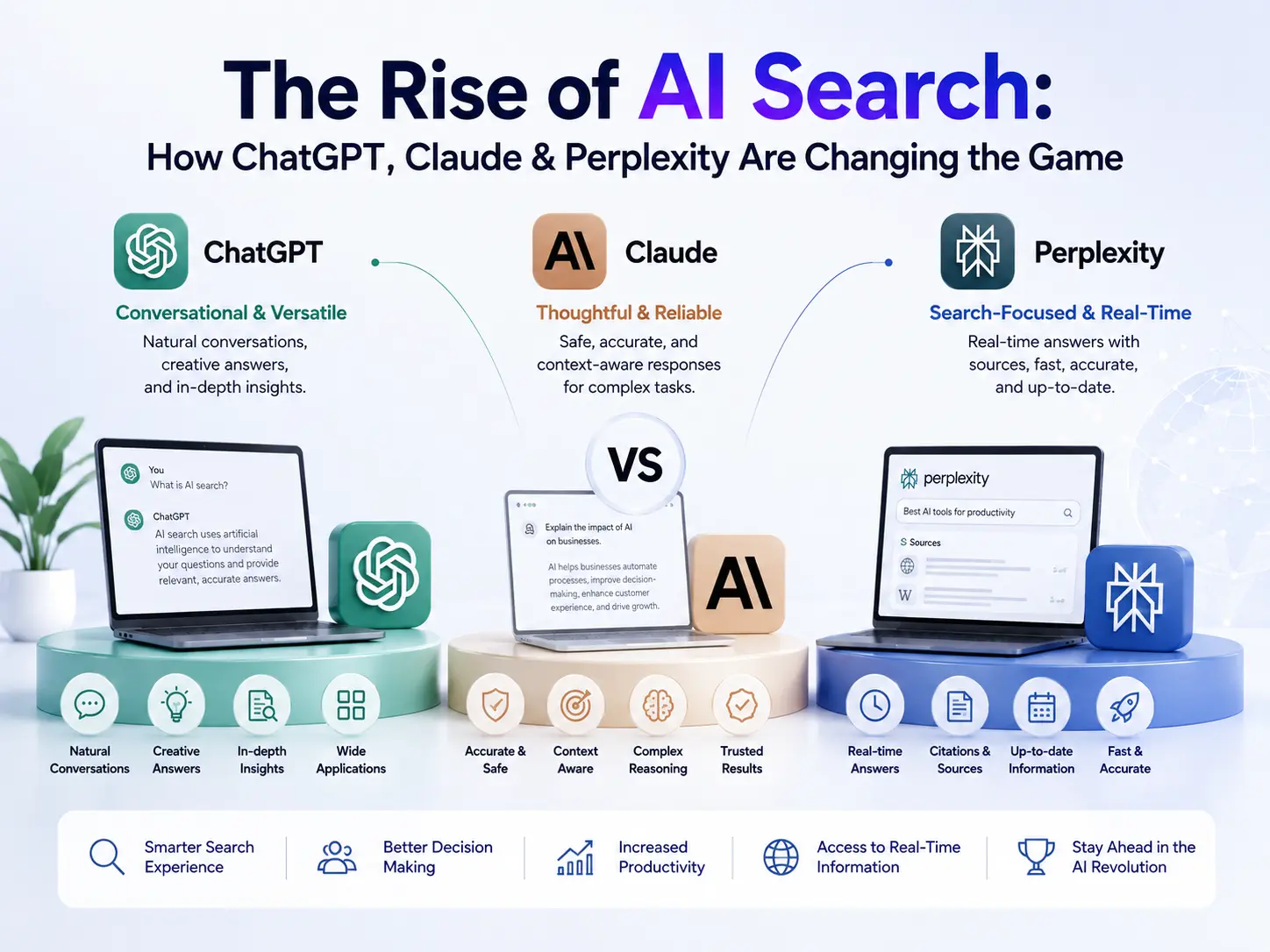
Search is no longer just about typing a query into Google and clicking links. So, we’re genuinely witnessing one of the biggest shifts in how people discover information: the rise of AI-powered search platforms like ChatGPT, Claude, and Perplexity.
Below, here are four of the biggest trends shaping the future of search.
1. AI Platforms Now Handle a Meaningful Share of All Searches
First, until recently, Google was the undisputed leader in global search. However, today, conversational AI platforms are genuinely eating into that dominance. So, ChatGPT, Claude, and Perplexity together have reached roughly 13% of all searches worldwide, according to recent data.
Therefore, this means millions of people are no longer just “Googling.” Instead, they’re asking AI systems for instant, context-rich answers, without ever leaving the platform.
2. Google's Market Share Has Softened
Next, for the first time in years, Google’s grip on search has genuinely started to loosen. So, its market share dipped to around 85% in that same dataset, signaling that users are willing to explore alternatives.
Therefore, the reason comes down to speed, convenience, and AI tools’ ability to deliver concise summaries, without overwhelming users with multiple links and ads.
3. AI Search Platforms See Billions of Visits
Meanwhile, traffic data tells the fuller story. So, in one recent month alone, AI-based search platforms collectively recorded around 7.5 billion visits.
Therefore, this isn’t a passing fad; instead, it’s a genuine sign of large-scale adoption. AI tools aren’t just popular with tech-savvy users; they’re quickly becoming mainstream.
4. Younger Generations Are Leading the Shift
However, Gen Z and Millennials are genuinely driving higher adoption of AI-based search. So, unlike older demographics who stay more comfortable with traditional search engines, younger users prefer direct, summarized, conversational answers.
Therefore, for them, AI isn’t just a tool; instead, it’s becoming a genuine replacement for search engines. Over time, this generational shift could reshape the entire digital ecosystem.
The New Search Behavior: Links Are Losing Relevance
Now, here’s the most important insight. So, the majority of searches still happen on traditional search engines like Google. However, when it comes to AI summaries, only a small fraction of users actually click a link below the summary.
Therefore, this means AI isn’t just changing where people search; instead, it’s changing how they interact with information. So, instead of browsing multiple sites, users increasingly stay satisfied with AI’s one-stop answers.
What This Means for Businesses and Marketers
Additionally, SEO is genuinely evolving. So, it’s no longer just about ranking on Google; instead, businesses must optimize for AI-driven answers too.
Meanwhile, content strategy matters more than ever. Because AI tools pull from trusted, high-quality sources, publishing authority-driven content becomes genuinely essential. Therefore, expect referral traffic from traditional search to decline gradually, as AI platforms capture more user attention.
Bringing It All Together
Ultimately, the search landscape is genuinely in the middle of a revolution. So, while Google remains dominant, AI platforms keep growing at an unprecedented pace, driven largely by younger generations and changing user behavior.
Therefore, for businesses and marketers, the message is clear: adapt now, or risk becoming invisible in the AI-driven search era.
How CreativeKatta Can Help
At CreativeKatta, we help brands stay ahead of the curve by building future-ready digital strategies. So, from AI-optimized SEO to social media storytelling and conversion-driven websites, we ensure your business isn’t just visible; instead, it’s genuinely unforgettable.
Contact CreativeKatta today, and let’s future-proof your search visibility together.
Frequently Asked Questions
Q: Is AI search genuinely replacing Google? A: Not entirely, at least not yet. Because traditional search still handles the majority of queries, AI platforms are growing quickly, but they remain a complement to Google rather than a full replacement so far.
Q: How should businesses adapt their SEO strategy for AI search? A: By focusing on authority and clarity. Since AI tools pull from trusted, high-quality sources, publishing genuinely well-researched, credible content matters more than keyword density alone.
Q: Why do younger users prefer AI search over traditional search engines? A: Because they favor direct, conversational answers. So, instead of browsing multiple links, younger users often prefer AI’s summarized, one-stop responses.