
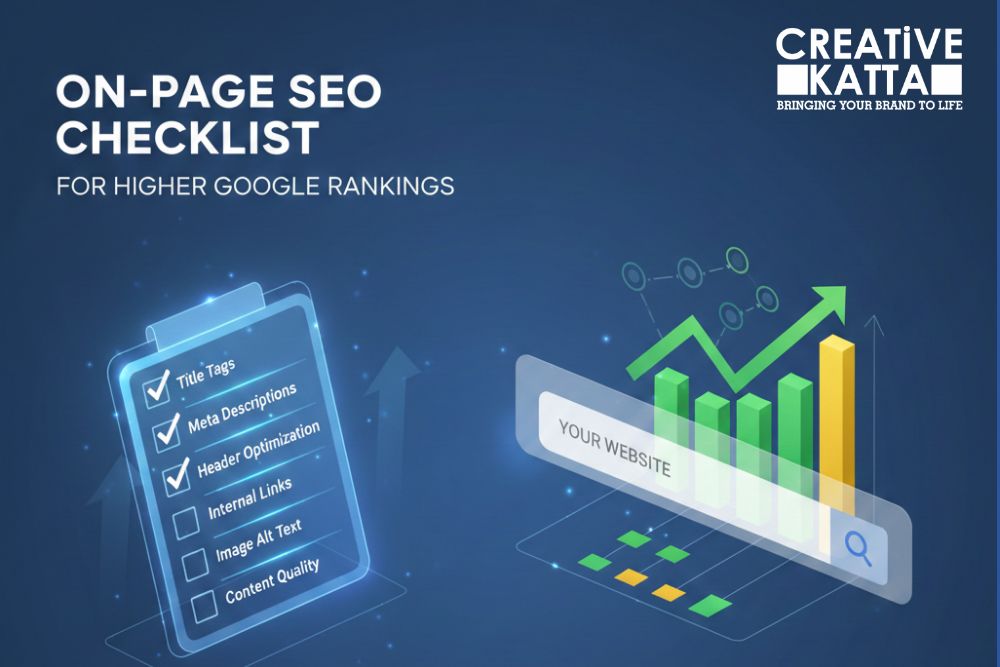
On-Page SEO Checklist for Higher Google Rankings in 2026
Introduction: Why On-Page SEO Still Matters in 2026
In today’s AI-driven search landscape, ranking on Google is no longer just about keywords. Instead, on-page SEO ensures your website communicates clearly with search engines and AI models alike. Moreover, when done right, it improves user experience, engagement, and conversions. Therefore, following a structured on-page SEO checklist is essential for higher rankings and sustainable growth.
1. SEO-Friendly Title Tags
First and foremost, your title tag is the most critical on-page ranking factor.
- Keep titles under 60 characters
- Place the primary keyword at the beginning
- Make it compelling and click-worthy
Example: On-Page SEO Checklist for Higher Google Rankings
2. Optimised Meta Descriptions
Although meta descriptions don’t directly impact rankings, they significantly improve CTR.
- Use transition words like discover, improve, boost
- Keep it within 140–160 characters
- Add a benefit-driven message
3. Proper Heading Structure (H1–H6)
Next, headings help both users and search engines understand content flow.
- Use only one H1
- Include keywords naturally in H2 and H3
- Maintain a logical hierarchy
As a result, your content becomes easier to scan and AI-friendly.
4. Keyword Placement & Semantic SEO
Rather than keyword stuffing, focus on context and intent.
- Use primary keywords in the first 100 words
- Add related terms and synonyms
- Write naturally for humans and AI
This approach helps your content rank in Google AI Overviews and LLM search results.
5. High-Quality, Readable Content
Equally important, content readability impacts rankings.
- Short paragraphs (2–3 lines)
- At least 20–30% transition words
- Use bullet points and examples
Consequently, users stay longer, improving dwell time.
6. Internal Linking Strategy
Internal links guide both users and crawlers.
- Link to relevant service pages and blogs
- Use keyword-rich anchor text
- Avoid over-linking
Therefore, your site authority improves organically.
7. Image Optimisation for SEO
Visual content must be optimised too.
- Compress images for faster loading
- Use descriptive ALT text
- Name files with keywords
This enhances both page speed and accessibility.
8. Mobile-First & Page Speed Optimisation
Since Google uses mobile-first indexing:
- Ensure responsive design
- Improve Core Web Vitals
- Minimise scripts and heavy plugins
A fast site directly boosts rankings and conversions.
9. Schema Markup & Structured Data
To stand out in search results:
- Add FAQ schema
- Use article and breadcrumb schema
- Improve eligibility for rich results
This increases visibility in zero-click searches.
10. Clear CTAs & Conversion Optimisation
Finally, SEO traffic must convert.
- Place CTAs strategically
- Use action-driven language
- Keep forms simple and fast
SEO-Optimised Website Development by CreativeKatta
Your website should not just look good—it should rank, engage, and convert.
At CreativeKatta, we build:
- SEO-optimised websites
- LLM-friendly content architecture
- Fast, mobile-first designs
- Conversion-driven user experiences
Looking to improve your Google rankings?
Get an SEO-ready website developed by CreativeKatta today and turn traffic into real business growth.
FAQs
1. What is on-page SEO?
On-page SEO refers to optimizing content, structure, and HTML elements to improve search rankings.
2. Why is on-page SEO important for Google rankings?
It helps search engines and AI understand your content, improving relevance and visibility.
3. How often should on-page SEO be updated?
Ideally every 6–12 months or after major algorithm updates.
4. Does on-page SEO help AI search results?
Yes, structured, semantic, and readable content performs better in LLM-based searches.
5. Is website design important for SEO?
Absolutely. Speed, mobile responsiveness, and UX directly impact rankings.
6. How many keywords should I use per page?
Focus on one primary keyword and several related terms naturally.
7. What is semantic SEO?
It focuses on meaning and context rather than exact keyword matching.
8. Do images affect SEO?
Yes, optimised images improve speed, accessibility, and visibility.
9. Can CreativeKatta redesign my existing website for SEO?
Yes, we specialise in SEO-first website redesigns.
10. How long does on-page SEO take to show results?
Results typically appear within 4–8 weeks, depending on competition.