
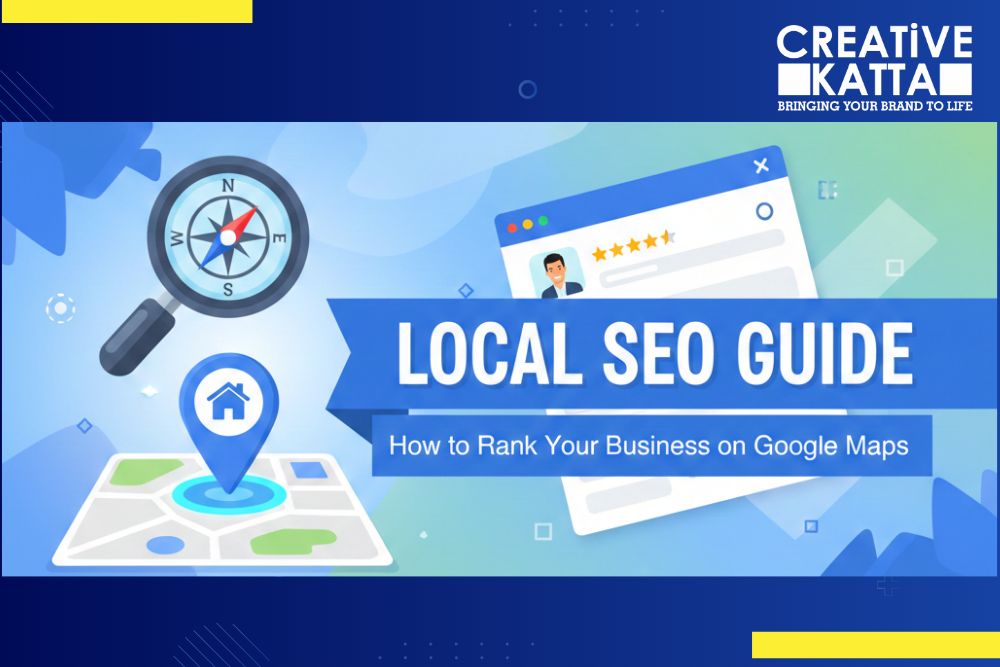
Local SEO Guide: How to Rank Your Business on Google Maps in 2026
Introduction: Why Google Maps Ranking Is No Longer Optional
Imagine this — a potential customer is searching for a service you offer, right in your neighbourhood. They pull out their phone, type a quick query, and Google Maps instantly shows them three businesses. If your business isn’t one of them, that customer walks straight to your competitor.
That’s the reality of local search today.
In fact, 46% of all Google searches have local intent. Even more striking, “near me” searches have grown by over 900% in recent years. If your business isn’t showing up in Google’s Local Pack — the map-based results at the top of the page — you’re leaving serious revenue on the table.
The good news? Ranking on Google Maps isn’t magic. It’s a process — and this guide walks you through every step of it.
What Is Local SEO and Why Does It Matter?
Local SEO (Search Engine Optimisation) is the practice of optimising your online presence so that your business appears in location-based search results. Unlike traditional SEO, which targets a global or national audience, local SEO focuses on reaching customers in a specific geographic area.
When someone searches “best digital marketing agency in Pune” or “coffee shop near me,” Google uses a combination of signals to decide which businesses to show — and in what order.
This is where your local SEO strategy either works for you or against you.
How Google Decides Who Ranks on Google Maps
To rank well, you first need to understand Google’s three core local ranking factors:
1. Relevance
Google matches your business to a user’s search query. The more accurately your business information reflects what someone is searching for, the better your chances of appearing.
2. Distance
Google considers how far your business is from the searcher. While you can’t move your physical location, you can optimise your profile to signal relevance within a wider radius.
3. Prominence
This refers to how well-known and reputable your business is — both online and offline. Reviews, backlinks, social presence, and overall authority all contribute to prominence.
Understanding these three pillars is the foundation of everything that follows.
Step 1: Claim and Optimise Your Google Business Profile
Your Google Business Profile (formerly Google My Business) is the single most important asset in your local SEO strategy. Without it, you simply won’t appear on Google Maps.
Getting Started
- Go to google.com/business and sign in with your Google account.
- Search for your business name — if it already exists, claim it. If not, create a new profile.
- Verify your business via postcard, phone, or video.
Optimising Your Profile
Once verified, here’s exactly what to do:
- Business Name: Use your real, legal business name. Avoid keyword stuffing — it violates Google’s guidelines.
- Category: Choose the most accurate primary category. This directly impacts which searches trigger your listing.
- Description: Write a compelling, keyword-rich description. Naturally include your primary keyword and location.
- Hours: Keep them accurate and current, including holiday hours.
- Photos: Upload high-quality images — exterior, interior, team, and products. Businesses with photos receive significantly more clicks.
- Services/Products: List everything you offer with descriptions and prices where applicable.
Pro Tip: Post regular updates to your GBP — promotions, events, new services. Google rewards active profiles.
Step 2: Build NAP Consistency Across the Web
NAP stands for Name, Address, Phone Number. Consistency in how your NAP appears across the internet is critical for local SEO.
Why? Because Google cross-references your business details across hundreds of directories and review sites. If your address appears differently on Justdial compared to your website, Google loses confidence in your listing — and your ranking suffers as a result.
What to Do
- Audit your current NAP across platforms (Google, Bing, Facebook, Justdial, Sulekha, IndiaMART, etc.)
- Correct any inconsistencies immediately
- Use the exact same formatting every time
Additionally, focus on building local citations — mentions of your business on reputable local directories. The more quality citations you have, the more trust signals Google receives.
Step 3: Generate and Manage Customer Reviews
Here’s a truth that many businesses overlook: reviews are one of the most powerful ranking factors for Google Maps.
Not only do they influence your position in the local pack, but they also directly affect whether potential customers choose you over a competitor.
How to Get More Reviews
- Ask satisfied customers directly — in person, via email, or through a follow-up WhatsApp message.
- Create a short, direct Google review link and share it on your website, invoices, and social media.
- Train your team to request reviews as part of the customer experience.
How to Respond to Reviews
Always respond to reviews — both positive and negative.
- Positive reviews: Thank the customer genuinely and personalise your response.
- Negative reviews: Stay calm, acknowledge the concern, and offer to resolve it offline.
Responding to reviews signals to Google that you’re an engaged, trustworthy business. Moreover, it builds social proof that influences new customers.
Step 4: Optimise Your Website for Local Search
Your Google Business Profile and your website work together. A well-optimised website amplifies your local SEO considerably.
Key On-Page Local SEO Tactics
- Add your city/region to title tags and H1s — e.g., “Best Digital Marketing Agency in Bengaluru”
- Create a dedicated Contact page with your full NAP, embedded Google Map, and business hours
- Use LocalBusiness Schema Markup — structured data helps Google understand your business type, location, and offerings
- Create location-specific landing pages if you serve multiple areas
- Embed a Google Map on your Contact or About page
Additionally, make sure your website is mobile-friendly and fast-loading. Since most local searches happen on mobile devices, a slow website will hurt both your rankings and conversions.
Step 5: Build Local Backlinks
Backlinks — links from other websites to yours — are a cornerstone of SEO in general. For local SEO specifically, locally relevant backlinks carry extra weight.
How to Earn Local Backlinks
- Get listed in your local Chamber of Commerce or business association
- Partner with complementary local businesses for co-promotions or guest blog swaps
- Sponsor local events and ensure you’re listed on the event’s website
- Pitch stories to local news outlets and blogs in your city
- Join industry-specific directories relevant to your niche
Even a handful of high-quality local backlinks can meaningfully move the needle on your Google Maps ranking.
Step 6: Use Local Keywords Strategically
Keyword research for local SEO is slightly different from general SEO. You’re targeting geo-modified keywords — search terms that include a specific location.
Examples of Local Keywords
| Generic Keyword | Local Keyword |
|---|---|
| Digital marketing agency | Digital marketing agency in Pune |
| Bakery near me | Best bakery in Koregaon Park |
| Web design services | Web design company in Bengaluru |
Use tools like Google Keyword Planner, Ubersuggest, or Semrush to find local keywords with decent search volume and manageable competition. Then, naturally incorporate them into your GBP description, website page titles, blog posts, and image alt text.
Step 7: Leverage Google Posts and Q&A
Two often-underused features of Google Business Profile deserve special attention.
Google Posts
These are short updates that appear directly on your GBP listing. Use them to announce new products, share blog content, promote offers, and highlight customer success stories. Aim to post at least once a week.
Q&A Section
Anyone can ask questions on your GBP listing — and anyone can answer them. As a business owner, you should:
- Proactively add FAQs with keyword-rich answers
- Monitor and respond to new questions promptly
- Flag any inappropriate or inaccurate content
This feature not only improves your ranking but also helps convert undecided customers.
Step 8: Track Your Local SEO Performance
You can’t improve what you don’t measure. Fortunately, there are several tools to help track your progress.
Key Metrics to Monitor
- Google Business Profile Insights — views, searches, direction requests, calls, and website clicks
- Google Search Console — which local keywords are driving impressions and clicks
- Google Analytics — organic traffic, bounce rate, and conversions from local searches
- Rank tracking tools (e.g., BrightLocal, Whitespark) — where you rank for specific local keywords
Review these metrics monthly, identify what’s working, and double down on it.
Common Local SEO Mistakes to Avoid
As you implement your strategy, watch out for these common pitfalls:
- Keyword stuffing in your business name — Google may suspend your listing
- Ignoring negative reviews — it signals poor customer service to both users and Google
- Inconsistent NAP information — confuses both Google and potential customers
- Neglecting mobile optimisation — most local searches are mobile-first
- Setting up GBP and forgetting about it — regular activity is rewarded with better rankings
Avoiding these mistakes is just as important as executing the right strategies.
Local SEO in 2026: Optimising for AI Search and Google’s Evolving SERP
This is the biggest shift in local SEO for 2026. AI-powered search is no longer emerging — it’s mainstream. Google’s AI Overviews, ChatGPT search, Perplexity, and Gemini are now answering local queries directly, often without the user clicking a traditional search result at all.
That means your business needs to be optimised not just for the classic search results — but for AI-generated answers.
How to Show Up in AI Search Results
- Keep your GBP fully up to date — AI tools pull live business data directly from Google’s knowledge graph. Stale information means you get left out.
- Create structured, authoritative content — FAQs, how-to guides, detailed service pages, and location-specific content are consistently cited by AI models.
- Use Schema Markup aggressively — LocalBusiness, FAQPage, Review, and Service schemas help AI systems parse and trust your content.
- Build genuine E-E-A-T (Experience, Expertise, Authoritativeness, Trustworthiness) — Google and AI models in 2026 weigh this more heavily than ever. Real reviews, author bios, case studies, and credentials all contribute.
- Optimise for conversational queries — AI search is driven by natural language. Think about how real people speak their questions, not just how they type keywords.
The Rise of Zero-Click Local Search
In 2026, a growing proportion of local searches result in zero clicks — the user gets their answer directly from an AI snippet or Google’s map panel. To still benefit from this:
- Ensure your GBP has complete, keyword-rich answers in the Q&A section
- Add detailed service descriptions so Google can surface them in AI responses
- Collect reviews that mention specific services, neighbourhoods, and outcomes — these are gold for AI citations
The businesses that invest in local SEO and AI-readiness today are the ones that will dominate both traditional and AI-powered local search in 2026 and beyond.
Conclusion: Your Local Customers Are Searching Right Now
Ranking on Google Maps isn’t about gaming the system — it’s about showing Google and your customers that your business is legitimate, active, and relevant. Every step in this guide builds on the last, creating a compounding effect that grows stronger over time.
The businesses that commit to local SEO consistently are the ones that own the top spots in the map pack — and capture the customers that come with it.
So, whether you’re just getting started or looking to sharpen an existing strategy, 2026 is the year to get serious about local SEO. Your local customers are already searching — on Google, on AI tools, on Maps. The question is: will they find you?
Ready to Dominate Local Search? Let CreativeKatta Help.
Local SEO requires strategy, consistency, and expertise. At CreativeKatta, we specialise in helping businesses like yours climb to the top of Google Maps — and stay there.
From Google Business Profile optimisation and citation building to content strategy and performance tracking, our team handles the full spectrum of local SEO so you can focus on what you do best: running your business.
Get Your Free Local SEO Audit from CreativeKatta — and find out exactly what’s holding your Google Maps ranking back.
Because your next customer is already searching. Let’s make sure they find you.