
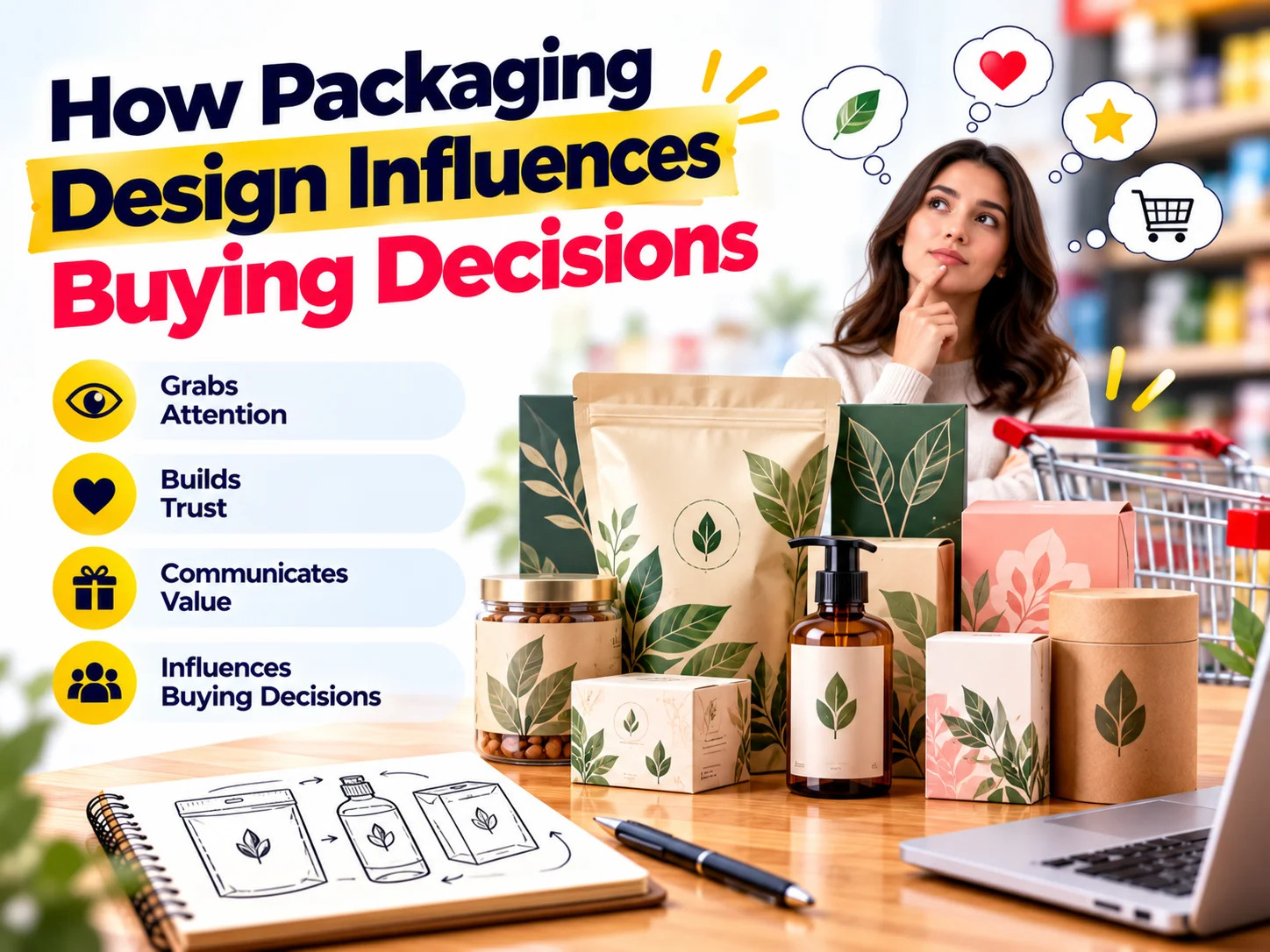
Packaging does more than protect a product. It can shape how customers notice, understand, compare, and remember a product.
When shoppers see a product for the first time, packaging often becomes one of the first brand touchpoints they experience. Before they read a detailed product description or visit a website, they may already form an impression based on the package design.
That is why packaging design plays an important role in buying decisions.
A well-designed package can communicate product quality, highlight key benefits, create brand recognition, and make a product easier to notice. However, effective packaging does not simply mean making a product look attractive. It requires a balance between branding, information, usability, and visual communication.
In this article, we explore how packaging design can influence customer buying decisions and how businesses can create packaging that supports their brand and products.
What Is Packaging Design?
Packaging design is the process of creating the visual and functional appearance of a product’s packaging.
It can include:
- Packaging structure and shape
- Colours
- Typography
- Logo placement
- Product images
- Illustrations
- Icons
- Product information
- Labels
- Patterns
- Materials and finishes
- Brand messaging
Good packaging brings these elements together to communicate what the product is and why customers should consider it.
Why Does Packaging Design Matter?
Customers encounter thousands of products in stores and online marketplaces. Therefore, products need to communicate quickly.
Packaging can help answer important questions such as:
- What is this product?
- Who is it for?
- What does it offer?
- What makes it different?
- Is it premium, affordable, natural, modern, or practical?
- Can I trust this brand?
When packaging answers these questions clearly, customers can understand the product faster.
1. Packaging Creates the First Impression
First impressions can influence how customers perceive a product.
Imagine two similar products placed next to each other. One uses a clear visual hierarchy, attractive imagery, readable information, and consistent branding. The other uses cluttered graphics and difficult-to-read text.
The first product may communicate its value more effectively because customers can understand it quickly.
Therefore, packaging should create a clear and relevant first impression rather than simply adding decorative elements.
2. Packaging Helps Products Stand Out
Retail shelves can contain dozens or even hundreds of competing products.
As a result, packaging needs to attract attention without creating confusion.
Strong packaging can use:
- Distinctive colours
- Clear typography
- Unique shapes
- Strong product photography
- Minimal layouts
- Relevant illustrations
- Strategic visual contrast
However, standing out does not mean using the brightest colours or the most complicated design.
Instead, the design should help the right customer notice the product and understand its purpose.
3. Colours Influence Product Perception
Colour is one of the most noticeable elements of packaging.
Different colour combinations can communicate different brand qualities.
For example:
- Green can communicate freshness or nature.
- Blue can suggest trust or reliability.
- Black can create a premium appearance.
- Yellow can create an energetic feel.
- White can communicate simplicity and cleanliness.
However, colour associations can vary depending on the product category, culture, audience, and context.
Therefore, businesses should choose colours based on their brand identity and target audience, rather than following colour trends blindly.
4. Typography Affects How Customers Read Packaging
Customers often scan packaging rather than reading every word.
That makes typography especially important.
A strong packaging design creates a clear hierarchy between:
Brand → Product Name → Key Benefit → Important Information → Supporting Details
For example, the product name should not compete visually with small regulatory or supporting information.
Similarly, overly decorative fonts can make important information difficult to read.
Therefore, packaging typography should balance personality with readability.
5. Packaging Communicates Product Quality
Customers often use visual cues to form expectations about a product.
Premium typography, carefully selected colours, quality imagery, structured layouts, and suitable materials can contribute to a premium perception.
Likewise, a simple and practical design may communicate affordability or everyday usability.
However, packaging should accurately represent the product.
A visually premium package cannot compensate for poor product quality or misleading claims.
Instead, effective packaging should reinforce the actual value of the product.
6. Packaging Builds Brand Recognition
Consistent packaging helps customers recognise a brand across different products.
For example, a company may use a consistent:
- Logo
- Colour palette
- Typography system
- Illustration style
- Photography style
- Packaging structure
- Brand pattern
Then, customers can recognise products from the same company even when product names or variants change.
This becomes particularly valuable when a business expands its product range.
7. Packaging Makes Product Benefits Easier to Understand
Customers want to know what they are getting.
However, packaging has limited space. Therefore, businesses need to communicate product benefits clearly.
Instead of filling the package with lengthy paragraphs, highlight the most relevant information.
For example:
Product: Face Cleanser
Benefit: Gentle daily cleansing
Key Features: Suitable for everyday use | Lightweight formula | Easy to use
Clear information helps customers understand the product without spending too much time reading.
8. Packaging Can Influence Emotional Responses
Purchasing decisions are not always based purely on product specifications.
Visual design can create emotional associations.
For instance, a playful package may appeal to families, while an elegant package may attract customers looking for a premium experience.
Similarly, natural imagery and earthy colours may support a nature-focused brand identity.
Therefore, packaging should consider both what the product does and how the customer should feel about it.
9. Packaging Influences Perceived Value
Packaging can contribute to perceived product value.
A carefully designed box, bottle, pouch, label, or container can make the overall product experience feel more considered.
This becomes particularly relevant for:
- Beauty products
- Skincare
- Food products
- Gifts
- Premium beverages
- Fashion accessories
- Consumer electronics
- Lifestyle products
However, perceived value should support genuine product value. The design should never rely on appearance alone.
10. Packaging Can Make Products Easier to Compare
Customers frequently compare products before making a purchase.
Clear packaging can make important differences easier to identify.
For example, customers may compare:
- Product size
- Quantity
- Features
- Flavours
- Ingredients
- Usage
- Benefits
- Variants
- Certifications
A well-structured information hierarchy allows customers to find these details quickly.
As a result, packaging can support faster and more informed product comparisons.
11. Packaging Matters in E-commerce Too
Packaging is not limited to physical retail stores.
Online shoppers often see product packaging in product photographs before they purchase.
Therefore, packaging design also influences the visual presentation of products on:
- E-commerce websites
- Amazon listings
- Social media
- Digital advertisements
- Online marketplaces
- Brand websites
A strong package can make product photography more recognisable and visually appealing.
Furthermore, customers eventually experience the physical packaging when the product arrives. This creates another opportunity for the brand to reinforce its identity.
12. Packaging Can Strengthen the Unboxing Experience
For many products, opening the package becomes part of the customer experience.
Businesses can use packaging to create a memorable unboxing journey through:
- Thoughtful opening mechanisms
- Branded inserts
- Thank-you cards
- Product information
- Protective presentation
- Consistent visual elements
This experience can also encourage customers to share products through social media.
However, the experience should remain practical. Attractive packaging should not create unnecessary waste or make the product difficult to access.
Packaging Design vs Product Design
Packaging and product design work together, but they serve different purposes.
Product design focuses primarily on the product itself, including its form, functionality, usability, and experience.
Packaging design focuses on how the product is protected, presented, communicated, and experienced before and during purchase.
For a strong customer experience, both should work together.
Common Packaging Design Mistakes
Even attractive packaging can fail when it does not communicate effectively.
Too Much Information
Filling every available space with text can overwhelm customers.
Instead, prioritise the information customers need most.
Weak Brand Visibility
If customers cannot quickly identify the brand, packaging may lose an important recognition opportunity.
Poor Typography
Small or difficult-to-read text can make important product information inaccessible.
Inconsistent Branding
Different packaging styles across product ranges can weaken brand recognition.
Copying Competitors
Following competitor packaging too closely can make your product look interchangeable.
Instead, identify opportunities to create a distinctive visual identity.
Ignoring the Target Audience
Packaging should reflect the expectations and preferences of the intended customer.
A design that works for one audience may not work for another.
How to Create Packaging That Supports Buying Decisions
Businesses can follow a structured process.
Step 1: Understand the Target Customer
Identify who buys the product, what they value, and what influences their purchase.
Step 2: Research the Competition
Review competing products to understand common design patterns and identify opportunities for differentiation.
Step 3: Define the Brand Positioning
Decide whether your brand should communicate qualities such as premium, accessible, modern, natural, innovative, traditional, or playful.
Step 4: Create the Visual Direction
Develop the colour palette, typography, imagery, graphics, and overall packaging style.
Step 5: Prioritise Information
Decide which information customers should notice first, second, and third.
Step 6: Design for Real-World Use
Consider printing, materials, packaging sizes, shelf visibility, transportation, storage, and usability.
Step 7: Test Before Production
Create realistic mockups and, where possible, test the design with relevant customers.
Then refine the design based on practical feedback.
A Simple Packaging Design Checklist
Before finalising your packaging, ask:
- Is the brand easy to identify?
- Is the product name clear?
- Can customers understand the product quickly?
- Are the key benefits visible?
- Is the typography readable?
- Does the colour palette fit the brand?
- Does the design stand apart from competitors?
- Does the packaging match the product’s positioning?
- Does it work across retail and digital channels?
- Is the packaging practical and usable?
- Does it support a consistent brand identity?
If the answer is yes across these areas, your packaging has a stronger foundation for communicating value.
Final Thoughts
Packaging design can influence how customers notice, understand, compare, and perceive a product.
However, effective packaging goes beyond attractive graphics. It combines brand identity, visual hierarchy, customer psychology, product information, usability, and differentiation.
A successful packaging design communicates the right message at the right moment while creating a consistent connection with the overall brand.
Whether you are launching a new product or refreshing an existing range, investing in thoughtful packaging design can help create a stronger and more recognisable customer experience.
Create Packaging That Gets Your Brand Noticed With CreativeKatta
Your packaging is often the first physical interaction customers have with your product. Make that interaction count.
CreativeKatta provides professional packaging design, brand identity design, creative design, website development, social media design, and digital marketing solutions for growing businesses.
Our creative approach connects your packaging, brand identity, website, and marketing communication so customers experience a consistent brand at every touchpoint.
Ready to give your product packaging a stronger visual identity? Connect with CreativeKatta and create packaging designed to communicate your brand clearly.
CTA: Create Your Packaging Design With CreativeKatta →
FAQ
Q. How does packaging design influence buying decisions?
A. Packaging can influence attention, product understanding, perceived value, brand recognition, and product comparison.
Q. Why is packaging important for a brand?
A. Packaging provides a physical brand touchpoint and helps communicate the product’s identity, benefits, positioning, and value.
Q. What makes packaging design effective?
A. Effective packaging combines clear information, strong branding, readable typography, appropriate colours, visual differentiation, and practical usability.
Q. Does packaging influence customer perception of product quality?
A. Yes. Visual elements, materials, typography, and overall presentation can influence perceived product quality, although the actual product experience remains important.
Q. How can packaging design make a product stand out?
A. Distinctive colours, typography, imagery, structure, and a clear visual hierarchy can help a product attract attention while remaining relevant to its target audience.