
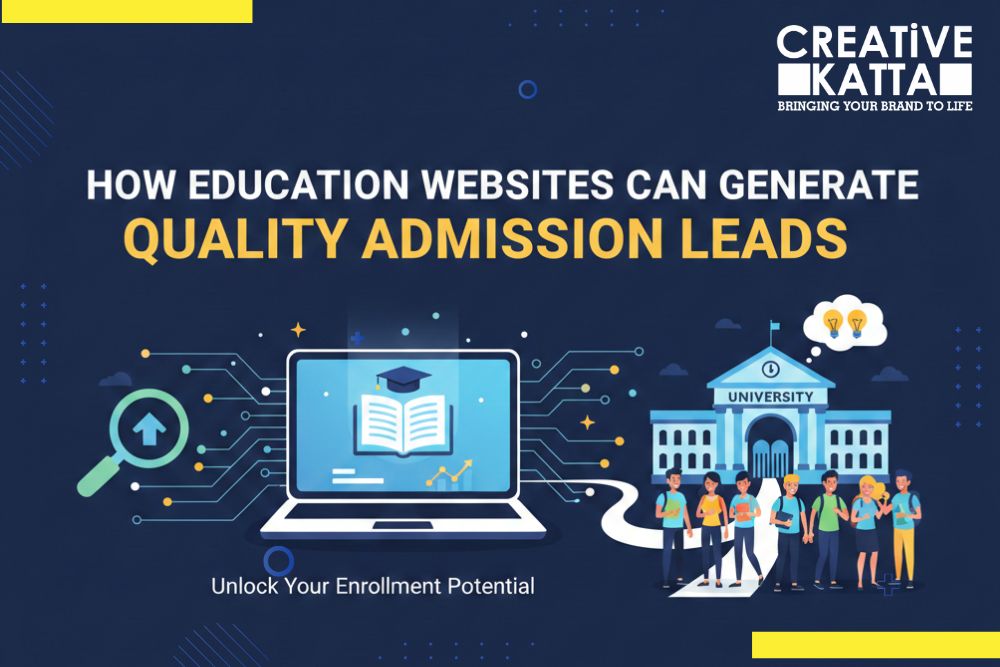
How Education Websites Can GenerateQuality Admission Leads
In today's hyper-competitive education landscape, having a website is simply not enough. What truly matters is whether that website is actively working to attract, engage, and convert prospective students into admission enquiries. Unfortunately, most school and college websites are little more than digital brochures — pretty to look at, but poor at generating leads.
So, how exactly do education websites generate quality admission leads? More importantly, how do you make sure those leads are genuinely interested — not just random clicks? In this guide, we break down the complete strategy, step by step.
1. Why Most Education Websites Fail to Generate Leads
Before diving into solutions, it is important to understand why so many education websites struggle with lead generation in the first place. The most common problems are surprisingly straightforward — and very fixable.
First and foremost, many education websites are designed for aesthetics rather than conversions. They feature stunning imagery and lengthy content about their institution's history, but completely lack clear calls-to-action (CTAs) that guide visitors toward filling out an enquiry form. As a result, even visitors who are genuinely interested end up leaving without taking any action.
Additionally, poor mobile optimization is a major culprit. Since more than two-thirds of users browse on smartphones, a slow or hard-to-navigate mobile website will almost always result in high bounce rates and lost leads. Furthermore, many institutions completely ignore local SEO — meaning their website doesn't even appear when a prospective student searches "best MBA college in [city]."
A beautifully designed website that nobody finds — or that nobody acts on — is a missed opportunity every single day of the admission season.
2. Optimize Your Website for Search (Education SEO)
Search Engine Optimization is, without question, the foundation of any sustainable lead generation strategy for education websites. When a student types "best engineering college in Pune" or "online MBA admission 2026," your website needs to appear prominently — otherwise, competitors will capture that lead instead of you.
Target the Right Keywords
Rather than targeting broad keywords like "college admission," focus on high-intent, long-tail keywords that reflect genuine admission intent. For example, terms like "BBA admission 2026 fees and eligibility" or "top nursing colleges in Karnataka with hostel" attract visitors who are already in decision-making mode.
Create Dedicated Course Landing Pages
One of the most effective SEO tactics is to create individual, well-optimized landing pages for each program or course you offer. Each page should include a keyword-rich title, a compelling description, eligibility criteria, fee structure, and — most critically — a lead capture form. This approach ensures that search engines index each program separately, significantly expanding your organic visibility.
- Use target keywords in H1 headings, meta titles, and first 100 words
- Add schema markup for educational organizations and courses
- Optimize your Google Business Profile for local searches
- Build backlinks from education directories and ranking websites
- Publish SEO blog content answering common admission questions
Not sure where your website ranks for admission-related keywords?
Get a Free SEO Audit from CreativeKatta3. Design High-Converting Admission Landing Pages
Even if you successfully drive traffic to your website, that traffic is worthless without a conversion-optimized landing page to capture the lead. A high-converting admission landing page is not just about good looks — it is about strategically guiding the visitor toward one specific action: submitting their contact details.
Moreover, the best landing pages follow a clear psychological flow. They begin by immediately establishing trust, then highlight key benefits, address common concerns, and finally present an irresistible reason to enquire right now.
Lead with a benefit-driven headline that speaks directly to what the student wants — not just your institution's name.
Ask only for essential information: name, phone, email, and preferred course. Every additional field reduces conversions by approximately 10–15%.
Include student testimonials, placement statistics, rankings, and accreditation badges prominently on the page.
Use countdown timers for application deadlines or messaging like "Limited seats available for 2026 batch" to encourage immediate action.
Ensure the page loads in under 3 seconds on mobile and that forms are easy to fill on a touchscreen.
4. Use Lead Magnets to Attract Quality Enquiries
One of the most underutilized yet highly effective strategies for education websites is the use of lead magnets. A lead magnet is a valuable piece of content or offer that you give away for free in exchange for a visitor's contact information.
The key insight here is that a student who downloads your course brochure or registers for a free counselling session is far more qualified than a random form submission. In other words, lead magnets don't just increase volume — they improve lead quality.
| Lead Magnet Type | Best For | Lead Quality |
|---|---|---|
| 📄 Free Course Brochure / Prospectus PDF | All institutions | ⭐⭐⭐⭐ |
| 🎙️ Free Counselling Session Booking | Competitive exam prep, MBA | ⭐⭐⭐⭐⭐ |
| 📊 Scholarship Eligibility Quiz | Schools, undergraduate colleges | ⭐⭐⭐⭐⭐ |
| 📹 Campus Virtual Tour Webinar | Out-of-city students | ⭐⭐⭐⭐ |
| 📝 Free Study Material / Sample Papers | Coaching institutes | ⭐⭐⭐ |
5. Run Targeted Google & Meta Ads for Admission Season
While organic SEO builds long-term visibility, paid advertising delivers immediate results — especially during critical admission windows. Therefore, a well-planned PPC (Pay Per Click) strategy should complement, not replace, your organic efforts.
Google Search Ads are particularly powerful for education lead generation because they target students who are actively searching. When someone searches "MBA colleges accepting 2026 applications," appearing at the top of those results can make an enormous difference in enquiry volume.
Similarly, Meta (Facebook and Instagram) Ads allow you to reach students based on age, location, interests, and educational background. This makes them ideal for building awareness and re-engaging visitors who landed on your website but didn't enquire — commonly known as retargeting.
- Use Google's Education audience segments for refined targeting
- Run retargeting ads to website visitors who didn't fill the form
- Test multiple ad creatives — video ads typically outperform static images
- Use Meta Lead Ads for instant in-app form submissions
- Align ad copy with your landing page message for higher Quality Scores
Want a results-driven paid ads strategy for your next admission season?
Talk to CreativeKatta — We Run Education Ad Campaigns6. Leverage Content Marketing to Build Trust & Authority
Content marketing is, in many ways, the most sustainable long-term strategy for education websites. When your institution consistently publishes high-quality, helpful content — such as blog posts answering common admission questions, career guidance articles, or student success stories — it builds trust with prospective students and their parents well before they ever enquire.
Furthermore, content marketing directly supports SEO. Every blog post targeting a specific long-tail keyword is an additional entry point into your website from search engines. Over time, this creates a compounding effect where your content continues to attract and convert leads 24/7 — without any additional ad spend.
High-Performing Content Ideas for Education Websites
- "Top 10 Career Options After B.Com in India [2026 Guide]"
- "[Your Course] vs [Competitor Course]: Which is Right for You?"
- "How to Prepare for [Entrance Exam] in 3 Months"
- "[Year] Admission: Eligibility, Dates, Fees & Process Explained"
- "Student Success Story: From [City] to [Dream Job]"
7. Implement a Lead Nurturing System (CRM + Email/WhatsApp)
Generating a lead is only the beginning. What happens after a student submits their enquiry largely determines whether they ultimately enroll. Without a proper follow-up system in place, even the best leads will slip through the cracks.
Consequently, implementing a CRM (Customer Relationship Management) system is non-negotiable for serious education institutions. When a lead comes in, your team should be able to respond within minutes — not hours. Studies consistently show that lead response time is one of the biggest factors in conversion rates.
Moreover, automated WhatsApp and email sequences can keep leads engaged over the weeks and months before the admission deadline. Rather than bombarding prospects with generic messages, personalize your follow-up based on the course they enquired about, their location, and where they are in the decision-making process.
Institutions that respond to enquiries within 5 minutes are 9x more likely to convert that lead compared to those who respond after 30 minutes. Speed is strategy.
8. Track, Analyze & Continuously Improve
Finally — and this is where many education institutions fall short — you must measure everything. Without data, you are essentially flying blind. Understanding which pages generate the most leads, which ad campaigns deliver the best ROI, and where visitors drop off in your conversion funnel is what separates high-performing institutions from those that waste their marketing budget every admission cycle.
To begin with, ensure Google Analytics 4 and Google Search Console are properly set up. Next, configure conversion tracking for every enquiry form submission, phone call, and WhatsApp click. Over time, this data will reveal powerful insights that allow you to make smarter, more profitable marketing decisions.
- Track cost per lead (CPL) for every marketing channel
- Use heatmaps (like Hotjar) to understand how users interact with your landing pages
- A/B test headlines, CTA buttons, and form placements regularly
- Monitor your website's Core Web Vitals for page speed performance
- Review and optimize your strategy at least monthly during admission season
Frequently Asked Questions
SEO is a medium-to-long-term strategy. Typically, you can expect to see meaningful improvements in organic traffic and leads within 3–6 months of consistent optimization. However, paid ads can generate leads almost immediately once campaigns are live.
For smaller institutions with limited budgets, focusing on local SEO, Google Business Profile optimization, and organic social media content tends to deliver the best return on investment. Even a modest Google Ads campaign with highly targeted keywords can generate significant leads during peak admission months.
Absolutely. AI-powered chatbots can engage website visitors 24/7, answer common admission queries, and capture lead information even outside office hours. This significantly reduces response time and ensures no enquiry is missed.
Ideally, you should have a lead capture form on every high-traffic page — including the homepage, individual course pages, and your blog posts. A sticky enquiry form or floating WhatsApp button that remains visible as users scroll is particularly effective on mobile.
A well-designed education website builds trust, improves user experience, reduces bounce rates, and makes it easier for prospective students to fill out enquiry forms — all of which directly improve lead conversion rates.
The best strategy combines local SEO, Google Search Ads, social media content marketing, retargeting campaigns, and a fast-loading mobile-friendly website with clear calls-to-action. A holistic approach that covers both organic and paid channels consistently outperforms single-channel strategies.
Key Takeaways
To summarize, generating quality admission leads through your education website requires a holistic, multi-channel approach. Here is a quick recap of the most important strategies covered in this guide:
- Optimize every page for high-intent education keywords and local search
- Build dedicated, conversion-focused landing pages for each program
- Offer valuable lead magnets to attract genuinely interested prospects
- Run targeted Google and Meta Ads during admission season
- Publish regular content that builds trust and authority in your niche
- Implement a CRM and fast follow-up system to nurture every lead
- Measure performance data and optimize continuously for better ROI
Ultimately, the education institutions that thrive in today's digital-first world are those that treat their website not as a static information page, but as a dynamic, always-on admission engine. The good news? With the right strategy and the right partner, this is entirely achievable.
Ready to Transform Your Education Website Into an Admission Lead Machine?
At CreativeKatta, we specialize in helping schools, colleges, and coaching institutes design, optimize, and market their websites for maximum admission enquiries. From SEO and paid ads to landing page design and lead management — we handle it all.
Get a Free Strategy Session → CreativeKatta No commitment. Just a clear plan for more admissions.