
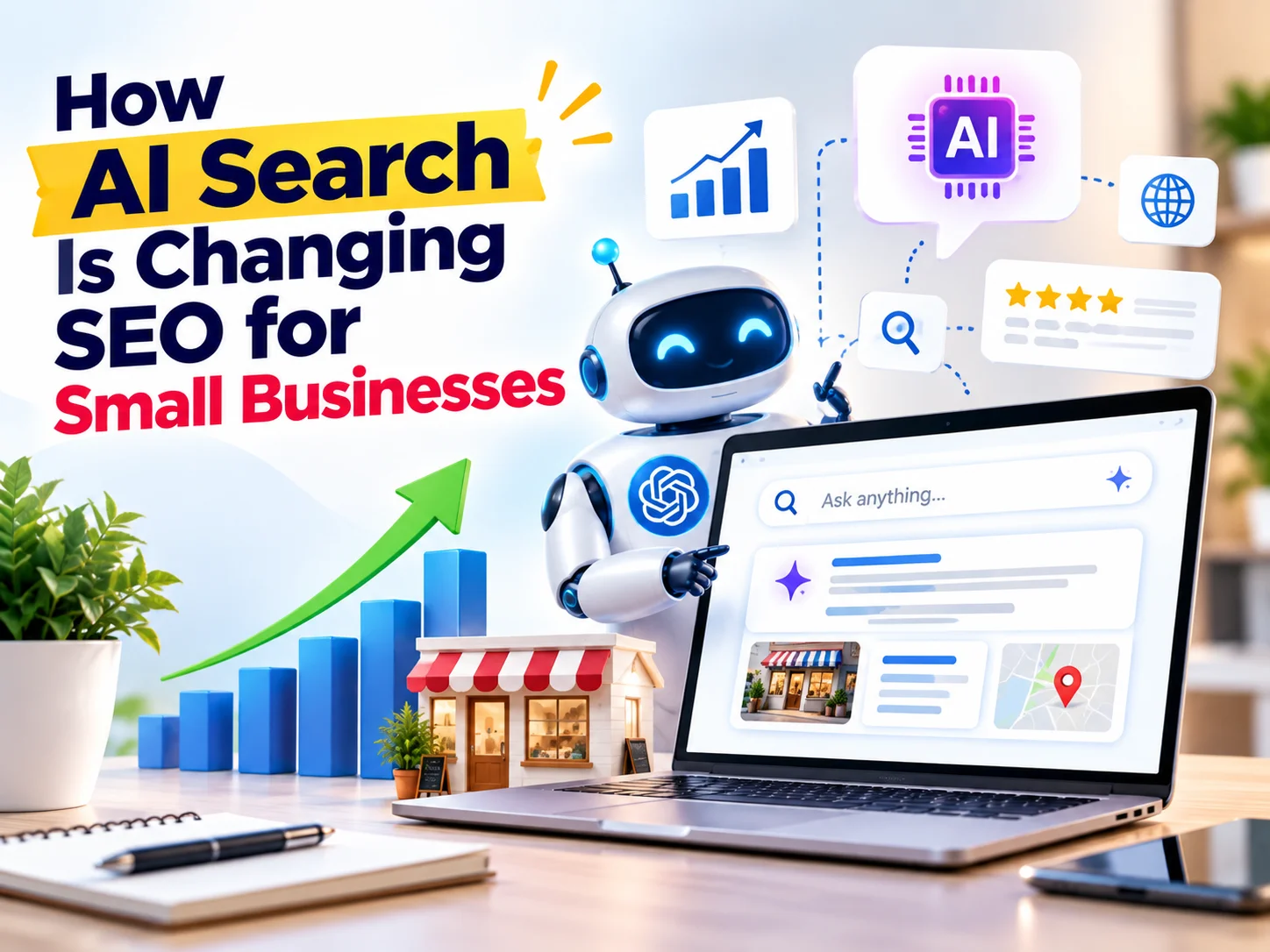
Search is changing quickly.
For years, small businesses focused on ranking their websites on Google for specific keywords. However, people now use AI-powered search tools to discover businesses, compare services, ask questions, and find recommendations.
Google’s AI-powered search experiences, ChatGPT, Microsoft Copilot, Perplexity, and other AI platforms can summarize information from multiple sources. As a result, users may get answers without visiting several traditional search results.
This change creates a new opportunity for small businesses.
Instead of focusing only on where your website ranks, businesses should also consider whether AI systems can understand, trust, and mention their business.
So, how is AI search changing SEO for small businesses?
What Is AI Search?
AI search uses artificial intelligence to understand a user’s question and provide a more conversational response.
Traditional search often works like this:
User searches → Search results → User opens websites
AI-powered search can work differently:
User asks a question → AI understands the intent → AI combines information → AI provides an answer
For example, instead of searching:
“SEO company Bangalore”
a user might ask:
“Which SEO agencies in Bangalore help small businesses improve their local search visibility?”
The second query contains more context.
Therefore, businesses need content that answers specific questions rather than simply targeting individual keywords.
Why AI Search Matters for Small Businesses
AI search can change how customers discover local companies and service providers.
A small business may not always appear first for a broad keyword. However, its website could still provide useful information that AI systems use when answering specific questions.
For example, a website may publish detailed content about:
- Services
- Pricing factors
- Service areas
- Customer problems
- Industry expertise
- FAQs
- Case studies
- Processes
- Customer results
As a result, the business gives search engines and AI systems more information to understand.
This is especially useful for small and local businesses because specific, helpful content can target niche search intent.
Traditional SEO vs AI Search Optimization
Traditional SEO still matters. However, AI search adds another layer.
Traditional SEO | AI Search |
Focuses heavily on rankings | Focuses on useful answers and visibility |
Targets keywords | Targets topics and search intent |
Optimizes individual pages | Builds topical authority |
Focuses on search results | Focuses on mentions and citations |
Uses structured content | Uses clear, contextual information |
Targets traditional search | Also targets conversational queries |
Therefore, small businesses shouldn’t abandon SEO.
Instead, they should expand their SEO strategy for AI-powered search.
1. Create Content That Answers Real Questions
AI search is conversational.
People often ask complete questions instead of entering short keywords.
For example:
“How much does website development cost for a small business?”
is different from:
“website development cost”
Therefore, create content that answers the questions your customers actually ask.
Useful content can include:
- How-to guides
- Service FAQs
- Pricing guides
- Comparison articles
- Industry guides
- Problem-solving articles
- Local service pages
- Product explanations
Most importantly, answer the question directly before adding supporting information.
2. Focus on Search Intent Instead of Keywords Alone
Keywords still matter.
However, keyword usage alone does not explain what the user wants.
Consider the keyword:
“website development.”
The user could be:
- Researching website development
- Looking for a developer
- Comparing agencies
- Looking for pricing
- Planning a redesign
- Learning how websites work
Therefore, your content should address the underlying search intent.
For example, a page targeting business customers could explain:
Website development includes planning, designing, developing, testing, and maintaining a website based on a business’s goals and customer requirements.
Then, it can explain services, process, pricing factors, technologies, FAQs, and next steps.
This gives both users and AI systems more context.
3. Build Topic Authority
One blog post is rarely enough to establish expertise around a subject.
Instead, create related content around your main services.
For example, a website development company could create content about:
- Website development
- Website redesign
- Responsive web design
- Ecommerce development
- WordPress development
- Website maintenance
- Website speed optimization
- Landing page design
- Website conversion optimization
Then, link these articles to the relevant service pages.
This creates a connected content ecosystem.
Consequently, search engines can better understand the topics your business covers.
4. Build Topic Authority
Clear website structure helps both people and search engines.
Use:
- Descriptive page titles
- Logical H1, H2, and H3 headings
- Short paragraphs
- Clear service descriptions
- Bullet points
- Tables where useful
- FAQs
- Internal links
- Relevant structured data
For example, instead of writing a long paragraph about your services, create separate sections:
Website Development
Explain the service and who it is for.
Ecommerce Development
Explain the ecommerce solutions you provide.
SEO
Explain how you help businesses improve organic visibility.
This structure makes information easier to scan and understand.
5. Strengthen Your Local SEO
AI search can be particularly useful for local discovery.
Users may ask questions such as:
“Who provides website development services near me?”
or:
“What are some website development companies in Bangalore?”
Therefore, local businesses should maintain accurate information across their online presence.
Make sure your business information is consistent, including:
- Business name
- Address
- Phone number
- Website
- Business category
- Service areas
- Opening hours
Also, maintain your Google Business Profile and encourage genuine customer reviews.
Local relevance can help search systems understand where your business operates and what services it provides.
6. Use First-Hand Experience in Your Content
AI-generated content is becoming easier to produce.
As a result, generic content can struggle to stand out.
Small businesses have an important advantage: real-world experience.
Share information based on your actual work.
For example:
- Project experiences
- Case studies
- Client challenges
- Before-and-after examples
- Industry observations
- Common mistakes
- Lessons learned
- Practical processes
Instead of writing:
“Website speed is important.”
Explain what you have actually seen when improving website performance for clients.
This makes your content more useful and distinctive.
7. Add Author and Business Information
Trust matters in search.
Make it easy for visitors and search systems to understand who created your content and who operates your business.
Consider adding:
- Author information
- Company information
- About page
- Contact information
- Business address
- Service areas
- Industry experience
- Client work
- Testimonials
Also, keep important business information consistent across your website and other reputable platforms.
8. Use FAQs Strategically
FAQs can help answer specific customer questions.
For example, a website development company could answer:
Q. How much does website development cost?
Explain the factors that affect pricing.
How long does it take to build a business website?
A. Explain the typical project stages and variables.
Q. Is WordPress suitable for small businesses?
A. Explain when WordPress can be useful and when another solution may be appropriate.
Q. Can an existing website be redesigned?
A. Explain the situations where redesigning an existing website makes sense.
These questions match the conversational nature of AI search.
However, don’t create FAQs only to add keywords.
Answer questions that your customers genuinely ask.
9. Don’t Forget Technical SEO
AI search does not make traditional SEO irrelevant.
Your technical foundation still matters.
Make sure your website has:
- Fast loading speeds
- Mobile-friendly design
- HTTPS
- Crawlable pages
- Clean site architecture
- Descriptive URLs
- Proper heading structure
- Optimized images
- Internal linking
- XML sitemap
- Appropriate structured data
In other words, AI-focused SEO should complement technical SEO—not replace it.
10. Create Content That Demonstrates Expertise
Instead of publishing large amounts of generic AI-written content, focus on useful and original information.
For example, a digital marketing agency could publish:
Generic topic:
What Is SEO?
More useful topic:
Why Small Businesses in Bangalore Struggle to Generate Leads From SEO
The second topic addresses a specific audience and problem.
Similarly:
Generic:
What Is Website Design?
Specific:
Why Your Business Website Looks Good but Doesn’t Generate Leads
Specific content often provides more value because it addresses a real business situation.
11. Create Content That Demonstrates Expertise
Instead of publishing large amounts of generic AI-written content, focus on useful and original information.
For example, a digital marketing agency could publish:
Generic topic:
What Is SEO?
More useful topic:
Why Small Businesses in Bangalore Struggle to Generate Leads From SEO
The second topic addresses a specific audience and problem.
Similarly:
Generic:
What Is Website Design?
Specific:
Why Your Business Website Looks Good but Doesn’t Generate Leads
Specific content often provides more value because it addresses a real business situation.
12. Measure More Than Google Rankings
AI search introduces additional visibility considerations.
Therefore, don’t look only at keyword positions.
Track:
- Organic traffic
- Leads
- Conversion rate
- Search impressions
- Click-through rate
- Branded searches
- Local visibility
- Referral traffic
- Engagement
- Important service-page performance
AI search visibility can be harder to measure consistently because different users may receive different answers.
Therefore, use multiple signals rather than relying on a single metric.
How Small Businesses Can Prepare for AI Search
You don’t need to completely rebuild your SEO strategy.
Instead, improve what you already have.
Start with your existing website
Review your important pages.
Ask:
- Is the service clearly explained?
- Does the page answer customer questions?
- Is the target audience clear?
- Does the page demonstrate expertise?
- Are relevant FAQs included?
- Are internal links useful?
- Is the business information accurate?
Next, improve your content
Create useful articles around your customers’ questions and problems.
Then, strengthen your authority
Add case studies, reviews, project examples, author information, and business details.
Finally, monitor performance
Use analytics and search tools to identify what attracts visitors and generates enquiries.
AI Search SEO Checklist for Small Businesses
Use this checklist when optimizing your website:
☑ Clear service pages
☑ Helpful and original content
☑ Question-based content
☑ Strong internal linking
☑ Relevant FAQs
☑ Local SEO optimization
☑ Accurate business information
☑ Google Business Profile optimization
☑ Customer reviews
☑ Case studies
☑ Author and company information
☑ Mobile-friendly website
☑ Fast loading speed
☑ Structured data where appropriate
☑ Search intent-focused keywords
☑ Conversion-focused CTAs
Frequently Asked Questions
Q. Will traditional SEO become irrelevant because of AI search?
A. No. Traditional SEO remains important. However, businesses now have an additional opportunity to optimize their content for AI-powered search experiences.
Q. How can a small business appear in AI search results?
A. Create accurate, useful, well-structured content that clearly explains your services, expertise, location, and customer value. Strong technical SEO and trustworthy business information also remain important.
Q. Is AI-generated content good for SEO?
A. AI can assist with research, outlines, and content production. However, businesses should review and improve AI-assisted content with accurate information, original insights, expertise, and useful examples.
Q. Does local SEO matter for AI search?
A. Yes. Local business information can help search systems understand what a business offers and where it operates. Therefore, accurate business information and a strong local presence remain important.
Q. What is LLM SEO?
A. LLM SEO refers to optimizing content and business information so that large language model-based systems can understand the subject, context, expertise, and relevance of a website.
Q. What is the difference between SEO and AI search optimization?
A. SEO traditionally focuses on improving visibility in search engines. AI search optimization adds a focus on creating clear, authoritative, contextual information that AI-powered systems can understand and use when generating responses.
Final Thoughts
AI is changing how people discover information online.
However, the fundamentals of good SEO remain valuable.
Small businesses should continue building technically strong websites, creating useful content, earning genuine trust, and targeting relevant search intent.
At the same time, businesses should make their information clear, structured, specific, and easy for AI systems to understand.
The biggest opportunity is not simply to create more content.
Instead, create better content that answers real customer questions and demonstrates genuine expertise.
When your website clearly communicates what you do, who you help, where you operate, and why customers should trust you, it becomes more useful across traditional search and AI-powered discovery.
Make Your Website Ready for the Future of Search
At CreativeKatta, we help businesses build websites and digital strategies designed for modern search.
Our services include:
- Website Development
- Website Redesign
- SEO
- LLM & AI Search Optimization
- Content Strategy
- Social Media Marketing
- Google Ads / PPC
- Creative Design
- Video Editing
Whether you’re building a new website or improving an existing one, CreativeKatta can help you create a search-friendly, user-focused, and conversion-ready digital presence.
Ready to improve your visibility in Google and AI-powered search?
Talk to CreativeKatta today and build a website designed for the next generation of search.
The Velocity Room
Find Your AI Infrastructure Community
Join peers building, securing, and operating AI in the real world for free.