
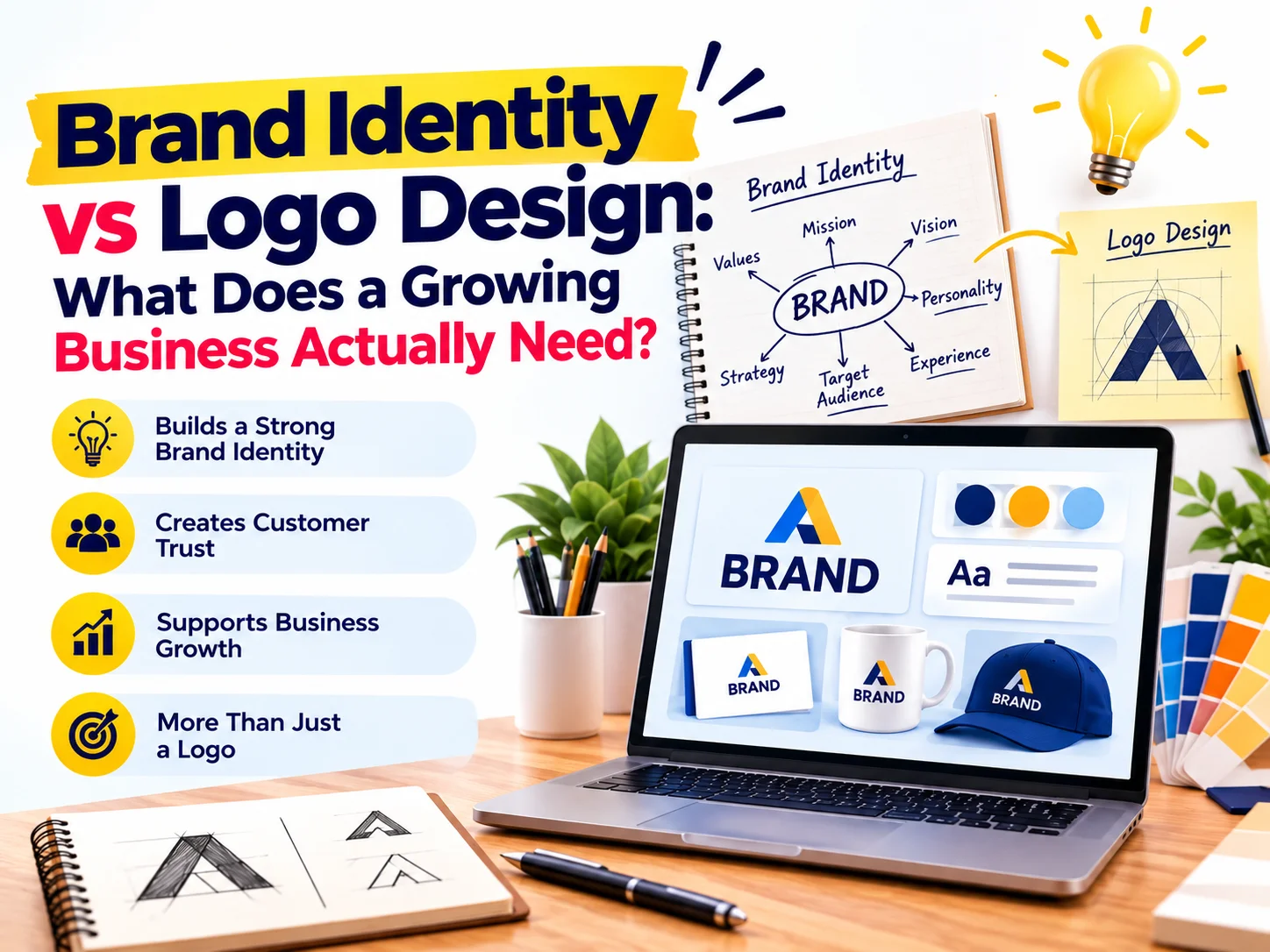
When a business starts growing, branding often becomes a priority.
At this stage, many business owners ask a simple question:
“Do we need a new logo, or do we need a complete brand identity?”
The answer depends on your business goals.
A logo is an important part of your brand. However, a logo and a brand identity are not the same thing.
Your logo identifies your business. On the other hand, your brand identity creates the complete visual and communication system that helps people recognize and remember your business.
Therefore, understanding the difference can help you invest your branding budget more effectively.
What Is Logo Design?
A logo is a visual symbol that represents your business.
It may include:
- A wordmark
- An icon
- A symbol
- A monogram
- A combination of text and graphics
For example, a logo appears on your:
- Website
- Business cards
- Social media profiles
- Packaging
- Presentations
- Signboards
- Marketing materials
The primary purpose of a logo is recognition.
A good logo should be:
- Simple
- Memorable
- Relevant
- Scalable
- Versatile
- Easy to recognize
However, a logo alone cannot communicate every aspect of your brand.
What Is Brand Identity?
Brand identity is the complete visual system that represents your business.
It goes beyond the logo.
A brand identity can include:
- Logo system
- Brand colors
- Typography
- Photography style
- Graphic elements
- Iconography
- Illustrations
- Packaging style
- Social media design
- Business stationery
- Presentation templates
- Brand guidelines
In addition, brand identity can define how your business communicates visually across different platforms.
For example, when customers see your website, Instagram post, brochure, packaging, and presentation, they should still recognize the same brand.
That consistency creates a stronger brand presence.
Brand Identity vs Logo Design: The Key Difference
The easiest way to understand the difference is:
A logo is one part of your brand identity.
Think of your brand as a complete visual language.
Your logo is one important word in that language.
Your colors, typography, imagery, layouts, graphics, and other visual elements create the rest.
Logo Design | Brand Identity |
Creates a business symbol | Creates a complete visual system |
Focuses on recognition | Focuses on consistency and recognition |
Usually includes logo variations | Includes logo plus supporting elements |
Used across brand materials | Defines how materials should look |
One branding asset | Complete branding framework |
Smaller project scope | Broader strategic project |
Therefore, a growing business often needs more than just a logo.
Why a Logo Alone May Not Be Enough
Imagine that your business has a great logo.
Now consider your website.
The website uses random colors and different fonts.
Your Instagram posts use another style.
Your brochures look completely different.
Your presentations use another color palette.
Although the logo remains the same, the overall brand experience feels inconsistent.
As a result, customers may find it harder to recognize your business across different touchpoints.
This is where a brand identity system becomes valuable.
What Does a Growing Business Actually Need?
The answer depends on your current stage.
If You Are Just Starting
A logo may be a reasonable starting point if your immediate goal is to establish a basic visual presence.
However, consider creating at least a simple visual direction for:
- Colors
- Fonts
- Logo usage
- Basic design style
This gives your business a consistent foundation from the beginning.
If Your Business Is Growing
As your business grows, you usually have more customer touchpoints.
You may now use:
- Website
- Social media
- Advertisements
- Packaging
- Sales presentations
- Brochures
- Email marketing
- Events
- Office signage
- Digital campaigns
At this point, a logo alone may not provide enough direction.
A complete brand identity can help keep these touchpoints visually consistent.
If You Are Entering a New Market
Expansion can also create a branding challenge.
For example, a company that started as a local business may now want to serve:
- Larger companies
- Corporate clients
- New cities
- International customers
- Premium customer segments
Your existing visual identity may no longer match your positioning.
In that situation, a brand identity refresh or complete rebranding may help align your visual communication with your new business direction.
What Does a Brand Identity Usually Include?
A professional brand identity project can include several elements.
1. Logo System
This can include:
- Primary logo
- Secondary logo
- Symbol or icon
- Horizontal version
- Vertical version
- Monochrome versions
These variations make the logo easier to use across different formats.
2. Color Palette
Colors help create visual recognition.
A brand identity may define:
- Primary colors
- Secondary colors
- Accent colors
- Background colors
- Digital color codes
- Print color specifications
For example, the brand guide can specify HEX, RGB, CMYK, and Pantone values where required.
3. Typography
Typography creates another layer of brand recognition.
A brand identity can define:
- Primary typeface
- Secondary typeface
- Heading styles
- Body text
- Font weights
- Spacing
- Usage guidelines
Consequently, your website, presentations, and marketing materials can maintain a consistent appearance.
4. Visual Style
Your brand identity can also define how your visual content should look.
This may include:
- Photography style
- Illustration style
- Icon style
- Graphic patterns
- Shapes
- Textures
- Layout principles
Therefore, designers have a consistent visual direction when creating new marketing materials.
5. Brand Guidelines
Brand guidelines bring everything together.
A guideline document can explain:
- How to use the logo
- Minimum logo size
- Clear space
- Approved colors
- Typography
- Image style
- Graphic elements
- Incorrect logo usage
- Brand applications
This becomes particularly useful when multiple designers, agencies, or marketing teams work on your brand.
Why Brand Consistency Matters
Brand consistency makes your business easier to recognize.
For example, imagine seeing the same:
- Colors
- Fonts
- Logo style
- Image treatment
- Graphic language
across your website, social media, packaging, and advertisements.
Over time, these repeated visual elements can create stronger brand recognition.
Moreover, consistent branding can make a growing business appear more organized and professional.
Common Branding Mistakes Growing Businesses Make
Mistake 1: Changing the Logo Frequently
Businesses sometimes redesign their logo every few years without a clear reason.
However, frequent changes can make it harder to build recognition.
Instead, update your logo when there is a genuine business or positioning reason.
Mistake 2: Using Too Many Colors
Using different colors for every marketing campaign can weaken visual consistency.
Instead, define a core palette and use additional colors strategically.
Mistake 3: Using Random Fonts
Using five or six fonts across different materials can make your brand look inconsistent.
Instead, select a small typography system and use it consistently.
Mistake 4: Designing Every Social Media Post Differently
Creative variety is useful.
However, your posts should still share recognizable brand elements.
Create templates and design rules that provide flexibility while maintaining consistency.
Mistake 5: Not Documenting the Brand
Even a strong brand identity can lose consistency if no one knows how to use it.
Therefore, create simple brand guidelines that your internal team and external partners can follow.
When Should You Invest in Brand Identity Design?
Consider investing in a brand identity when:
- Your business is growing rapidly
- Your existing branding looks inconsistent
- You are entering new markets
- You are targeting premium customers
- You are launching new products
- You have multiple marketing channels
- Different designers create your marketing materials
- Your current branding no longer reflects your business
- Customers struggle to recognize your brand
- You are preparing for a major business launch
In contrast, if you are still testing your business idea, a professional logo and basic visual direction may be enough initially.
Does Every Small Business Need a Complete Brand Identity?
Not necessarily.
Your branding investment should match your business stage and goals.
A new business may start with:
Logo + Colors + Fonts + Basic Guidelines
A growing business may need:
Logo System + Color Palette + Typography + Visual Style + Templates + Brand Guidelines
A larger organization may require:
Complete Brand Strategy + Brand Identity + Guidelines + Multiple Brand Applications
Therefore, branding should grow with the business.
Brand Identity Helps Create a Consistent Customer Experience
Customers interact with brands in many places.
They may first discover your business through Google.
Then, they may visit your website.
Later, they may see your Instagram profile.
After that, they may receive a proposal or sales presentation.
Finally, they may interact with your packaging or physical location.
Each interaction contributes to their perception of your business.
A consistent brand identity connects these experiences.
How to Choose Between Logo Design and Brand Identity
Ask yourself these questions:
Do you already have a logo?
If no, start with logo design.
Is your existing logo still relevant?
If yes, you may not need to replace it.
Does your business look different across platforms?
If yes, consider a brand identity system.
Are you targeting a new audience?
If yes, review your existing positioning and visual identity.
Are multiple people creating your marketing materials?
If yes, brand guidelines can help maintain consistency.
Are you launching a major new product or service?
If yes, review whether your current identity supports the new direction.
A Simple Branding Roadmap for Growing Businesses
Stage 1: Foundation
Start with:
Logo + Colors + Typography
Stage 2: Consistency
Add:
Brand Guidelines + Social Templates + Marketing Templates
Stage 3: Growth
Develop:
Complete Visual Identity + Packaging + Website + Campaign Assets
Stage 4: Expansion
Review:
Brand Positioning + Brand Architecture + Rebranding or Brand Refresh
This approach allows your branding investment to grow alongside your business.
Frequently Asked Questions
Q. Is a logo the same as brand identity?
A. No. A logo is one part of a brand identity. Brand identity includes the logo along with colors, typography, imagery, graphic elements, guidelines, and other visual components.
Q. Why is brand identity important for small businesses?
A. Brand identity helps small businesses maintain a consistent visual presence across websites, social media, marketing materials, packaging, and other customer touchpoints.
Q. Do I need a new logo for a brand identity project?
A. Not always. If your existing logo works well, you may keep it and develop a broader identity system around it.
Q. How much does brand identity design cost?
A. The cost depends on the scope of the project. A basic identity requires fewer deliverables, while a complete brand identity may include strategy, logo systems, guidelines, templates, packaging, and other applications.
Q. How long does brand identity design take?
A. The timeline depends on the number of deliverables, research, revisions, and approval stages. A simple identity project can take less time than a complete brand system.
Q. Can I create a brand identity without changing my logo?
A. Yes. You can build a broader visual system around an existing logo if the logo remains suitable for your current business positioning.
Final Thoughts
Logo design and brand identity design serve different purposes.
A logo helps people recognize your business. However, a brand identity creates the broader visual system that makes your business consistent and memorable across different channels.
For a new business, a strong logo with basic brand guidelines can provide a useful starting point.
For a growing business, however, a complete brand identity can provide greater consistency as the number of marketing channels and customer touchpoints increases.
Ultimately, the right choice depends on your business stage, audience, goals, and branding requirements.
Build a Brand That Grows With Your Business
At CreativeKatta, we help businesses build distinctive and consistent brands through logo design, brand identity design, creative design, packaging design, website design, and digital branding.
Whether you need a new logo or a complete brand identity system, our team can help you create a visual presence that works consistently across your website, social media, marketing materials, and customer touchpoints.
Ready to build a stronger brand?
Talk to CreativeKatta today and let’s create a brand identity designed to grow with your business.