
For years, businesses measured SEO success by one simple question:
“How many people clicked through to our website?”
That measurement is still important. However, search behaviour is changing.
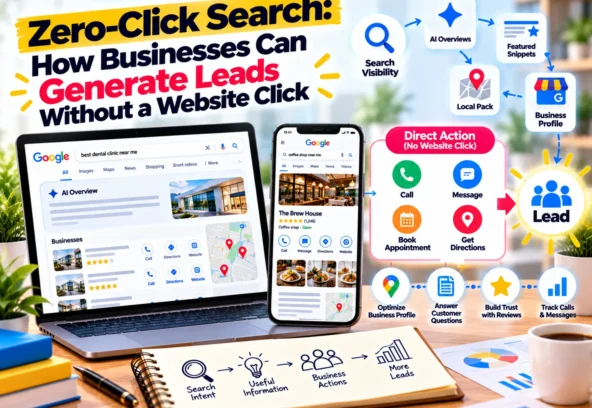
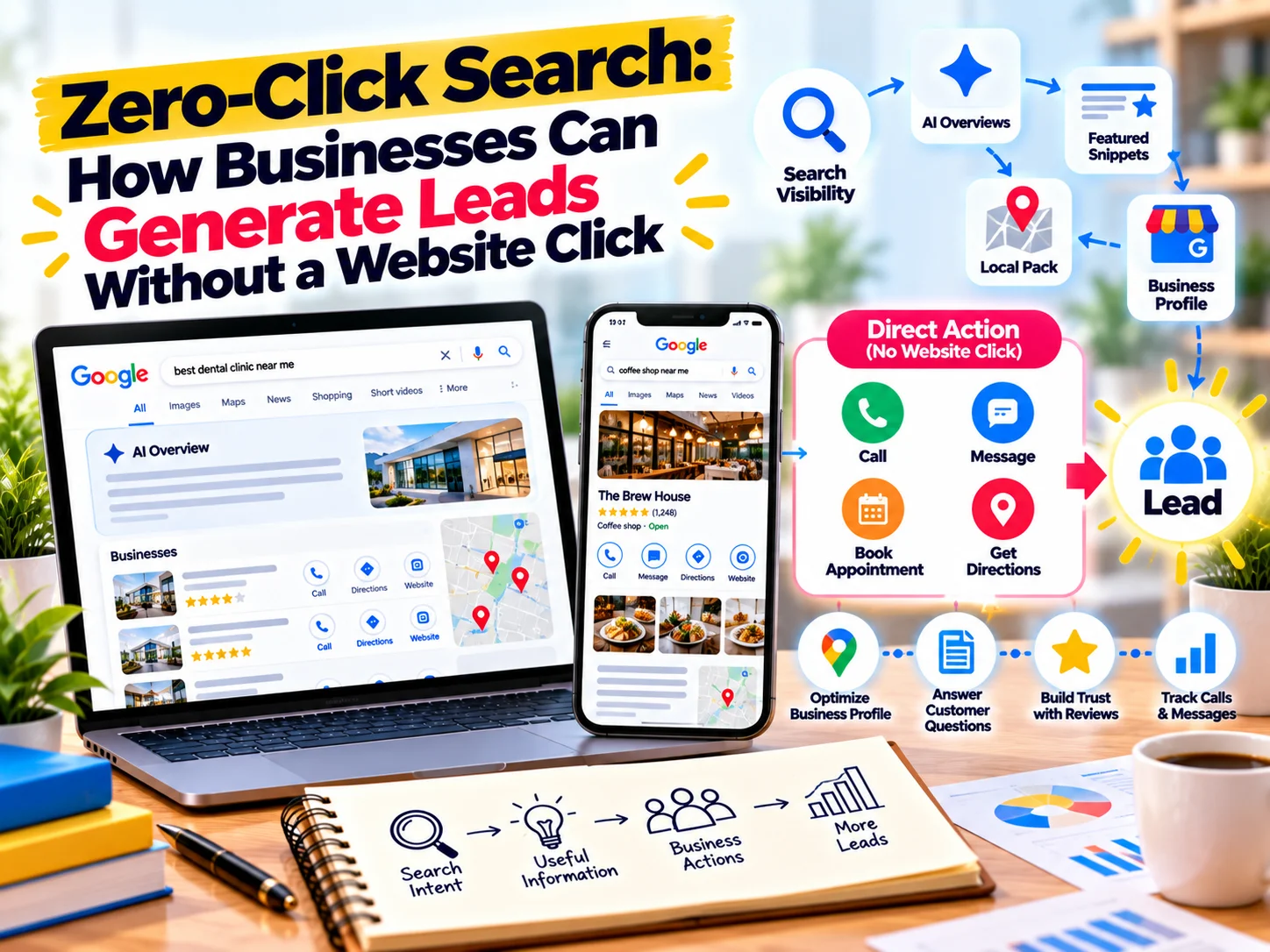
Today, people can discover a business, compare options, read key information, find its location, check reviews, call the business, or take another action directly from search results.
They may never visit the website.
This behaviour is commonly described as zero-click search.
At first, a search without a website click might look like a missed opportunity. However, that isn’t always the case. If someone finds your business information, sees your expertise, checks your reviews, and contacts you directly, the search can still contribute to a lead.
Therefore, modern SEO needs to focus on more than website traffic.
The bigger question is:
How can your business generate visibility, trust, and leads even when users don’t click your website?
Let’s explore how zero-click search works and how businesses can build a strategy around it.
What Is Zero-Click Search?
A zero-click search happens when a person gets the information or action they need directly from a search results page without clicking through to another website.
For example, someone searches:
“Digital marketing agency near me.”
They may immediately see:
- Business listings
- Ratings and reviews
- Opening hours
- Phone number
- Location
- Services
- Photos
- Directions
They can then call or visit the business without opening its website.
Similarly, someone searching:
“What is local SEO?”
may find the answer directly in the search results.
Other searches may show:
- Featured snippets
- Knowledge panels
- Local results
- Maps
- FAQs
- Images
- Videos
- AI-generated search summaries
- Product information
As a result, the traditional journey of search → website → enquiry is no longer the only path.
Why Zero-Click Search Matters for Businesses
Zero-click search doesn’t mean SEO is becoming less valuable.
Instead, it changes where visibility happens.
A potential customer may encounter your business several times before contacting you.
For example:
Google Search
↓
Business Profile
↓
Reviews
↓
Photos
↓
Phone call
↓
Enquiry
The website may not appear in this particular journey.
However, your website can still support the process by providing detailed information, building credibility, and strengthening your overall search presence.
Therefore, businesses should think about search visibility as a complete ecosystem, rather than measuring success only through website sessions.
Zero-Click Search Doesn't Mean Zero-Value Search
This distinction is important.
A zero-click search doesn’t necessarily mean that nothing happened.
Suppose someone searches:
“Packaging design company in Bangalore.”
They see your business in local search.
They read your reviews.
They look at your project images.
They check your phone number.
Then they call you.
There was no website click.
However, there was still a potential lead.
This is why businesses should separate:
Website traffic
from
Search-driven actions.
Both matter, but they represent different stages of customer behaviour.
How Can Zero-Click Search Generate Leads?
There are several ways a business can turn search visibility into actions without requiring a website visit.
1. Phone Calls
For local businesses, phone calls can be one of the most direct conversion paths.
A potential customer may find your business through search and call immediately.
Your Google Business Profile should therefore contain accurate:
- Business name
- Phone number
- Address
- Opening hours
- Service information
- Business category
Make it easy for customers to understand what you do and how they can contact you.
2. Directions and Store Visits
Local businesses can also benefit from searches that lead to physical visits.
For example:
“Interior designers near me”
or
“Best salon near me”
can lead users directly to Maps and directions.
A customer doesn’t necessarily need to visit the website first.
Therefore, local businesses should treat their Google Business Profile as an important customer-facing asset.
3. Direct Messages and Enquiries
Depending on the platform and available features, users may also be able to contact businesses directly.
This creates another opportunity to convert search visibility into enquiries.
The key is to keep business information accurate and make the preferred contact method easy to find.
4. Reviews Can Influence Decisions
Reviews play an important role in local discovery.
Imagine two businesses appear for the same search.
One has:
- Clear business information
- Recent reviews
- Project photos
- Complete services
- Consistent branding
The other has an incomplete profile with little information.
The searcher can make a decision without visiting either website.
Therefore, review management and business-profile optimisation should be part of a broader local SEO strategy.
5. Featured Snippets Can Build Brand Awareness
Some searches produce direct answers at the top of the results.
For example:
“What is technical SEO?”
A search engine may display a concise explanation before the traditional organic results.
If your content provides that answer, your brand can gain visibility even when the searcher doesn’t click immediately.
This creates an important SEO opportunity:
Become a useful source of information, not just a website competing for clicks.
6. AI Search Can Change the Customer Journey
Search is also becoming more conversational.
People increasingly ask longer questions rather than searching only for short keywords.
For example:
“Which digital marketing services does a small manufacturing company need?”
Instead of simply displaying ten blue links, modern search experiences can summarise information and help users explore the topic.
This makes it increasingly important for businesses to create content that clearly explains:
- What they do
- Who they serve
- Which problems they solve
- How their services work
- What makes their approach different
- Where they operate
- What evidence supports their expertise
Clear, structured content can help search systems understand your business and its expertise.
Build Content Around Questions, Not Just Keywords
Traditional SEO often starts with keyword research.
Keyword research remains useful. However, businesses should also think about the questions behind those keywords.
For example, instead of targeting only:
“SEO agency Bangalore”
create useful content around questions such as:
- How does SEO help Bangalore businesses?
- How long does SEO take?
- What does an SEO agency actually do?
- How much does SEO cost?
- What should businesses check before hiring an SEO agency?
This creates a broader topical footprint.
It also gives search engines more useful information to understand and potentially surface.
Create Content That Can Stand Alone
Your content should answer important questions clearly enough that a person can understand the main point without needing to navigate through five different pages.
For example, if you publish:
“What Is Local SEO?”
don’t hide the definition at the bottom of the page.
Start with a clear explanation.
Then provide:
- Examples
- Benefits
- Best practices
- Common mistakes
- FAQs
- Practical steps
This improves usability while also making the content easier to interpret.
Optimise Your Google Business Profile
For local businesses, Google Business Profile deserves special attention.
Make sure your profile includes accurate and consistent information.
Business Information
Check:
- Business name
- Category
- Address
- Phone number
- Website
- Opening hours
Services
Clearly describe your services.
For example, a digital marketing agency might include:
- SEO
- Google Ads
- Social media marketing
- Website development
- Video editing
- Brand identity design
- Packaging design
Photos and Videos
Add useful visual content showing:
- Office
- Team
- Products
- Projects
- Services
- Events
Reviews
Encourage genuine customers to leave reviews.
Most importantly, respond professionally to reviews.
Your profile should give potential customers enough information to understand your business before they ever visit your website.
Make Your Brand Information Consistent
Search engines need to understand who your business is.
Therefore, keep important information consistent across your online presence.
Check your:
- Business name
- Address
- Phone number
- Website
- Service descriptions
- Business categories
- Social profiles
For example, if one platform describes your business as a “Digital Marketing Agency” while another describes it only as a “Web Design Company”, the difference may create unnecessary ambiguity.
A consistent digital presence helps reinforce your brand entity.
Build Strong Brand Signals
Zero-click search makes brand recognition even more important.
Suppose someone sees your company in search today.
They don’t click.
A few days later, they see your brand on Instagram.
Then they notice your name in a LinkedIn post.
Later, they search your company directly.
This is a multi-touch customer journey.
Therefore, your SEO strategy should work together with:
- Social media
- Content marketing
- Video
- Reviews
- Branding
- PR
- Local listings
- Digital advertising
Search visibility becomes stronger when the same brand appears consistently across multiple channels.
Use Structured Data Where Relevant
Structured data helps search engines understand specific information on a page.
Depending on the content, businesses may use relevant structured data for things such as:
- Organisation
- Local business
- Product
- Service
- Article
- Breadcrumbs
- Events
Structured data doesn’t guarantee enhanced search visibility.
However, accurate implementation can help search engines interpret the information on your pages more effectively.
Therefore, use structured data where it genuinely matches the content rather than adding irrelevant markup.
Create Content for Different Search Intents
Not every search is looking for the same thing.
A strong zero-click strategy considers different types of search intent.
Informational
“What is SEO?”
Create educational content.
Commercial Investigation
“SEO agency vs freelancer”
Create comparison and decision-support content.
Local
“SEO agency near me”
Optimise your local presence.
Transactional
“Hire SEO agency Bangalore”
Make your services, contact options, proof, and next steps clear.
Branded
“CreativeKatta reviews”
Make sure your brand information is accurate and consistent across relevant platforms.
This creates a broader search presence.
Turn Search Visibility Into Trust
Visibility alone isn’t enough.
Imagine that a potential customer sees your business in search.
What happens next?
They may check:
- Reviews
- Portfolio
- Case studies
- Social media
- Brand presentation
- Expertise
- Contact details
Therefore, your business needs strong trust signals.
Consider adding:
Client Testimonials
Show genuine customer experiences.
Case Studies
Explain the problem, solution, and outcome.
Portfolio
Show examples of actual work.
Team Information
Introduce the people behind the business.
Industry Experience
Explain your expertise and areas of specialisation.
Together, these elements can reduce uncertainty during the buying process.
Don't Abandon Website SEO
Zero-click search doesn’t mean you should stop trying to generate website traffic.
Your website remains the central source of detailed information for many businesses.
It can provide:
- Service pages
- Product information
- Case studies
- Blog content
- FAQs
- Contact forms
- Lead magnets
- Conversion pages
The goal is not:
Clicks vs zero clicks.
The goal is:
Visibility + trust + action.
Website traffic remains one part of that larger system.
Measure More Than Organic Traffic
Traditional SEO reports often focus on:
- Clicks
- Impressions
- Rankings
- Organic sessions
These metrics remain useful.
However, businesses should also monitor actions that can happen without a website click.
Depending on the business, consider tracking:
- Phone calls
- Direction requests
- Business Profile interactions
- Form enquiries
- Branded searches
- Reviews
- Social mentions
- Direct enquiries
- Leads by source
For example, an increase in local visibility may generate more phone calls even if website traffic remains relatively stable.
That is why SEO reporting should connect visibility with actual business outcomes.
A Practical Zero-Click SEO Strategy
Businesses can start with this simple framework.
Step 1: Identify Your Important Searches
Find the queries customers use to discover your:
- Business
- Products
- Services
- Location
- Expertise
Step 2: Analyse the Search Results
Look at what appears for those searches.
Do you see:
- Maps?
- Featured snippets?
- Videos?
- FAQs?
- AI-generated answers?
- Product results?
- Knowledge panels?
This tells you what type of search experience you need to optimise for.
Step 3: Improve Your Business Information
Make your local listings accurate and complete.
Step 4: Build Question-Based Content
Answer the questions customers ask before they buy.
Step 5: Strengthen Trust Signals
Add reviews, case studies, testimonials, project examples, and useful business information.
Step 6: Improve Your Website
Make sure your website supports the information users discover elsewhere.
Step 7: Track Actions
Measure calls, enquiries, direction requests, leads, and branded searches alongside organic clicks.
Common Zero-Click SEO Mistakes
Focusing Only on Website Traffic
Traffic is important, but it isn’t the only outcome of search visibility.
Ignoring Local Search
Local businesses can lose valuable opportunities by treating Google Business Profile as an afterthought.
Creating Content Only for Keywords
Content should answer real customer questions rather than simply repeating keywords.
Neglecting Reviews
Reviews can influence how customers evaluate businesses during search.
Providing Inconsistent Business Information
Different information across platforms can create confusion.
Forgetting Brand Building
A person may discover your business through search but remember your brand through another channel.
Zero-Click SEO Checklist
Use this checklist to review your current search presence:
Google Business Profile is complete
Business information is accurate
Services are clearly described
Business category is relevant
Recent genuine reviews are available
Reviews receive professional responses
Photos and videos are updated
Website contains clear service information
Important customer questions have dedicated answers
Content covers multiple search intents
Relevant structured data is implemented
Business information is consistent online
Case studies and testimonials are visible
Phone and enquiry options are easy to find
SEO reporting includes conversions and business actions
Frequently Asked Questions
Q. Is zero-click search bad for SEO?
A. Not necessarily.
A search without a website click can still create brand exposure, calls, direction requests, trust, or other customer actions.
The important point is to measure the right outcomes.
Q. How can a local business benefit from zero-click searches?
A. Optimise your Google Business Profile, maintain accurate business information, collect genuine reviews, publish useful content, and make contact options easy to access.
Q. Does zero-click search make websites less important?
A. No.
Websites remain valuable for detailed information, lead generation, credibility, content, and conversions.
However, businesses should also optimise the other places where customers discover them.
Q. How does AI search affect zero-click SEO?
A. AI-powered search experiences can provide users with summaries and answers without requiring a traditional website visit.
Businesses can respond by creating clear, useful, well-structured content that demonstrates their expertise and clearly explains their products, services, and areas of focus.
Q. Should businesses stop focusing on rankings?
A. No.
Rankings, impressions, clicks, and traffic remain useful SEO indicators.
However, businesses should combine them with visibility, engagement, enquiries, calls, and other meaningful business outcomes.
Final Thoughts
Search is no longer simply a path from Google to your website.
Customers can discover your business through local listings, reviews, snippets, videos, maps, branded results, and increasingly conversational search experiences.
Therefore, your SEO strategy should focus on being visible wherever customers make decisions.
The goal isn’t simply to get every person to click.
The goal is to make your business discoverable, useful, credible, and easy to contact.
When your brand provides the right information at the right stage of the search journey, a zero-click search doesn’t necessarily mean a lost opportunity.
It can be the first step toward a conversation.
Want to Build a Stronger Search Presence?
CreativeKatta helps businesses build a complete digital presence through SEO, website development, Google Ads, social media marketing, video editing, brand identity, and creative design.
From traditional Google search to local discovery and emerging AI search experiences, your digital presence should work together as one system.
Build a Search Presence That Turns Visibility Into Business — Talk to CreativeKatta.