
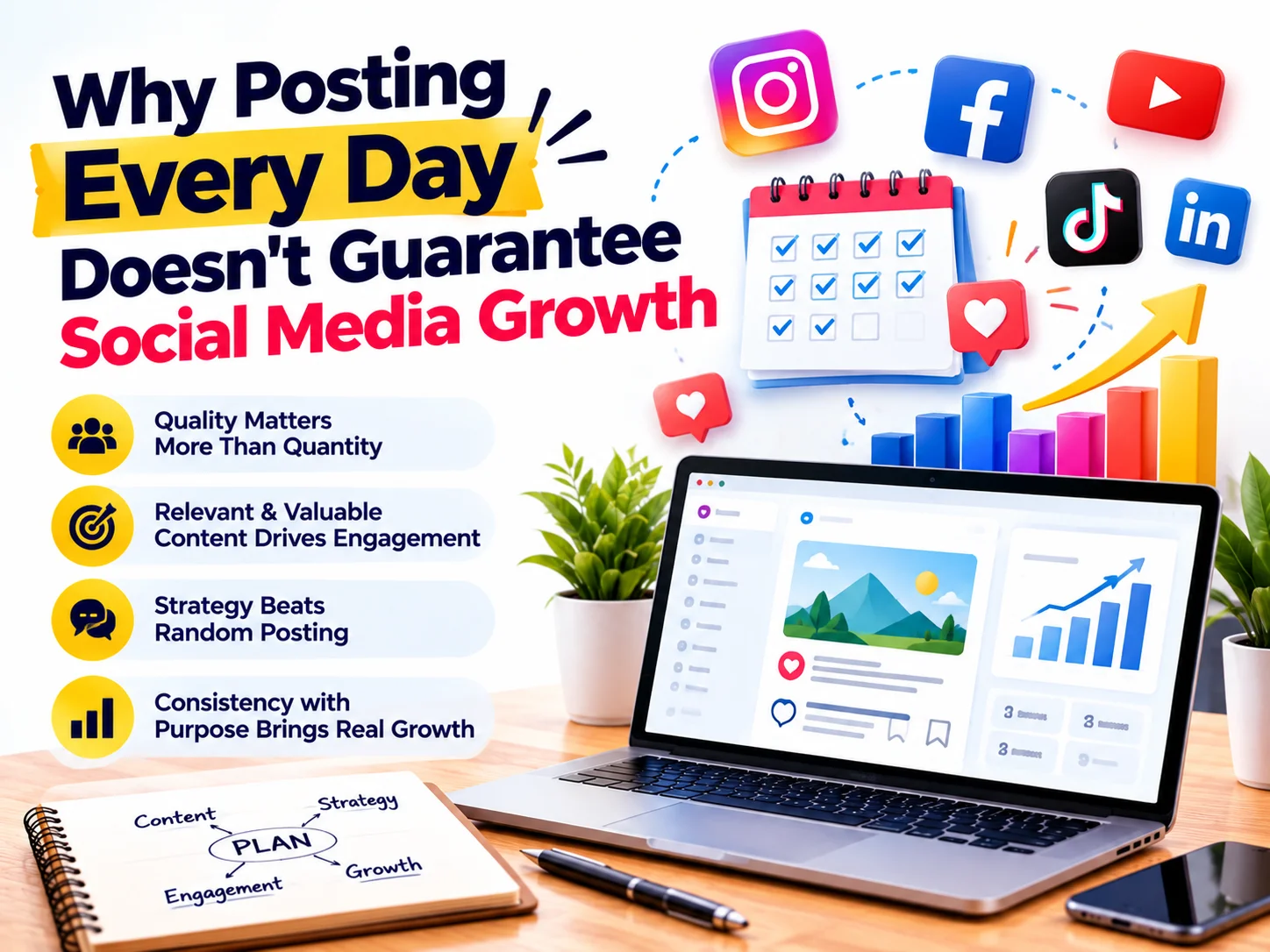
Posting every day sounds like the perfect social media strategy.
Many businesses believe that more posts automatically mean more followers, better engagement, and higher reach.
However, posting more does not always mean growing more.
You can publish content every day and still see little improvement in followers, engagement, website traffic, or enquiries.
Why?
Because social media growth depends on more than frequency.
Your audience also needs useful content, strong creative ideas, consistent branding, meaningful engagement, and a clear strategy.
So, if you’re posting every day but your social media accounts aren’t growing, the problem may not be how often you post.
It may be what you post, who you target, and what you want your content to achieve.
Does Posting Every Day Help Social Media Growth?
Posting consistently can help you stay visible.
However, there is no universal rule that says a business must post every day to grow.
The ideal posting frequency depends on:
- Your audience
- Platform
- Industry
- Content format
- Team capacity
- Content quality
- Business goals
For example, a business may publish three highly useful posts each week and generate more engagement than another business that publishes seven low-value posts.
Therefore, focus on consistent and valuable content, rather than simply increasing the number of posts.
1. More Content Doesn’t Always Mean Better Content
The first problem with daily posting is content quality.
When businesses focus heavily on posting frequency, they may start creating content simply to fill the content calendar.
This can lead to:
- Repetitive posts
- Generic captions
- Stock images
- Weak hooks
- Low-value tips
- Recycled ideas
Eventually, followers may stop paying attention.
Instead, every post should have a purpose.
Ask:
What will the audience learn, feel, or do after seeing this post?
If you cannot answer that question, the post may not need to go live.
2. More Content Doesn’t Always Mean Better Content
The first problem with daily posting is content quality.
When businesses focus heavily on posting frequency, they may start creating content simply to fill the content calendar.
This can lead to:
- Repetitive posts
- Generic captions
- Stock images
- Weak hooks
- Low-value tips
- Recycled ideas
Eventually, followers may stop paying attention.
Instead, every post should have a purpose.
Ask:
What will the audience learn, feel, or do after seeing this post?
If you cannot answer that question, the post may not need to go live.
3. Your Posts May Lack a Strong Hook
Social media users scroll quickly.
Therefore, the first few seconds or first line can determine whether someone stops and pays attention.
Compare:
Weak:
5 Digital Marketing Tips
with:
Stronger:
Your Website Gets Traffic but No Leads? Here Are 5 Things to Check.
The second version creates curiosity and addresses a specific problem.
Strong hooks can include:
- A question
- A surprising fact
- A common mistake
- A customer problem
- A useful promise
- A bold statement
However, make sure the hook accurately represents the content.
4. You’re Creating Content Without a Strategy
Posting every day without a content strategy can quickly become repetitive.
Instead, define your main content pillars.
For a digital marketing company, they could include:
Educational Content
SEO tips, website advice, social media insights, and digital marketing guides.
Problem-Solving Content
Common website, branding, and marketing problems.
Portfolio Content
Completed projects and design work.
Case Studies
Client challenges, solutions, and measurable outcomes where available.
Behind-the-Scenes Content
Team activities, processes, and company culture.
Promotional Content
Services, offers, consultations, and calls to action.
This mix creates variety while keeping your content aligned with business goals.
5. You’re Creating Content Without a Strategy
Posting every day without a content strategy can quickly become repetitive.
Instead, define your main content pillars.
For a digital marketing company, they could include:
Educational Content
SEO tips, website advice, social media insights, and digital marketing guides.
Problem-Solving Content
Common website, branding, and marketing problems.
Portfolio Content
Completed projects and design work.
Case Studies
Client challenges, solutions, and measurable outcomes where available.
Behind-the-Scenes Content
Team activities, processes, and company culture.
Promotional Content
Services, offers, consultations, and calls to action.
This mix creates variety while keeping your content aligned with business goals.
6. You’re Focusing Only on Likes
Likes can provide useful feedback.
However, they are not the only measure of social media performance.
Depending on your business goals, track:
- Reach
- Saves
- Shares
- Comments
- Profile visits
- Website clicks
- Enquiries
- Leads
- Conversion rate
For example, a post with 50 saves and 10 website visits may provide more business value than a post with 500 likes but no meaningful action.
Therefore, measure metrics that connect with your actual objectives.
7. Your Content Is Too Promotional
People don’t usually follow business accounts because they want advertisements every day.
They follow accounts that provide something useful or interesting.
Therefore, avoid turning every post into:
“Buy our service.”
Instead, create a healthy mix of:
Educate → Inform → Entertain → Build Trust → Promote
For example, if you provide SEO services, you could create:
- SEO tips
- Google Search insights
- SEO mistakes
- Website audits
- Client case studies
- Industry trends
- SEO service information
Then, promotional content becomes more natural.
8. You’re Using the Same Content Everywhere
Posting identical content across every platform can save time.
However, each platform has different audience behaviours and content formats.
For example:
Instagram: Visual storytelling, reels, carousels, short-form content
LinkedIn: Professional insights, case studies, industry opinions, business content
Facebook: Community-focused posts, videos, updates, and discussions
YouTube: Longer educational videos and demonstrations
Therefore, adapt your content instead of simply copying and pasting it everywhere.
9. Your Visual Identity Is Inconsistent
A strong social media presence should feel recognizable.
If every post uses different:
- Colors
- Fonts
- Layouts
- Image styles
- Graphic styles
your audience may struggle to identify your content.
Instead, create a simple visual system.
Use consistent:
- Brand colors
- Typography
- Logo placement
- Graphic elements
- Image style
- Post templates
This creates stronger visual recognition over time.
10. You Aren’t Giving Content Enough Time to Work
Some content needs time.
A useful educational post may continue generating:
- Shares
- Saves
- Comments
- Profile visits
- Website traffic
long after publication.
Therefore, don’t immediately assume that a post failed simply because it did not perform strongly within the first few hours.
Review your content performance over a longer period and identify patterns.
11. You’re Not Learning From Your Analytics
Social media analytics can show what your audience actually responds to.
Look for patterns such as:
- Which topics get the most saves?
- Which posts generate shares?
- Which videos retain viewers?
- Which posts drive profile visits?
- Which content generates website traffic?
- Which formats generate enquiries?
Then, use those insights to improve future content.
This creates a simple cycle:
Create → Measure → Learn → Improve → Repeat
12. You Don’t Have a Clear Business Goal
Social media growth means different things to different businesses.
Your goal might be:
- Brand awareness
- Website traffic
- Lead generation
- Product sales
- Community building
- Recruitment
- Customer education
Therefore, define your goal before creating content.
For example:
Goal: Generate website enquiries.
Your content strategy could focus on:
Educational content → Problem awareness → Case studies → Trust → CTA
This approach makes your social media activity more purposeful.
Quality vs Quantity: What Should Businesses Focus On?
The answer isn’t simply “post less.”
Instead, focus on sustainable consistency.
For example:
Approach | Likely Challenge |
7 low-value posts/week | Content fatigue |
1 post/month | Low consistency |
3–5 useful posts/week | More manageable consistency |
Strategic content calendar | Clearer direction |
Your ideal frequency depends on your audience, platform, resources, and goals.
The important point is this:
Consistency should support quality, not replace it.
A Better Social Media Strategy
Instead of asking:
“How many times should we post?”
ask:
“What content will help our audience and support our business goals?”
Then build your strategy around five steps.
Step 1: Define Your Audience
Understand:
- Who they are
- What they need
- What problems they face
- What questions they ask
- What influences their buying decisions
Step 2: Choose Content Pillars
Create 4–6 recurring themes that match your audience and services.
Step 3: Create Different Formats
Experiment with:
- Reels
- Carousels
- Static posts
- Stories
- Videos
- Case studies
- Infographics
- Polls
Step 4: Add Clear CTAs
Depending on the post, ask people to:
- Save
- Share
- Comment
- Visit your website
- Download a resource
- Send a message
- Request a consultation
Step 5: Measure and Improve
Review your analytics regularly.
Then, create more of what works.
How Often Should a Business Post on Social Media?
There is no single posting frequency that works for every business.
Instead, choose a schedule your team can maintain without sacrificing quality.
For example, you could start with:
3–4 quality posts per week
Then add:
- Stories
- Short videos
- Community engagement
- Occasional promotional content
Most importantly, test your schedule and adjust it based on audience response and business results.
Social Media Content Ideas for Growing Businesses
If you’re struggling to create useful content every day, try these ideas:
Educational
- 5 common mistakes
- Quick industry tips
- How-to guides
- FAQs
- Myths vs facts
Problem-Solving
- Why your website isn’t generating leads
- Why your ads aren’t converting
- Why your social media reach has dropped
Trust-Building
- Client testimonials
- Case studies
- Portfolio projects
- Team introductions
- Behind-the-scenes content
Engagement
- Questions
- Polls
- Opinions
- Quizzes
- Industry discussions
Promotional
- Service highlights
- New launches
- Offers
- Consultations
- Product demonstrations
This approach gives you more content variety without posting simply for the sake of posting.
Frequently Asked Questions
Does posting every day increase social media followers?
Not necessarily. Posting consistently can help maintain visibility, but follower growth also depends on content quality, relevance, audience targeting, engagement, platform behaviour, and overall strategy.
How often should a small business post on social media?
There is no universal number. A sustainable schedule of several useful posts per week can work well for many businesses, but the right frequency depends on the platform, audience, resources, and goals.
Is quality more important than quantity on social media?
Quality and consistency work together. High-quality content provides value, while consistent publishing helps maintain an active presence. Posting frequently without useful content can reduce audience interest.
What should a business post on social media?
Businesses can combine educational content, problem-solving posts, case studies, testimonials, behind-the-scenes content, engagement posts, and promotional content.
Which social media metrics should businesses track?
Track metrics that match your goals. These can include reach, engagement, saves, shares, profile visits, website clicks, enquiries, leads, and conversions.
Why is my social media engagement low even though I post regularly?
Low engagement can result from irrelevant content, weak hooks, repetitive topics, limited audience interaction, inconsistent visuals, or content that doesn’t address your audience’s needs.
Final Thoughts
Posting every day can keep your social media account active.
However, activity alone doesn’t guarantee growth.
Your audience needs content that solves problems, answers questions, provides useful information, or creates meaningful interaction.
Therefore, instead of asking:
“Did we post today?”
ask:
“Did we give our audience a reason to care today?”
A strong social media strategy combines quality content, consistent publishing, audience understanding, engagement, creative formats, and measurable business goals.
When these elements work together, your social media presence becomes more than a content calendar.
It becomes a valuable part of your marketing strategy.
Build a Social Media Strategy That Supports Business Growth
At CreativeKatta, we help businesses build strategic social media presence through social media marketing, creative design, content strategy, video content, branding, and digital marketing.
Instead of simply filling your content calendar, we focus on creating content that communicates your brand, engages your audience, and supports your business objectives.
Ready to make your social media more strategic?
Talk to CreativeKatta today and build a social media strategy focused on meaningful content, stronger engagement, and business growth.