
Your website is often the first place potential customers visit before choosing your business. It introduces your brand, explains your services and helps people decide whether they can trust you. Therefore, your website needs to do more than look attractive. It should also provide a smooth user experience, communicate your value clearly and make it easy for visitors to contact you.
However, customer expectations, technology and business goals change over time. A website that worked well a few years ago may no longer reflect your brand or meet your customers’ needs. For example, outdated layouts, slow loading speeds, confusing navigation and poor mobile experiences can make visitors leave before exploring your services.
So, how do you know when it is time for a website redesign?
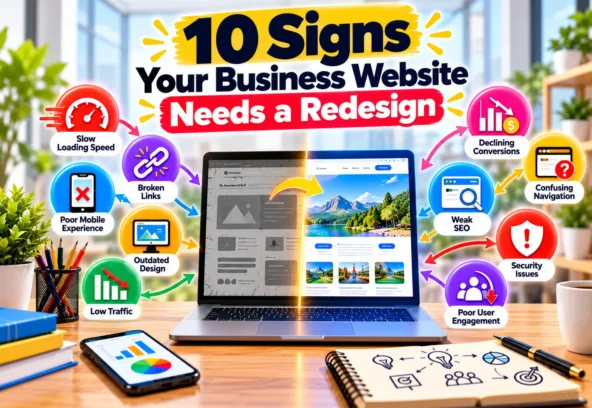
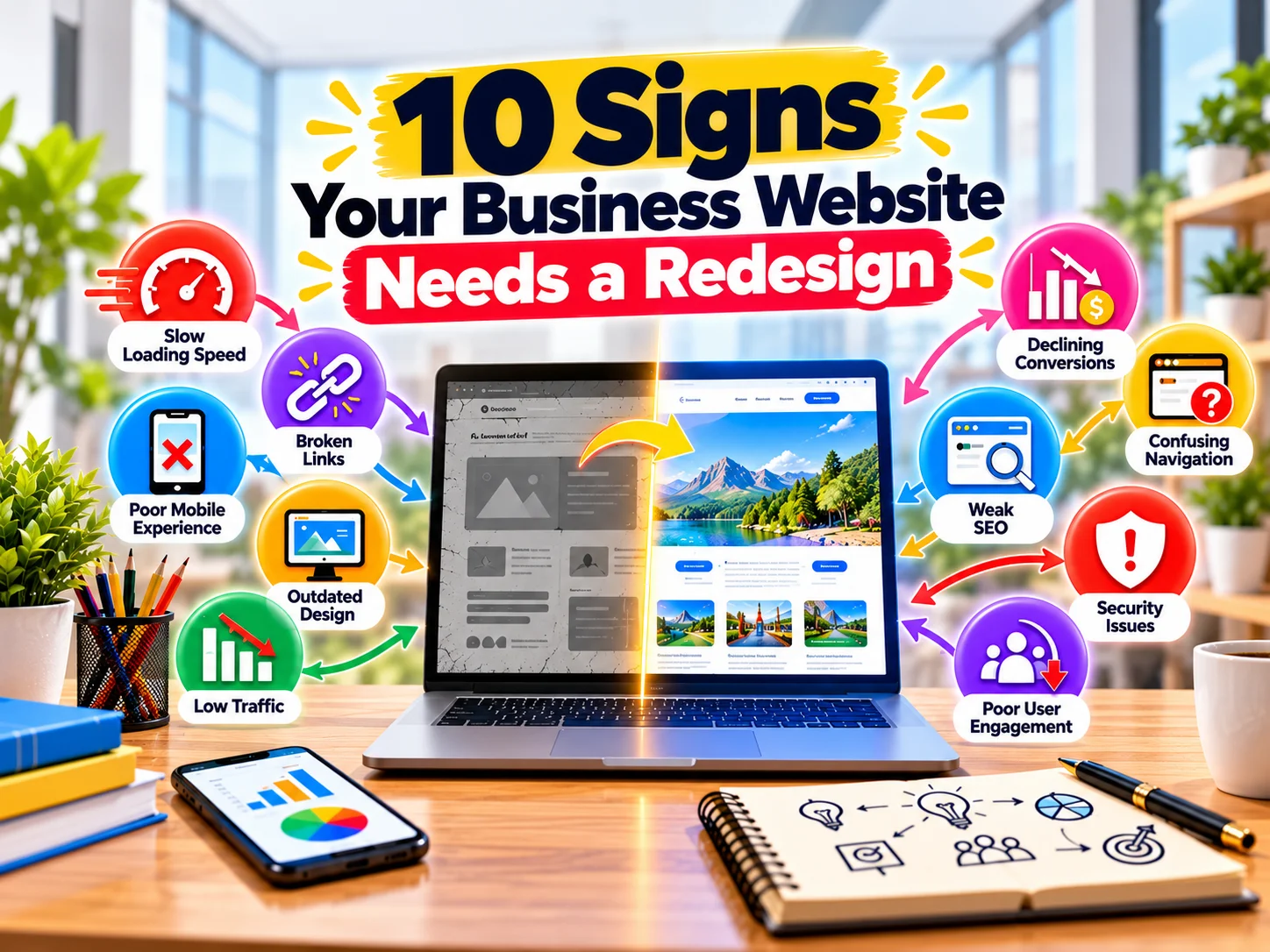
In this guide, we explore 10 signs your business website needs a redesign, explain why they matter and share practical ways to improve your website’s design, performance, usability and search visibility.
Why Is Website Redesign Important for Your Business?
A professional business website supports your marketing, builds credibility and helps potential customers understand what you offer. Moreover, it provides a central place to showcase your services, answer customer questions and generate enquiries.
A website redesign involves more than changing colours, images or fonts. Instead, it reviews your website’s overall structure, content, functionality, user experience and technical performance.
When planned carefully, a website redesign can help you:
- Create a modern and consistent brand identity.
- Improve navigation and mobile usability.
- Make important business information easier to find.
- Strengthen your website’s SEO foundations.
- Improve calls to action and enquiry journeys.
- Support your changing business goals.
However, a redesign alone does not guarantee higher rankings or more sales. The best results come from understanding existing problems and making improvements based on user needs, website data and business objectives.
10 Signs Your Business Website Needs a Redesign
1. Your Website Design Looks Outdated
First impressions matter. When visitors land on your website, its design influences how they perceive your business.
An outdated layout, inconsistent typography, low-quality images or mismatched colours may make your brand appear less professional. Similarly, excessive animations, crowded sections and old-fashioned design elements can distract visitors from your message.
For instance, imagine a potential customer comparing two service providers. One has a clean, modern website with clear service information, while the other has cluttered pages and outdated visuals. Although design alone does not determine quality, the first website may communicate greater attention to detail.
How a website redesign helps: Refresh the visual identity, improve spacing, use consistent typography and create a clear content hierarchy. In addition, make sure your design reflects your current brand positioning and audience expectations.
Ultimately, your website should communicate what makes your business valuable rather than simply follow design trends.
2. Your Website Does Not Work Well on Mobile Devices
Today, people browse websites using smartphones, tablets, laptops and desktop computers. Therefore, your website must provide a comfortable experience across different screen sizes.
If visitors need to zoom in to read text, struggle to tap buttons or scroll sideways to view content, they may leave without contacting you. Furthermore, mobile usability problems can make it harder for search engines to deliver a satisfying experience to users.
Check your website on several devices. Are the menus easy to use? Do the images fit the screen? Can visitors complete forms without difficulty? Most importantly, can they find your phone number or enquiry button quickly?
How a website redesign helps: Responsive website design adapts page layouts to different screen sizes. It also improves text readability, button spacing, navigation and form usability.
Consequently, a mobile-friendly website makes it easier for potential customers to explore your business wherever they are.
3. Your Website Loads Slowly
A visually appealing website can still lose visitors if its pages take too long to load. People generally expect websites to respond quickly, especially when they are searching for a product, service or business contact.
Large images, unnecessary scripts, excessive plugins, inefficient code and poor server response can all affect website speed. However, the actual cause depends on your website’s setup and should be investigated before making changes.
You can start by testing important pages using Google PageSpeed Insights. The report highlights performance issues and suggests possible improvements.
How a website redesign helps: Review image sizes, optimise media, reduce unnecessary scripts and improve the way pages load. Where appropriate, refine the website’s code, hosting configuration and caching setup.
Additionally, check Core Web Vitals, including loading performance, responsiveness and visual stability. These metrics help you understand aspects of the real-world user experience.
A faster website can make browsing more comfortable. Nevertheless, speed improvements should be measured rather than assumed after a redesign.
4. Visitors Struggle to Find Information
A good website helps visitors find what they need without unnecessary effort. However, complicated menus, unclear page titles, poorly organised services and crowded layouts can make navigation frustrating.
For example, if visitors cannot quickly understand what your business offers, who you serve or how to request a quotation, they may look elsewhere.
This problem often develops as businesses grow. New services, products and pages get added over time, but the original website structure remains unchanged.
How a website redesign helps: Organise your content around customer needs. Use descriptive navigation labels, logical service categories, clear headings and relevant internal links. In addition, place essential information, such as contact details and enquiry options, where visitors can easily find it.
A well-structured website helps users understand your offerings and move naturally from discovering your business to taking action.
5. Your Website Is Not Generating Enough Enquiries
Website traffic is useful, but traffic alone does not tell the whole story. If people visit your website without calling, submitting enquiry forms, requesting quotations or taking another meaningful action, something may need attention.
However, low enquiries do not automatically mean your website design is the problem. Your traffic quality, pricing, offer, competition, content and target audience may also influence conversions.
Start by examining your customer journey. Are your services explained clearly? Do visitors understand the benefits? Are enquiry forms too long? Is the contact button visible? Does your content answer common customer questions?
How a website redesign helps: Create clearer calls to action, simplify enquiry forms and present relevant information near decision-making points. For example, buttons such as “Request a Quote”, “Discuss Your Project” or “Contact Our Team” can guide visitors towards the next step.
Moreover, use analytics and conversion tracking to identify where users leave the journey. This allows you to prioritise improvements based on evidence rather than guesswork.
6. Your Website Content No Longer Reflects Your Business
Your business may have evolved since your website was first developed. Perhaps you have introduced new services, entered different markets, updated your branding or started targeting a new audience.
Nevertheless, your website may still contain outdated descriptions, old team information, discontinued services or messaging that no longer represents your business.
As a result, potential customers may misunderstand what you offer or overlook services that are now important to your business.
How a website redesign helps: Review your website content before changing the design. Update your service descriptions, company information, project examples, testimonials and calls to action. In addition, ensure that the homepage communicates your current value proposition clearly.
A redesign is also an opportunity to improve content readability. Short paragraphs, descriptive headings, relevant examples and straightforward language help visitors understand your message.
Most importantly, your website should reflect the business you are today, not the business you were when it launched.
7. Your Website Is Not Supporting Your SEO Goals
Search engine optimisation involves much more than adding keywords to a page. Search engines need to understand your content, while users need useful information that matches their search intent.
If your website has confusing URLs, duplicated content, missing page titles, weak internal linking, poorly organised headings or technical issues, it may be harder to maintain a strong search presence.
Likewise, a website that does not clearly explain its services may miss opportunities to connect with people searching for relevant solutions.
How a website redesign helps: Build SEO considerations into the planning process. Organise pages around relevant search topics, write descriptive title tags and meta descriptions, use logical heading structures and connect related pages through useful internal links.
For example, a website development company in Bangalore can create clear service pages covering business website development, WordPress website development, e-commerce website development and website redesign services.
Additionally, review existing organic traffic and indexed pages before changing URLs. If URLs must change, implement appropriate redirects to help users and search engines reach the correct pages.
Remember, a redesign creates an opportunity to improve SEO foundations; it does not guarantee higher rankings. Content quality, competition, backlinks, technical health and ongoing optimisation also matter.
8. Your Website Looks Inconsistent With Your Brand
Your website is an important part of your brand identity. Therefore, its colours, typography, imagery, tone of voice and messaging should align with your other business communications.
However, if your social media profiles, advertisements, brochures and website look unrelated, customers may find it harder to recognise your brand. Similarly, an old logo or inconsistent service descriptions can create confusion.
For example, a company that positions itself as a modern technology provider may struggle to communicate that message through an outdated website with inconsistent visuals and unclear content.
How a website redesign helps: Establish consistent visual guidelines, update brand imagery and refine the messaging across key pages. In addition, make sure your website reflects your current positioning and speaks to the audience you want to attract.
A consistent digital presence helps create a more recognisable and cohesive brand experience.
9. Your Website Is Difficult to Update or Maintain
Your website should make it practical to publish new content, update service information and maintain essential functionality. However, an outdated content management system, incompatible plugins or a complicated editing process can make even small changes difficult.
Over time, these challenges may delay updates and create unnecessary maintenance work. Furthermore, unsupported software and neglected plugins can introduce security and compatibility risks.
How a website redesign helps: Review your current platform, themes, plugins and integrations. Where necessary, simplify the setup, improve the content management workflow and update outdated components.
For businesses using WordPress, a properly planned website can make it easier to manage pages, publish blogs and maintain service information without rebuilding the entire website for every change.
Nevertheless, a complete redesign is not always necessary. Sometimes, targeted technical improvements, software updates or a better editing workflow can solve the problem more efficiently.
10. Your Website No Longer Supports Your Business Goals
Finally, consider whether your website still supports your current business strategy.
Perhaps your business has moved from offering a single service to providing several solutions. Alternatively, you may want to reach a new audience, launch an online store, attract B2B enquiries or promote a new service.
If your website structure and functionality do not support these goals, it may limit how effectively you communicate with potential customers.
For example, an established company may need detailed service pages, project portfolios, downloadable resources and enquiry forms. Meanwhile, an e-commerce business may need improved product categories, product filters and a smoother checkout experience.
How a website redesign helps: Begin with your business objectives and identify the functionality, content and user journeys needed to support them. Then create a website structure that accommodates current requirements while allowing for future improvements.
In this way, your website becomes a more useful business asset rather than simply an online presence.
Website Redesign Checklist: Does Your Business Need One?
Before investing in a complete website redesign, review these common warning signs.
- My website design no longer reflects my brand.
- My website is difficult to use on mobile devices.
- Important pages load slowly or have performance issues.
- Visitors struggle to find services and contact information.
- My website receives visits but generates few relevant enquiries.
- My content contains outdated or incomplete information.
- My website has SEO or technical issues that need attention.
- My visual identity is inconsistent across digital channels.
- Updating content or maintaining functionality is difficult.
- My website does not support my current business goals.
If several points apply to your website, consider conducting a website audit. The findings can help you decide whether you need a complete redesign, a technical upgrade or a series of targeted improvements.
Website Redesign vs Website Refresh: Which Do You Need?
Not every website problem requires a complete rebuild. In fact, choosing the right approach can save time, effort and budget.
Website refresh | Complete website redesign |
Updates colours, typography and selected visual elements | Reconsiders the overall design and user experience |
Improves specific sections or pages | May restructure the sitemap and page layouts |
Addresses limited usability or content issues | Addresses broader design, content and functionality problems |
Usually involves a narrower scope | May require extensive planning, development and testing |
A website refresh may be suitable when your website structure and functionality remain effective. On the other hand, a complete redesign may be more appropriate when several issues affect usability, brand presentation, technical performance or business objectives.
Therefore, assess your current website before deciding which option offers the most value.
What Should a Modern Business Website Include?
Once you identify the problems, the next step is to plan a website that serves both your audience and your business.
A modern business website should include:
- Clear value proposition: Explain what your business does, who it serves and why customers should consider your services.
- Responsive website design: Make pages accessible and comfortable to use across mobile devices, tablets and desktops.
- Intuitive navigation: Help visitors find your services, portfolio, company information and contact details.
- Useful, SEO-friendly content: Answer customer questions with relevant information, descriptive headings and logical page structure.
- Strong calls to action: Give visitors clear next steps, such as requesting a quotation or contacting your team.
- Trust-building elements: Showcase genuine testimonials, relevant projects, credentials and business information.
- Performance-conscious development: Address loading speed, image optimisation, accessibility and technical reliability.
- Analytics and tracking: Measure relevant actions, including form submissions, calls and other enquiry conversions.
Furthermore, your website should be easy to maintain and flexible enough to accommodate future changes. A thoughtful combination of design, content, functionality and technical planning helps create a more useful online experience.
How CreativeKatta Helps Businesses Redesign Their Websites
At CreativeKatta, we combine creative thinking, website design and development to help businesses build a stronger digital presence. Our approach focuses on more than appearance. We also consider usability, content structure, responsive design, functionality and SEO-friendly foundations.
Whether you need to update an existing website or develop a new digital experience, we can tailor the approach to your business requirements.
Our website design and development services can include:
Website design and UI/UX improvements: Create a professional visual experience with clear layouts, consistent branding and intuitive navigation.
Responsive website development: Improve the browsing experience across mobile phones, tablets and desktop screens.
WordPress website development: Build manageable websites that allow businesses to update pages and publish content as needed.
SEO-friendly website structure: Organise content, headings, page hierarchy and internal links to support discoverability.
Business and e-commerce websites: Develop digital experiences suited to your services, products, customers and business objectives.
Website redesign and improvement: Review existing websites and identify opportunities to improve their design, content, usability and functionality.
Explore our website design and development services to learn more about how we approach business websites and redesign projects.
Our Work: Website Design Projects by CreativeKatta
A website redesign should reflect the business it represents. Therefore, reviewing relevant website projects can help you understand how layout, content, branding and functionality work together.
At CreativeKatta, our portfolio includes website projects across different business categories, including industrial businesses, product brands, corporate websites and landing pages.
Here are a few projects you can explore:
Yuvita Naturals — E-commerce Website
A skincare e-commerce website focused on presenting products and supporting online product discovery.
Website: https://yuvitanaturals.com/
Paragon Engineers — Industrial Website
A website for an electrical manufacturer, presenting its products, expertise and business information.
Website: https://paragonengineers.com/
Olla Mamma — Landing Page
A landing page for a kidswear brand, designed to present the brand and its offering in a focused format.
Website: https://ollamamma.com/
Logispace Realty — Industrial Real Estate Website
A website presenting industrial real estate and logistics-related services for businesses exploring suitable spaces.
Website: https://logispacerealty.com/
These examples demonstrate different website requirements, from product discovery to industrial information and focused landing pages.
Explore more projects in Our Work portfolio to discover the types of websites and creative solutions we develop.
When Is the Right Time to Redesign Your Website?
The right time depends on your website’s current performance, your business goals and the problems you need to solve.
However, you should consider a review when your website no longer reflects your brand, visitors struggle to use it, important pages perform poorly or your business has outgrown its existing structure.
Before committing to a redesign, review your website analytics, search performance, customer feedback and enquiry journey. This information can help you distinguish between cosmetic issues and deeper technical or strategic problems.
Most importantly, avoid redesigning your website simply because a new design trend has appeared. Instead, focus on improvements that make your website more useful to customers and better aligned with your business objectives.
Ready to Give Your Business Website a Fresh Start?
Your website should grow alongside your business. If it looks outdated, feels difficult to use or no longer supports your marketing goals, a well-planned redesign can help you move forward.
At CreativeKatta, we help businesses create modern, responsive and user-friendly websites with clear content, thoughtful design and practical functionality.
Whether you need a complete website redesign or improvements to your existing website, start by identifying what is not working and what you want to achieve next.
Let’s build a website that reflects your brand and supports your business goals.
Explore CreativeKatta’s website design and development services or view our portfolio to get started.
You can also visit CreativeKatta to learn more about our creative and digital services.
Frequently Asked Questions
1. How do I know if my business website needs a redesign?
Your business website may need a redesign if it looks outdated, performs poorly on mobile devices, loads slowly, has confusing navigation, contains outdated information or fails to support your current business goals. Review analytics and customer feedback to identify the underlying problems before deciding on the right solution.
2. How often should a business website be redesigned?
There is no fixed schedule for redesigning a website. Instead, review its usability, security, performance, content and business relevance regularly. A website may need significant changes sooner if technology, customer expectations or business requirements change.
3. Does redesigning a website improve SEO?
A redesign can support SEO by improving site structure, mobile usability, performance, content organisation and technical foundations. However, it does not automatically improve rankings. Preserve valuable URLs where possible, implement redirects when necessary and monitor indexing and organic traffic after launch.
4. How much does website redesign cost in Bangalore?
The cost of website redesign in Bangalore depends on the number of pages, design complexity, content requirements, integrations and functionality. A simple visual refresh generally requires a smaller scope than a complete redesign involving custom layouts, e-commerce features or extensive technical changes. Contact CreativeKatta to discuss your requirements and obtain a project estimate.
5. Can I redesign my WordPress website without losing SEO rankings?
Yes, you can redesign a WordPress website while taking steps to protect its existing SEO value. Preserve important URLs where practical, maintain useful content, review metadata, configure redirects for changed URLs and check indexing after launch. Nevertheless, ranking changes are possible, so monitoring is essential.
6. What is the difference between website redesign and website development?
Website development involves creating the website’s structure, functionality and technical implementation. Website redesign focuses on improving an existing website’s appearance, usability, structure or functionality. Depending on the project, a redesign may also involve substantial redevelopment.
7. Can a website redesign help generate more enquiries?
A redesign can make it easier for visitors to understand your services, find relevant information and contact your business. Clear calls to action, useful content and simpler enquiry journeys may support conversions. However, actual results also depend on traffic quality, your offering, pricing and other business factors.