
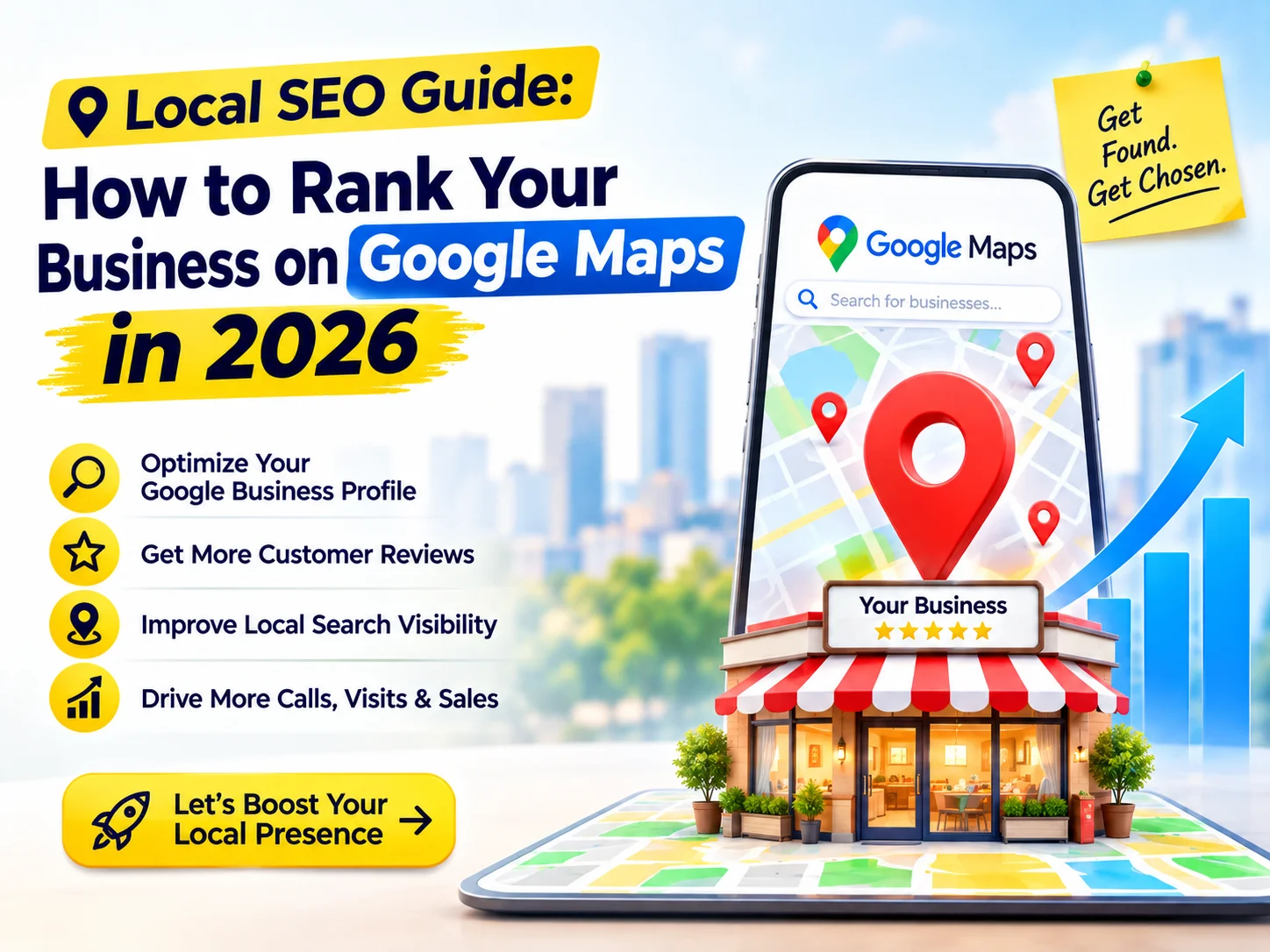
When someone searches for “digital marketing agency near me,” “best restaurant nearby,” “plumber in Bengaluru,” or another location-based service, Google often displays businesses through Google Maps and the Local Pack.
For local businesses, appearing prominently in these results can mean more calls, website visits, enquiries, directions and customers.
That is why Google Maps SEO and local SEO are essential parts of a modern digital marketing strategy in 2026.
The good news is that ranking on Google Maps is not about adding keywords everywhere or trying to manipulate Google’s algorithm. Instead, it is about giving Google accurate, relevant and trustworthy information about your business while creating a useful experience for potential customers.
In this guide, you’ll learn how to rank your business on Google Maps, how to optimize your Google Business Profile, how reviews and local citations contribute to visibility, and how to prepare your local business for AI-powered search.
What Is Local SEO?
Local SEO is the process of optimizing your online presence so that your business can appear for searches connected to a specific geographic location.
For example, instead of targeting only:
- Digital marketing agency
- Dental clinic
- Interior designer
- Restaurant
a local SEO strategy can target searches such as:
- Digital marketing agency in Bengaluru
- Dental clinic in Indiranagar
- Interior designer in Bangalore
- Best restaurant near me
Traditional SEO helps businesses reach a broader audience. In contrast, local SEO focuses on reaching people who are searching for products or services in a particular area.
Therefore, local SEO is especially valuable for businesses that serve customers within specific cities, neighbourhoods or service areas.
Why Google Maps Ranking Matters for Local Businesses
Google Maps is often one of the first places people encounter a local business.
When a potential customer searches for a product or service, Google may display a map and a group of local businesses before the traditional organic results.
A strong Google Maps presence can help your business generate:
- More local visibility
- More phone calls
- More website visits
- More requests for directions
- More enquiries
- More store visits
- Greater brand awareness
- More opportunities to convert local searchers into customers
However, simply creating a Google Business Profile does not guarantee top placement.
Instead, businesses need to build a consistent local search presence across their Google Business Profile, website, reviews, citations and other relevant online sources.
How Does Google Decide Which Businesses Rank on Maps?
Google explains that local results are primarily based on relevance, distance and prominence.
Understanding these three concepts is the starting point for a successful Google Maps SEO strategy.
1. Relevance
Relevance refers to how closely a business matches what the user is searching for.
For example, if someone searches for:
“web design company in Bengaluru”
Google needs to understand which businesses actually provide web design services in Bengaluru.
Consequently, your business information should clearly explain:
- What your business does
- Which services you provide
- Which products you offer
- Where you serve customers
- What makes your business relevant to local searches
Complete and accurate business information helps Google better understand your business and match it with relevant searches.
2. Distance
Distance refers to how far the business is from the searcher or the location included in the search.
For example, a person searching for “coffee shop near me” may receive different results depending on where they are located.
Importantly, distance is something businesses cannot completely control.
Instead, focus on making your business information accurate and building strong local relevance for the areas you genuinely serve.
3. Prominence
Prominence relates to how well-known a business is.
Google can consider information from across the web, including links, reviews and other references to the business. Google also notes that review count and positive ratings can contribute to local ranking.
Therefore, building a reputable business presence both online and offline can support your local SEO strategy.
Step-by-Step Guide to Ranking Your Business on Google Maps
Step 1: Create and Verify Your Google Business Profile
Your Google Business Profile (GBP) is one of the most important assets for local search visibility.
If you operate an eligible local business, start by claiming and verifying your profile.
Once verified, make sure your information is complete and accurate.
Optimize These Google Business Profile Elements
Business Name
Use your real-world business name.
Avoid adding unnecessary keywords to your business name simply to influence rankings.
For example, don’t turn:
CreativeKatta
into:
CreativeKatta – Best SEO Company in Bengaluru – Digital Marketing Agency
unless that is genuinely your business’s real-world name.
Keyword stuffing can create a poor user experience and may violate Google’s guidelines.
Primary Category
Choose the category that most accurately represents your main business.
Your primary category helps Google understand what your business does and which searches may be relevant.
You can also add appropriate secondary categories where applicable.
Business Description
Write a natural, informative description explaining:
- What you offer
- Who you serve
- Your main services
- Your service area
- What differentiates your business
Include important keywords naturally rather than repeating them unnecessarily.
Address and Service Area
Keep your business location and service-area information accurate.
Do not create fake locations simply to target additional cities.
Opening Hours
Keep your regular hours and special holiday hours updated.
Accurate hours are important because customers use Google Search and Maps to decide when and where to visit a business.
Google specifically recommends keeping business information such as addresses, hours and categories complete and accurate.
Photos and Videos
Add useful, high-quality visual content such as:
- Exterior photographs
- Interior photographs
- Products
- Services
- Team photographs
- Completed projects
- Before-and-after examples
- Videos
Visual content can help potential customers understand your business before they contact you.
Products and Services
Where applicable, add your products and services with clear descriptions.
This gives both customers and search systems additional context about what your business provides.
Step 2: Keep Your Business Information Consistent Everywhere
Local SEO is not limited to Google.
Your business information can appear across websites, directories, social profiles, industry portals and other online sources.
Google explains that information in local listings can come from multiple sources, including public web content, third-party data, user contributions and business owners.
Therefore, make sure your core business information is consistent.
This commonly includes:
NAP = Name + Address + Phone Number
Check your information across:
- Google Business Profile
- Your website
- Bing
- Industry directories
- Local directories
- Review websites
- Business portals
- Relevant professional associations
For example, avoid having three different versions of your company name or phone number across important listings.
Why Local Citations Matter
A local citation is an online mention of your business information.
Quality citations from relevant and trustworthy websites can help create a stronger, more consistent online presence.
However, don’t focus on collecting hundreds of low-quality directory links.
Instead, prioritize relevant, trustworthy and genuine business listings.
Step 3: Build a Strong Google Review Strategy
Reviews are important for both local visibility and customer decision-making.
Google notes that review count and positive ratings can contribute to local ranking.
More importantly, reviews provide social proof.
A potential customer may compare:
Business A: 4.8 stars with detailed recent reviews
versus
Business B: 4.1 stars with very few reviews.
The first business may immediately appear more trustworthy.
How to Get More Genuine Reviews
Ask satisfied customers for feedback after completing a project or delivering a service.
You can share your review link through:
- SMS
- Invoices
- Receipts
- Follow-up messages
- Your website
- Social media
However, avoid buying fake reviews or manipulating customers into leaving misleading feedback.
Respond to Your Reviews
Make review responses useful and genuine.
For positive reviews:
- Thank the customer
- Mention something specific about their experience
- Keep the response natural
For negative reviews:
- Stay professional
- Acknowledge the concern
- Avoid arguing publicly
- Offer a way to resolve the issue
A thoughtful response can also demonstrate to future customers that your business takes feedback seriously.
Step 4: Optimize Your Website for Local SEO
Your Google Business Profile and website should work together.
A strong website gives Google and potential customers additional information about your business, services and locations.
Important Local SEO Elements for Your Website
Use Location-Relevant Page Titles
For example:
Digital Marketing Agency in Bengaluru | CreativeKatta
rather than:
Home | CreativeKatta
when the latter does not communicate the page’s purpose.
Create Dedicated Service Pages
Instead of putting every service on one page, consider creating useful individual pages.
For example:
- SEO Services
- Local SEO Services
- Website Design
- Social Media Marketing
- Google Ads Management
Each page should provide genuinely useful information about that service.
Create Location Pages Where They Make Sense
If your business genuinely serves multiple locations, create useful location-specific pages.
For example:
- SEO Services in Bengaluru
- SEO Services in Mysuru
- SEO Services in Hyderabad
However, avoid creating dozens of nearly identical pages simply by replacing city names.
Each location page should contain genuinely useful local information.
Add Consistent Contact Information
Your website should make it easy for customers to find:
- Business name
- Address
- Phone number
- Opening hours
- Service areas
- Contact options
Make Your Website Mobile-Friendly
Many local searches happen on smartphones.
Therefore, your website should be:
- Mobile-friendly
- Fast
- Easy to navigate
- Secure
- Easy to contact
- Clear about your services
Step 5: Add Local Business Structured Data
Structured data gives search engines machine-readable information about your business.
Depending on your business and page type, relevant structured data may include:
- LocalBusiness
- Organization
- Service
- Breadcrumb
- Product
- Review
Use structured data accurately and only for information that is actually present on the page.
The goal is not to add every possible schema type.
Instead, the goal is to make your business information easier for search engines to understand.
Step 6: Build Relevant Local Backlinks
Backlinks remain an important part of broader SEO.
For local businesses, links from relevant local or industry websites can help establish greater contextual relevance.
For example, you could earn links through:
- Local business associations
- Industry organizations
- Local publications
- Community websites
- Genuine partnerships
- Business events
- Local sponsorships
- Expert interviews
- Relevant guest contributions
The focus should be on quality and relevance rather than quantity.
One meaningful link from a respected local or industry website can be more valuable than dozens of irrelevant directory links.
Step 7: Target Local Keywords Naturally
Local keyword research helps you understand how potential customers search for your products or services.
Consider keyword patterns such as:
| Search Intent | Example |
|---|---|
| Service + city | SEO company in Bengaluru |
| Service + area | SEO agency in Indiranagar |
| Best + service + location | Best web design company in Bengaluru |
| Near-me search | SEO agency near me |
| Problem-based search | How to improve Google Maps ranking |
| Commercial search | Local SEO services for small businesses |
Don’t force these keywords into every paragraph.
Instead, use them naturally across:
- Page titles
- H1/H2 headings
- Service pages
- Blog content
- Meta descriptions
- Image alt text
- FAQs
- Internal links
The objective is to satisfy search intent, not simply increase keyword density.
Step 8: Create Content Around Local Search Intent
A strong local SEO strategy should go beyond your Google Business Profile.
Create useful content that answers questions your local customers actually ask.
For example:
- How much does SEO cost in Bengaluru?
- How can a small business improve Google Maps visibility?
- What is local SEO?
- How long does local SEO take?
- How do Google reviews affect local businesses?
- How can restaurants improve local search visibility?
- Local SEO checklist for small businesses
- Google Business Profile optimization checklist
This content can help your website capture informational searches while supporting your broader topical authority.
Step 9: Use Google Business Profile Updates Strategically
If available for your profile, use Google Business Profile features to keep customers informed about your business.
You can share:
- New services
- Offers
- Events
- Product updates
- Company news
- Helpful content
- Seasonal announcements
However, don’t publish content merely for the sake of activity.
Each update should provide a reason for a potential customer to engage with your business.
Step 10: Optimize Your Business for Conversational Search and AI
Local search is becoming increasingly conversational.
People may ask:
“What’s the best digital marketing agency near me for small businesses?”
instead of simply searching:
“digital marketing agency near me.”
Therefore, your content should answer complete questions naturally.
How to Make Local Content AI-Friendly
Create content that is:
- Clear
- Factually accurate
- Well structured
- Easy to scan
- Written around real questions
- Supported by first-hand experience
- Consistent with your business information
Use clear headings and direct answers.
For example:
What Is Local SEO?
Local SEO is the process of optimizing a business’s online presence to improve visibility for searches associated with a specific geographic area.
This format makes the information easy for both people and search systems to understand.
Build Real E-E-A-T Signals
Demonstrate genuine:
- Experience
- Expertise
- Authority
- Trust
You can do this through:
- Author profiles
- Expert-written articles
- Case studies
- Customer testimonials
- Project examples
- Business credentials
- Original research
- First-hand experience
- Accurate contact information
Don’t write content simply to “feed AI.”
Create genuinely useful information that can be trusted by customers and search engines.
Step 11: Create an FAQ Section for Local Search
FAQs can address long-tail and conversational queries while making the article more useful.
Frequently Asked Questions About Google Maps SEO
How do I rank my business on Google Maps?
Start by claiming and verifying your Google Business Profile. Then make sure your business information is complete and accurate, select appropriate categories, add relevant services and photos, build genuine reviews, maintain consistent business information across the web and strengthen your website’s local SEO.
How long does it take to rank on Google Maps?
There is no guaranteed timeframe for Google Maps rankings. Results can vary depending on competition, location, relevance, prominence, business history and the strength of your overall local presence.
Is Google Business Profile free?
Google provides businesses with a Business Profile at no charge. However, businesses may spend money on professional photography, website development, SEO, advertising or other marketing activities.
Do Google reviews help local SEO?
Reviews can contribute to local ranking, and Google specifically states that review count and positive ratings can influence local ranking.
They also influence customer trust and purchasing decisions.
Does adding keywords to my Google Business Profile name improve rankings?
You should use your real business name rather than adding keywords solely for SEO purposes. Keyword stuffing can create an inaccurate profile and may violate Google’s guidelines.
Can I rank in multiple cities?
You can potentially appear in searches across multiple areas when your business genuinely serves those areas. However, you cannot control distance-based ranking, and creating fake locations is not a sustainable local SEO strategy.
What is the difference between Google Maps SEO and traditional SEO?
Traditional SEO focuses primarily on improving visibility in organic search results, while Google Maps SEO focuses on improving a local business’s visibility in Google Maps and local search results.
In practice, the two strategies work together. A strong website can support your overall local search presence.
How can I improve my Google Maps ranking?
Focus on the fundamentals:
- Complete and verify your Google Business Profile.
- Keep business information accurate.
- Choose appropriate categories.
- Add relevant services and photos.
- Earn genuine customer reviews.
- Respond to reviews.
- Maintain consistent business information across the web.
- Optimize your website for local search.
- Earn relevant local backlinks and citations.
- Track your performance and improve continuously.
Common Google Maps SEO Mistakes to Avoid
Even a well-planned local SEO strategy can fail because of basic mistakes.
Avoid:
1. Keyword Stuffing
Don’t repeatedly insert city names or keywords into every sentence.
2. Fake Locations
Don’t create fake offices simply to rank in additional locations.
3. Buying Fake Reviews
Fake reviews can damage trust and create serious problems for your business.
4. Inconsistent Business Information
Make sure important business details are accurate across key platforms.
5. Ignoring Negative Reviews
Respond professionally instead of leaving legitimate customer concerns unanswered.
6. Creating Thin Location Pages
Don’t create dozens of pages that only replace one city name with another.
7. Ignoring Your Website
Your Google Business Profile is important, but your website remains a valuable part of your overall search presence.
8. Publishing Content Without User Intent
Don’t write hundreds of generic local SEO articles.
Instead, answer questions your customers actually ask.
How to Measure Your Local SEO Performance
SEO becomes much more effective when you measure what is happening.
Track metrics such as:
- Google Business Profile interactions
- Calls
- Website clicks
- Direction requests
- Search impressions
- Organic clicks
- Local keyword rankings
- Website conversions
- Review growth
- Leads from organic search
Use tools such as:
- Google Business Profile performance data
- Google Search Console
- Google Analytics
- Rank-tracking platforms
- Website analytics
- Call tracking
Review your data regularly.
For example, if impressions are increasing but enquiries are not, your next priority may be improving landing pages, calls to action or conversion paths rather than simply trying to increase rankings.
Final Thoughts: Build a Local Presence, Not Just a Google Listing
Ranking on Google Maps in 2026 is not about finding one secret SEO trick.
Instead, successful local SEO comes from building a consistent, relevant and trustworthy online presence.
Start with your Google Business Profile. Then strengthen your website, reviews, local citations, content and authority.
Most importantly, focus on the customer.
When your business information is accurate, your services are clearly explained, your customers can easily find you, and your online reputation reflects the quality of your business, you create stronger signals for both search engines and potential customers.
So, if you’re wondering how to rank your business on Google Maps, don’t focus only on rankings.
Focus on becoming the most useful and trustworthy local answer for the customers you want to reach.
Ready to improve your local visibility? Start with a complete Google Business Profile audit, identify your biggest local SEO gaps and build a strategy around the searches that actually bring customers to your business.