
Getting visitors to your website is only the first step. The real challenge is turning those visitors into qualified leads and paying customers.
For years, website forms have been one of the most common ways to collect customer information. However, WhatsApp leads have become increasingly popular because they allow businesses to start conversations instantly.
So, should your business use a traditional website contact form, a WhatsApp button, or both?
The answer depends on your audience, sales process, industry, and the type of information you need from potential customers.
In this guide, we compare website forms vs WhatsApp leads across user experience, conversion, lead quality, automation, follow-up, and business use cases.
What Are Website Forms?
A website form allows visitors to submit their information directly through your website.
A typical form may ask for:
- Name
- Email address
- Phone number
- Company name
- Service required
- Project details
- Budget
- Additional information
For example, a web design company may use a form that asks: Name → Email → Phone → Website Requirement → Project Budget → Message.
Once the visitor submits the form, the business can send the information to email, a CRM, or another lead management system.
Why Do Businesses Use Website Forms?
Website forms provide a structured way to collect customer information. Therefore, they work particularly well when your sales team needs specific details before contacting a prospect.
What Are WhatsApp Leads?
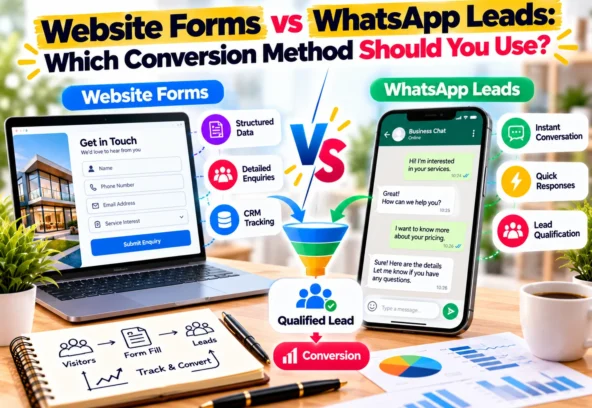
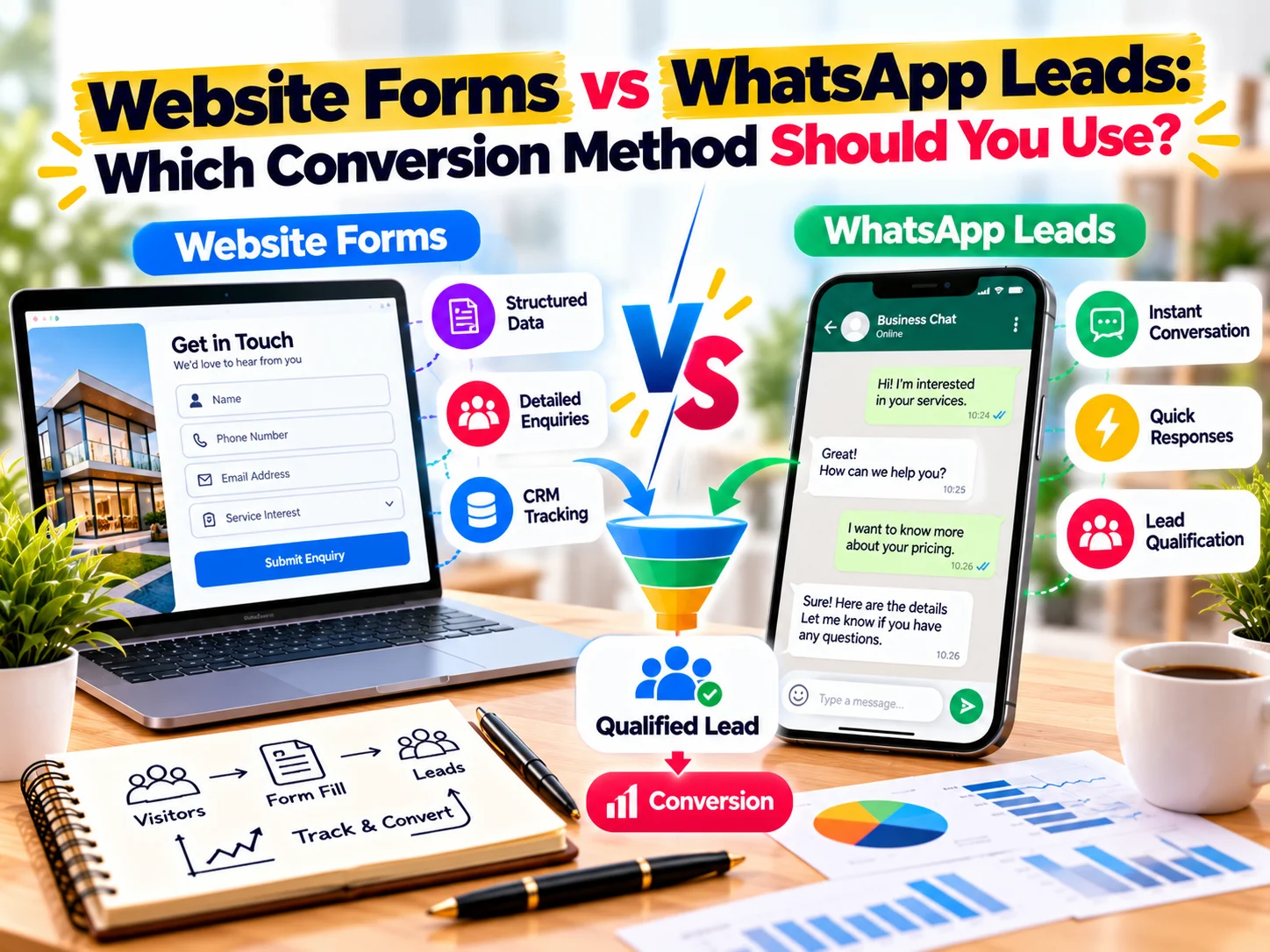
WhatsApp lead generation allows website visitors to contact a business directly through WhatsApp.
Instead of completing several form fields, the visitor clicks a WhatsApp button and starts a conversation.
For example: “Have questions about our services? Chat with us on WhatsApp.”
The visitor can then ask questions, share requirements, send documents, or request a quotation.
This approach reduces the number of steps between website visit and customer conversation.
Website Forms vs WhatsApp Leads: Key Differences
Both methods can generate leads, but they work differently.
1. User Experience
User experience plays an important role in lead conversion.
A long website form can discourage visitors, especially when they only want a quick answer.
For example, imagine someone visiting a website to ask, “How much does this service cost?” If the website asks the visitor to complete eight fields before submitting the enquiry, they may leave without contacting the business.
WhatsApp can make that interaction simpler. With one click, the visitor can start a conversation.
Website forms work well when:
- You need detailed information.
- The visitor understands the service.
- You want to qualify leads immediately.
- Your sales process requires structured data.
WhatsApp works well when:
- Customers have quick questions.
- Customers prefer messaging.
- Your sales team responds quickly.
- The buying process involves conversation.
2. Lead Quality
More leads do not always mean better leads.
Website forms can help businesses collect specific information before a salesperson follows up.
For example:
Project Type: Website Development
Budget: ₹1–3 lakh
Timeline: Within 30 days
Company: ABC Pvt. Ltd.
This information gives the sales team useful context.
WhatsApp leads, on the other hand, can provide more natural customer conversations. A potential customer might explain their entire requirement in a few messages. The sales representative can then ask follow-up questions and understand the customer’s needs.
Therefore, forms generally provide more structured information, while WhatsApp can provide richer conversational context.
3. Conversion Friction
Conversion friction refers to anything that makes it harder for a visitor to take the next step.
A complicated form creates friction.
For example:
Name → Email → Phone → Company → Location → Service → Budget → Message → CAPTCHA → Submit
That’s a lot of steps.
A WhatsApp CTA can be much simpler: “Chat with us on WhatsApp.”
The visitor clicks and starts a conversation.
However, businesses should not remove forms completely. A well-designed short form can still perform effectively.
A better approach is to ask only for information that you genuinely need, such as Name, Phone, Email, and Requirement.
4. Speed of Response
Speed matters because customer interest can decline when businesses take too long to respond.
WhatsApp provides a natural environment for quick communication. A customer can send a message and receive a response from a sales representative without switching between multiple communication channels.
However, WhatsApp only delivers this advantage when the business actually manages incoming messages efficiently.
Therefore, businesses should establish response-time targets, sales team ownership, automated welcome messages, FAQs, lead assignment, and follow-up processes.
A WhatsApp button alone does not create a successful lead-generation system.
5. Automation and CRM Integration
Website forms have traditionally worked well with CRM systems because they collect information in predefined fields.
For example:
Name → Phone → Email → Service → Source → Lead Status
Businesses can then automatically:
- Create a lead.
- Assign the lead to a salesperson.
- Send an email notification.
- Add the lead to the CRM.
- Trigger a follow-up workflow.
WhatsApp can also connect with CRM and automation systems, depending on the technology and setup.
For example:
Website → WhatsApp → Lead Qualification → CRM → Sales Follow-Up
This approach can combine conversational communication with structured lead management.
6. Customer Trust
Trust also influences conversion.
Some visitors feel comfortable submitting a form because it looks professional and familiar. Others prefer WhatsApp because they can communicate directly with a real person.
The right option depends on your audience.
For professional B2B services, a detailed enquiry form may make sense.
For local services, real estate enquiries, education, healthcare appointments, home services, and quick quotations, WhatsApp may provide a more convenient communication path.
7. Website Forms vs WhatsApp Leads for B2B Businesses
B2B companies often need detailed information before starting a sales conversation.
For example, a software development company may need to understand:
- Business type
- Project requirements
- Number of users
- Existing technology
- Budget
- Timeline
A structured form can collect these details efficiently.
However, WhatsApp can still work as an additional conversion option for prospects who have quick questions.
A practical B2B strategy is to use both:
Primary CTA: Request a Consultation
Secondary CTA: Chat on WhatsApp
This gives visitors two ways to contact the business based on their preferences.
8. Website Forms vs WhatsApp Leads for Local Businesses
Local businesses often depend on fast enquiries.
Examples include:
- Real estate
- Interior design
- Dental clinics
- Salons
- Restaurants
- Home services
- Coaching institutes
- Travel companies
- Repair services
Customers may want a quick answer rather than a detailed form. In such situations, WhatsApp can become a convenient conversion channel.
For example: “Interested in this property? WhatsApp us for price and availability.”
This CTA directly connects customer intent with communication.
9. Which Method Generates More Leads?
There is no universal answer.
The number of leads depends on several factors, including:
- Website traffic
- Audience demographics
- Industry
- Offer
- Form length
- CTA placement
- Mobile experience
- Response time
- Sales process
- Trust signals
- Website speed
Therefore, businesses should avoid assuming that WhatsApp or forms will automatically produce better results.
Instead, test both conversion methods and measure the complete customer journey.
10. Should You Use Website Forms and WhatsApp Together?
For many businesses, using both channels creates a more flexible conversion system.
Your website can provide:
Website Form: “Request a Free Consultation”
WhatsApp: “Chat With Our Team”
Visitors can then choose the method they prefer.
This strategy also helps businesses capture different types of intent. Someone ready to provide detailed project information may complete the form. Someone with a quick question may choose WhatsApp.
Both can become valuable sales opportunities.
How to Improve Website Form Conversions
If you use website forms, focus on reducing friction.
1. Keep the form short
Ask only for information that you genuinely need.
2. Use a clear CTA
Instead of “Submit,” try “Get a Free Consultation” or “Request a Quote.”
3. Make forms mobile-friendly
Your form should work smoothly on smaller screens.
4. Explain what happens next
For example: “Submit your enquiry and our team will contact you shortly.”
5. Add trust signals
Consider adding client testimonials, reviews, certifications, privacy information, portfolio examples, and case studies.
How to Improve WhatsApp Lead Conversions
WhatsApp also needs a proper conversion strategy.
1. Use clear CTA buttons
Examples: “Chat With Us,” “Get a Quote on WhatsApp,” “Ask About Pricing,” and “Talk to an Expert.”
2. Pre-fill the first message
For example: “Hi, I would like to know more about your website development services.”
3. Respond quickly
A WhatsApp lead can lose interest if the response takes too long.
4. Create a lead-handling process
Assign incoming conversations to the right team member.
5. Track your leads
Connect WhatsApp with your CRM or lead-management workflow where appropriate.
Website Forms vs WhatsApp Leads: What Should You Choose?
The choice depends on your conversion goal.
Choose website forms when:
- You need structured lead information.
- Your sales process requires qualification.
- You sell complex B2B services.
- You want consistent CRM data.
- You need detailed project requirements.
Consider WhatsApp when:
- Customers prefer instant communication.
- Your business receives quick enquiries.
- Your audience primarily uses mobile devices.
- Sales conversations influence purchasing decisions.
- Customers frequently ask questions before buying.
Consider using both when:
- You serve different customer segments.
- Your website receives substantial mobile traffic.
- You need structured leads as well as quick conversations.
- You want visitors to choose their preferred communication method.
A Practical Conversion Strategy
Instead of asking “Website forms or WhatsApp?”, consider asking: “Which conversion option fits each stage of the customer’s journey?”
Awareness
Visitor reads a blog or service page.
↓
Interest
Visitor wants more information.
↓
Conversion Options
Request a Quote → Website Form
Have a Question? → WhatsApp
↓
Lead Qualification
Collect requirements.
↓
Sales Follow-Up
Call, WhatsApp, email, or meeting.
↓
Conversion
Turn the qualified lead into a customer.
This approach creates a more flexible lead-generation funnel.
How CreativeKatta Can Help Improve Your Website Conversions
A website should do more than look professional. It should help visitors take the next step.
At CreativeKatta, we help businesses build digital experiences that combine website design, SEO, content, conversion-focused layouts, and effective lead-generation strategies.
Whether your business needs a better contact form, WhatsApp integration, landing page, SEO strategy, or complete website redesign, the goal remains the same:
Turn more relevant website visitors into meaningful business enquiries.
Ready to Improve Your Website Lead Generation?
Don’t make visitors search for a way to contact you.
Make the next step simple, clear, and relevant to their needs.
Talk to CreativeKatta today and discover how a conversion-focused website can help your business generate better leads.
Frequently Asked Questions
Q. Is WhatsApp better than a website contact form?
A. Neither method works universally better. Website forms provide structured information, while WhatsApp enables direct conversations. The appropriate option depends on your audience, sales process, and conversion goals.
Q. Can I use WhatsApp and website forms together?
A. Yes. Using both can give visitors multiple ways to contact your business. You can use forms for detailed enquiries and WhatsApp for quick questions or conversations.
Q. Do WhatsApp leads have better conversion rates?
A. Conversion rates vary by business, audience, offer, traffic source, and response time. Businesses should test both channels and track qualified leads and sales rather than comparing clicks alone.
Q. Should a B2B website use WhatsApp?
A. A B2B website can use WhatsApp as an additional communication channel, particularly when prospects frequently ask questions before requesting a proposal. A structured form can remain useful for detailed project enquiries.
Q. How can I improve website lead generation?
A. Start by simplifying your forms, improving CTA placement, optimising mobile UX, adding trust signals, improving page speed, offering WhatsApp where appropriate, and tracking conversions from different channels.
Q. What is the best CTA for website lead generation?
A. The CTA should reflect the user’s intent. Examples include Request a Quote, Book a Consultation, Get Started, Talk to an Expert, and Chat on WhatsApp.
Key Takeaway
Website forms and WhatsApp leads serve different purposes.
Forms provide structure and make lead qualification easier. WhatsApp reduces communication friction and allows businesses to start conversations quickly.
For many businesses, the most practical approach is not choosing one over the other. Instead, use website forms and WhatsApp strategically at different points in the customer journey.
The real goal is simple: make it easy for the right visitor to become a lead and give your sales team the information they need to convert that lead into a customer.
Comparison at a Glance
Factor | Website Forms | WhatsApp Leads |
Lead collection | Structured | Conversational |
User effort | Moderate | Usually low |
Information collected | Predefined fields | Flexible conversation |
Instant conversation | No | Yes |
Lead qualification | Easy to structure | Requires conversation |
Automation | Strong | Strong with integrations |
Best for | Detailed enquiries | Quick enquiries |
Follow-up | Email, phone, CRM | WhatsApp, phone, CRM |
Customer interaction | Form submission | Real-time conversation |
Data consistency | High | Can vary |