
Many businesses invest in branding and digital marketing, but they often treat them as the same thing.
They are connected, yet they serve different purposes.
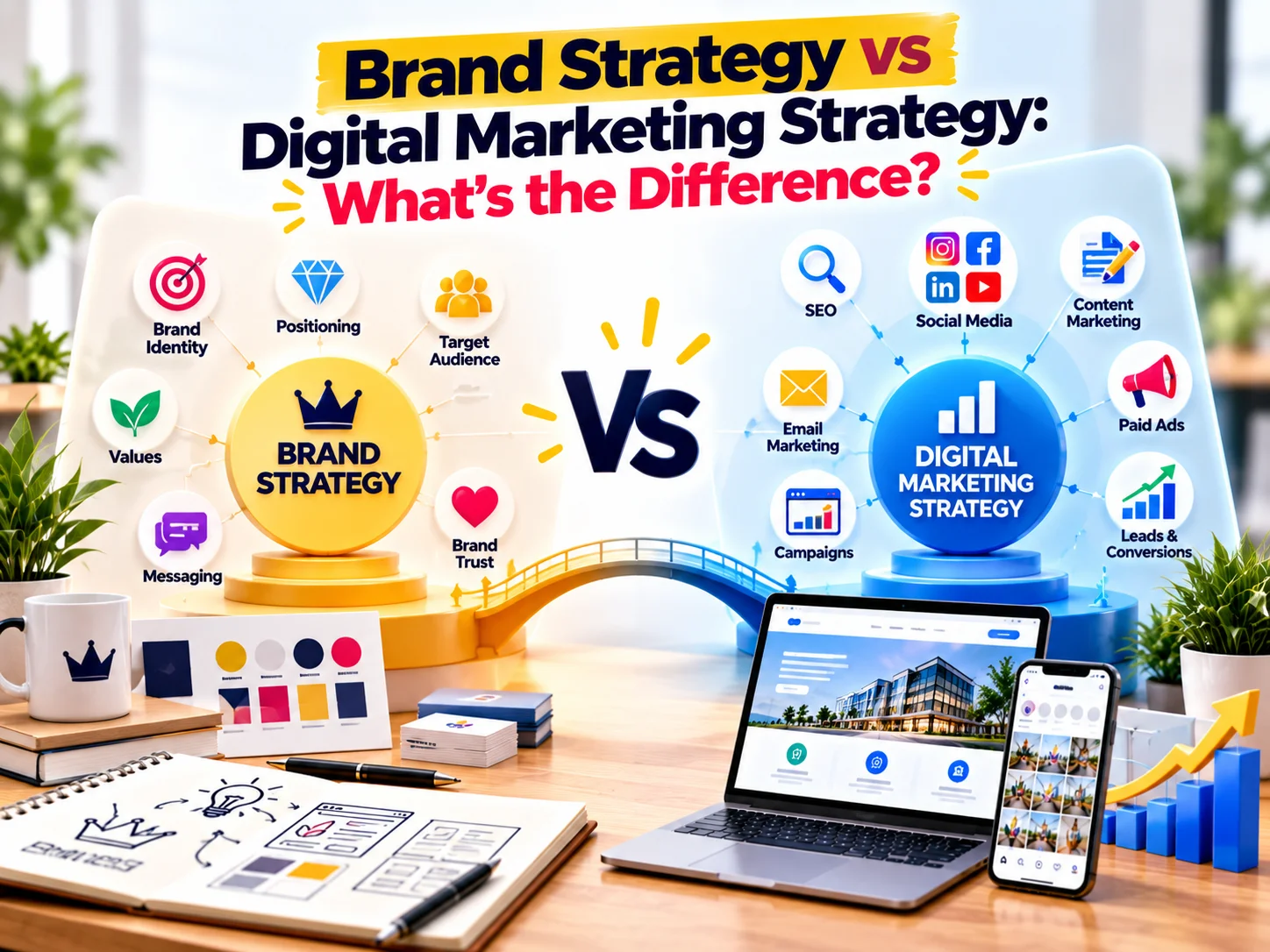
A brand strategy defines what your business stands for, who it serves, how it is positioned, and how people should perceive it.
A digital marketing strategy focuses on how your business reaches, engages, and converts customers through digital channels.
In simple terms:
Brand strategy defines who you are. Digital marketing strategy helps you reach the right people.
Both strategies work better together. However, understanding the difference can help you make smarter decisions about your website, content, social media, advertising, and overall digital presence.
What Is a Brand Strategy?
A brand strategy is a long-term plan that defines how your business builds a distinct position in the market.
It goes beyond your logo and colours.
A brand strategy can cover:
- Brand purpose
- Vision and mission
- Target audience
- Brand positioning
- Brand personality
- Brand values
- Unique value proposition
- Competitor positioning
- Brand messaging
- Tone of voice
- Visual identity
- Customer experience
The goal is to create a clear and consistent identity that customers can recognise and remember.
For example, if two companies offer similar products, their brand strategies can create very different perceptions.
One might position itself as affordable and accessible, while another might focus on premium quality and expertise.
The products may be similar, but the brand experience can feel completely different.
What Is a Digital Marketing Strategy?
A digital marketing strategy is a plan for promoting your business through online channels.
It focuses on reaching specific audiences, generating awareness, attracting website visitors, creating leads, and supporting sales.
A digital marketing strategy can include:
- Search engine optimisation
- Google Ads
- Social media marketing
- Content marketing
- Email marketing
- Video marketing
- Online advertising
- Local SEO
- Conversion optimisation
- Analytics and reporting
The strategy determines which channels you should use, what content you should publish, who you should target, and how you should measure performance.
For example, a business may use SEO to attract people searching on Google, social media to build awareness, and Google Ads to reach customers with immediate purchase intent.
Brand Strategy vs Digital Marketing Strategy
The easiest way to understand the difference is to compare their primary roles.
Brand Strategy | Digital Marketing Strategy |
Defines the brand | Promotes the brand |
Builds identity | Builds online reach |
Establishes positioning | Targets audiences |
Defines messaging | Distributes content |
Shapes perception | Drives traffic and engagement |
Builds recognition | Generates leads |
Focuses on long-term brand value | Focuses on marketing objectives |
Guides communication | Guides digital campaigns |
These strategies should not operate independently.
Your digital marketing should communicate the brand consistently.
At the same time, your brand should give your digital marketing a clear identity.
1. Brand Strategy Answers "Who Are We?"
A brand strategy starts with identity.
It asks questions such as:
- Who are we?
- What do we believe?
- Who do we serve?
- What problem do we solve?
- Why should customers choose us?
- What makes us different?
- How do we want people to perceive us?
The answers influence every major brand decision.
Your website copy, logo, colours, social media content, packaging, advertisements, and customer communication should reflect this foundation.
2. Digital Marketing Strategy Answers "How Do We Reach Customers?"
Digital marketing starts with audience and channel planning.
It asks:
- Where does our audience spend time online?
- What do they search for?
- What content do they consume?
- Which channels can reach them?
- What offers can encourage action?
- What should we measure?
- How can we improve campaign performance?
For example, an audience may discover a business through Google Search, see its Instagram content later, visit the website, and eventually convert through a remarketing campaign.
A digital marketing strategy connects these touchpoints.
3. Brand Strategy Comes Before Campaign Execution
A campaign can generate traffic.
However, the brand needs to give that traffic context.
Imagine a company launches a Google Ads campaign without clear brand positioning.
The advertisements may generate clicks, but users could still struggle to understand:
- Who the company is
- What makes it different
- Why they should trust it
- What value it provides
A clear brand strategy gives your marketing a consistent foundation.
Then, digital marketing can amplify that foundation.
4. Brand Strategy Builds Recognition
People interact with businesses across multiple platforms.
They may see your:
- Website
- Instagram post
- Google advertisement
- YouTube video
- Product packaging
- Brochure
- Business listing
If every touchpoint looks and sounds different, customers may struggle to connect them to the same business.
A brand strategy creates consistency across these experiences.
Your colours, typography, visual style, messaging, photography, and tone can work together to create recognition.
5. Digital Marketing Builds Reach
Even a strong brand needs visibility.
Digital marketing helps put your brand in front of potential customers.
For example:
SEO
Helps your website attract people searching for relevant information, products, or services.
Google Ads
Allows businesses to advertise for relevant searches and other Google advertising placements.
Social Media Marketing
Helps businesses communicate with audiences and build ongoing engagement.
Content Marketing
Provides useful information that can attract and educate potential customers.
Video Marketing
Uses visual storytelling to demonstrate products, services, ideas, or expertise.
Each channel serves a different purpose.
The right combination depends on your audience and business objectives.
6. Brand Messaging Supports Digital Marketing
Your marketing campaigns need consistent messaging.
Suppose your brand positioning focuses on premium quality.
Your website, social media, advertisements, and content should communicate that positioning.
However, consistency does not mean repeating the same sentence everywhere.
Instead, adapt the message to each channel while keeping the core idea consistent.
For example:
Website:
Explain your value proposition in detail.
Instagram:
Communicate it through visuals and short-form content.
Google Ads:
Communicate the most relevant benefit quickly.
Blog:
Educate users around problems related to your product or service.
Different formats can communicate the same brand idea.
7. Brand Strategy Is Usually Long-Term
Brand building takes time.
A business may spend months or years developing recognition and trust.
Therefore, brand strategy often focuses on long-term questions such as:
- How should customers remember us?
- What position should we own?
- What should our brand represent?
- How can we remain consistent as we grow?
Digital marketing can also have long-term goals, but individual campaigns often work around shorter objectives.
For example:
- Generate 100 qualified leads
- Increase website traffic
- Promote a product launch
- Increase enquiries
- Grow social media engagement
- Drive sales
Both timeframes can work together.
8. Digital Marketing Needs Measurable Goals
One major difference is measurement.
Digital marketing provides many measurable data points.
You can track:
- Website traffic
- Search impressions
- Clicks
- CTR
- Leads
- Conversions
- Cost per lead
- Advertising spend
- Engagement
- Email opens
- Revenue
This data helps marketers evaluate campaigns and improve performance.
Brand performance can also be measured, but brand objectives often involve broader indicators such as awareness, recognition, perception, customer preference, and loyalty.
9. Your Website Connects Both Strategies
Your website sits at the intersection of branding and digital marketing.
From a brand perspective, your website should communicate:
- Identity
- Positioning
- Personality
- Visual style
- Brand message
- Trust
From a digital marketing perspective, it should support:
- SEO
- Paid advertising
- Content marketing
- Lead generation
- Conversion optimisation
- Analytics
This is why website development should not happen separately from your branding and marketing strategy.
A visually attractive website needs clear messaging and strong functionality.
At the same time, an SEO-friendly website needs a brand identity that creates a consistent experience.
10. Content Can Serve Both Strategies
Content is another area where the two strategies overlap.
Brand strategy determines the topics, tone, personality, and perspective you want to communicate.
Digital marketing determines where and how you distribute that content.
For example, a business can create:
- Educational blog posts
- Social media posts
- Videos
- Case studies
- Guides
- Infographics
- Email campaigns
- Product content
The content should provide useful information while reinforcing the brand.
This approach helps businesses avoid creating disconnected marketing campaigns.
11. Brand Identity and Digital Marketing Work Together
Your visual identity influences how digital campaigns look.
For example, your:
- Logo
- Colour palette
- Typography
- Photography
- Graphic elements
- Icon style
- Design system
can appear across your website, advertisements, social media, and marketing materials.
This consistency helps create a unified customer experience.
However, your marketing creatives do not need to look identical.
Instead, they should share recognisable brand elements while adapting to each platform.
12. What Happens When Businesses Ignore Brand Strategy?
Businesses that focus only on digital marketing can sometimes create inconsistent customer experiences.
For example:
An Instagram advertisement may use one tone.
The website may use another.
The packaging may follow a completely different visual style.
The sales team may communicate another message.
Even when individual campaigns perform well, the overall brand experience can become unclear.
A brand strategy helps establish common guidelines.
13. What Happens When Businesses Ignore Digital Marketing?
The opposite problem can also occur.
A business may have:
- A professional logo
- Strong brand colours
- Excellent packaging
- A clear brand story
but still struggle to reach potential customers online.
Branding creates identity.
Digital marketing creates opportunities to put that identity in front of relevant audiences.
Therefore, businesses need both sides of the equation.
14. Brand Strategy + Digital Marketing Strategy = Stronger Digital Presence
Think of the relationship this way:
Brand Strategy → Defines the identity
↓
Brand Identity → Makes the business recognisable
↓
Digital Marketing Strategy → Reaches the audience
↓
Content + Campaigns → Communicate the value
↓
Website → Educates and converts visitors
↓
Customer Experience → Reinforces the brand
Each part supports the next.
When these elements work together, your marketing becomes more consistent and purposeful.
When Should a Business Focus on Brand Strategy?
Brand strategy becomes particularly useful when:
- You are launching a new business
- Your positioning is unclear
- You are entering a competitive market
- Your target audience has changed
- You are launching a new product
- Your visual identity feels outdated
- Your messaging lacks consistency
- Your business has expanded into new markets
- Different teams communicate differently
In these situations, revisiting your brand foundation can provide useful direction.
When Should a Business Focus on Digital Marketing Strategy?
Digital marketing planning becomes important when:
- Website traffic is low
- Lead generation is inconsistent
- Your business lacks online visibility
- Paid campaigns lack structure
- Social media lacks direction
- SEO needs improvement
- Content does not reach the right audience
- Marketing activities lack measurable goals
A digital marketing strategy helps connect marketing activities with specific business objectives.
How to Build Both Strategies Together
Instead of treating branding and digital marketing as separate projects, build them together.
Step 1: Define Your Audience
Understand who you want to reach.
Step 2: Research Your Market
Study competitors, customer expectations, industry trends, and market gaps.
Step 3: Define Your Positioning
Identify how you want customers to understand your business.
Step 4: Build Your Brand Identity
Develop your logo, colours, typography, visual language, messaging, and brand voice.
Step 5: Define Marketing Goals
Set clear objectives for SEO, advertising, social media, content, leads, or sales.
Step 6: Select Digital Channels
Choose the channels that align with your audience and goals.
Step 7: Create Consistent Content
Develop content that supports both your brand message and marketing objectives.
Step 8: Measure and Improve
Review performance data and update your strategy when necessary.
Brand Strategy vs Digital Marketing Strategy: A Simple Example
Imagine a skincare company launching a new product.
Brand Strategy
The company defines itself as a premium skincare brand focused on quality, simplicity, and a modern customer experience.
It develops:
- Brand positioning
- Visual identity
- Packaging
- Brand voice
- Product messaging
Digital Marketing Strategy
The company then develops:
- SEO content
- Google Ads campaigns
- Social media campaigns
- Product videos
- Influencer collaborations
- Email marketing
- Landing pages
The brand strategy determines how the company should be presented.
The digital marketing strategy determines how the company reaches potential customers online.
Together, they create a more connected marketing system.
Frequently Asked Questions
Q. Is brand strategy the same as digital marketing strategy?
A. No. Brand strategy defines your identity, positioning, messaging, and desired perception. Digital marketing strategy focuses on reaching and engaging audiences through online channels.
Q. Which comes first: branding or digital marketing?
A. Brand strategy usually provides the foundation for digital marketing. However, both can develop together, especially for businesses that already have an established brand.
Q. Does digital marketing include branding?
A. Digital marketing can communicate and strengthen a brand, but it does not replace a complete brand strategy.
Q. Can a small business benefit from brand strategy?
A. Yes. A clear brand strategy can help a small business define its audience, positioning, messaging, and visual identity before investing heavily in marketing.
Q. Is a logo part of brand strategy?
A. A logo is one part of a brand identity. Brand strategy goes beyond visual elements and includes positioning, audience, values, messaging, personality, and customer experience.
Q. How do branding and SEO work together?
A. Branding creates a consistent identity and message, while SEO helps people discover the business through search. Strong content can support both brand awareness and organic visibility.
Q. Should branding and digital marketing have the same budget?
A. Not necessarily. Budget allocation depends on business goals, market conditions, growth stage, audience, and existing brand assets.
Final Thoughts
Brand strategy and digital marketing strategy solve different problems, but they work best together.
Brand strategy defines who you are, what you stand for, and how you want customers to perceive your business.
Digital marketing strategy determines how you reach those customers through online channels.
A strong visual identity without visibility may struggle to reach enough people. Likewise, aggressive digital marketing without a clear brand can create an inconsistent customer experience.
The strongest approach connects the two.
Build a clear brand foundation first. Then use SEO, social media, content, Google Ads, video, and other digital channels to communicate that brand to the right audience.
Build Your Brand and Digital Strategy With CreativeKatta
Your brand and marketing should work as one connected system.
CreativeKatta helps businesses build and grow their digital presence through brand identity design, website development, SEO, social media marketing, Google Ads, creative design, packaging design, and video editing.
From creating a distinctive brand identity to developing a search-friendly website and digital marketing strategy, we bring strategy and creative execution together.
Ready to build a stronger digital presence? Talk to CreativeKatta today.