
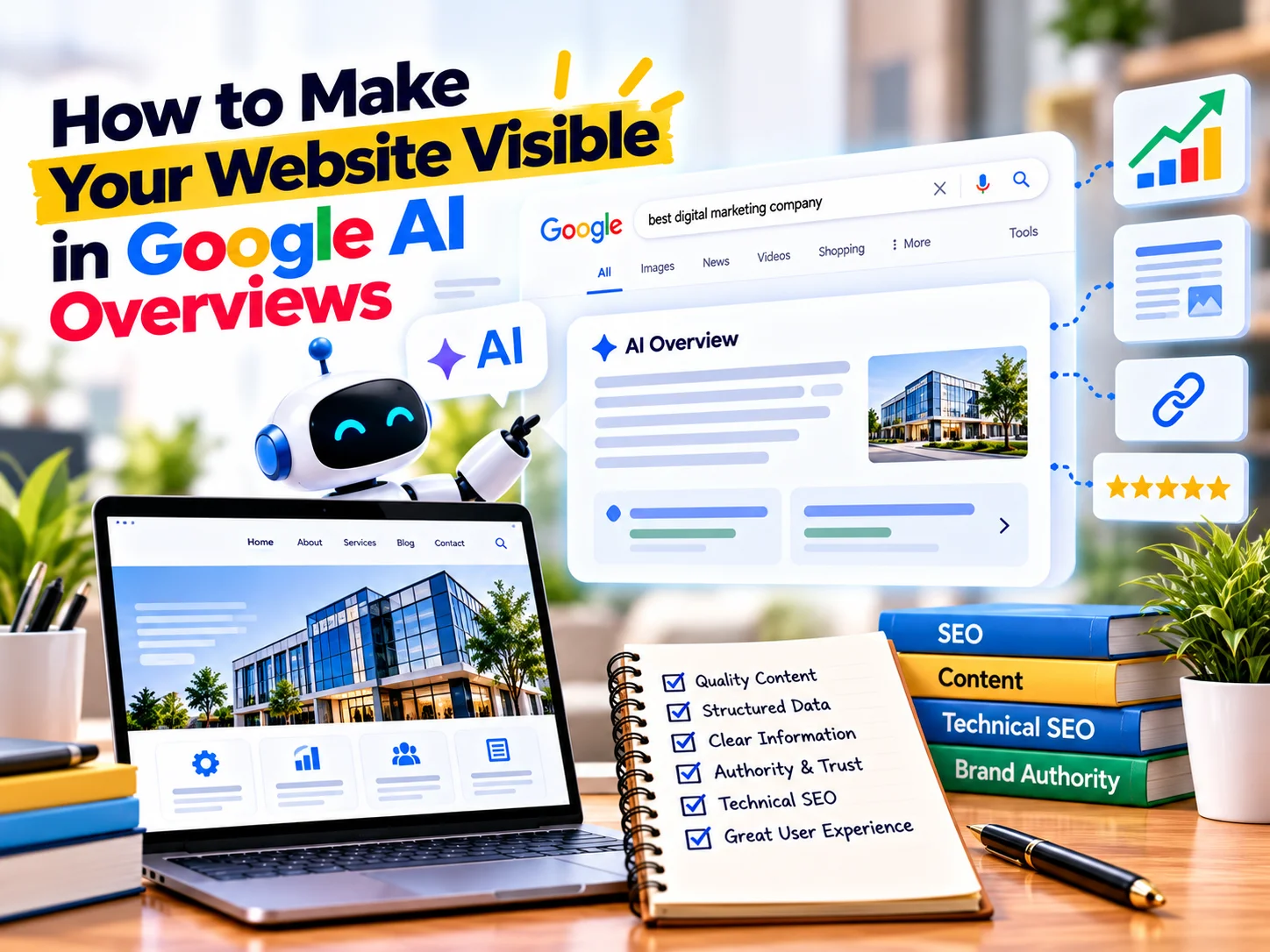
Google Search is changing the way people discover businesses, products, and information. Today, users do more than type a few keywords into Google. They ask detailed questions, compare options, and expect direct answers.
Google AI Overviews can provide AI-generated answers directly within Search while also directing users to relevant websites for more information.
For businesses, this creates a new opportunity to reach potential customers. However, there is no shortcut or guaranteed method to appear in an AI Overview. Instead, businesses need to build websites and content that provide clear, useful, trustworthy answers.
So, how can you make your website more visible in Google AI Overviews?
Let’s explore the key SEO strategies that can help.
What Are Google AI Overviews?
Google AI Overviews are AI-generated summaries that can appear at the top of Google Search for certain queries.
They help users understand complex topics without requiring them to open multiple search results. At the same time, Google can show links to websites that provide relevant information.
For businesses, this means your website can become a useful source for people researching your industry, services, products, or solutions.
However, AI Overviews do not replace traditional SEO.
Your website still needs strong technical SEO, useful content, relevant pages, and a good user experience.
Why Google AI Overviews Matter for Businesses
Search behaviour is becoming more conversational.
For example, a user might previously search:
“SEO agency Bangalore”
Now, they may search:
“How can a small business improve its Google rankings and generate more leads?”
The second search requires a detailed answer.
This change creates opportunities for businesses that publish helpful, well-structured content.
Instead of targeting only short keywords, you can answer the questions your potential customers ask before making a purchase.
That means your content strategy should cover:
- Common customer questions
- Industry problems
- How-to searches
- Comparisons
- Buying decisions
- Service-related questions
- Costs and processes
- Common mistakes
- Practical solutions
The more completely you address a topic, the more useful your website becomes to both users and search engines.
1. Create Helpful Content That Answers Real Questions
The foundation of AI search visibility is useful content.
Start by identifying questions your customers actually ask.
For example, an SEO agency can create content around questions such as:
- How long does SEO take?
- Why is my website not ranking on Google?
- How can I improve local SEO?
- Does SEO work for small businesses?
- How much does SEO cost?
- What is technical SEO?
- How does AI search affect SEO?
Then provide direct and practical answers.
Avoid lengthy introductions that delay the answer.
Instead, answer the main question early and then explain the topic in greater detail.
This approach improves readability and gives users immediate value.
2. Understand Search Intent
Keywords alone do not tell the whole story.
You also need to understand why someone is searching.
For example, the search term “website development” is broad.
A user could be looking for:
- Information about website development
- A website development company
- Website development pricing
- A website developer
- Website development ideas
Each intent requires different content.
Therefore, create pages and articles that match the specific purpose behind the search.
For example, a service page can target users who are ready to hire a website development company, while a blog post can answer questions about website development costs or processes.
When content matches intent, users are more likely to find it useful.
3. Build Topic Clusters Around Your Services
One blog post is rarely enough to establish authority around a competitive topic.
Instead, create a collection of related content.
For example, a digital marketing agency can create an SEO content cluster:
Main Topic
SEO Services for Businesses
Supporting Topics
- How SEO Works for Small Businesses
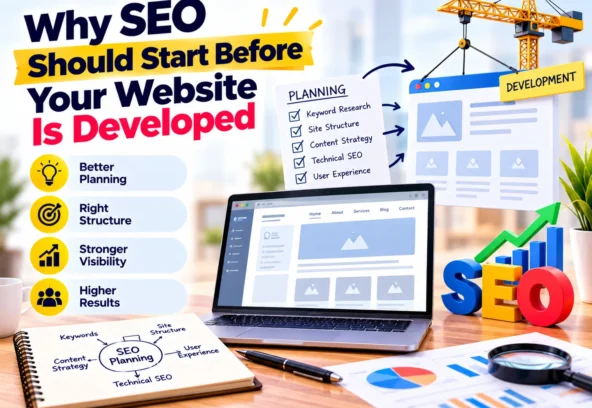
- Why SEO Should Start Before Website Development
- Technical SEO Checklist for Business Websites
- How to Improve Local SEO
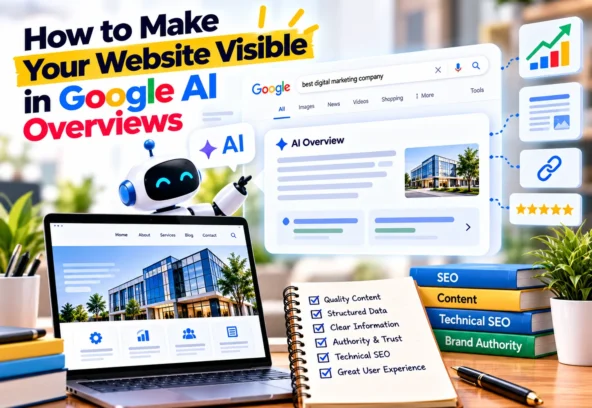
- How to Make Your Website Visible in Google AI Overviews
- Why Your Website Is Not Ranking on Google
- How Long Does SEO Take to Show Results?
Then connect these articles with relevant internal links.
This creates a clear relationship between your content.
It also helps visitors discover additional information without returning to Google.
4. Optimise Your Website Structure
Your content may be excellent, but users and search engines still need to understand your website easily.
Create a logical structure with clear navigation.
For example:
Home → Services → SEO → SEO for Businesses
Your blog should also have clear categories and related articles.
Use descriptive headings such as:
- What Is Google AI Overviews?
- Why AI Search Visibility Matters
- How to Optimise Your Website
- Common AI Search SEO Mistakes
- Frequently Asked Questions
Avoid vague headings such as “Things You Need to Know” or “Our Approach.”
Clear headings make the page easier to scan and understand.
5. Write Clear and Natural Content
You do not need to use complicated language to demonstrate expertise.
In fact, simple language often creates a better experience.
Instead of writing:
“Businesses should leverage an integrated digital ecosystem to maximise organic visibility.”
write:
“Businesses need a website and content strategy that work together to improve online visibility.”
The second sentence communicates the same idea more clearly.
Use short paragraphs, descriptive headings, bullet points, examples, and tables where they add value.
Most importantly, write for people first.
6. Add Original Insights and Experience
The internet already contains millions of articles about SEO and digital marketing.
Therefore, simply rewriting information that already exists may not give your content enough value.
Add your own experience.
For example, a digital agency can share:
- Common website mistakes found during projects
- SEO problems discovered during audits
- Lessons from website redesigns
- Content strategy observations
- Common questions from clients
- Case studies
- Campaign insights
- Practical recommendations
Original experiences make content more useful and distinctive.
They also give visitors a reason to trust your business.
7. Create Detailed Service Pages
Your blog should support your service pages, not replace them.
If your agency provides multiple digital services, create dedicated pages for each one.
For example:
Website Development
Explain your website development process, features, technologies, industries, and benefits.
SEO
Explain technical SEO, on-page SEO, local SEO, content strategy, reporting, and optimisation.
Social Media Marketing
Explain content planning, creative development, posting, engagement, and campaign strategy.
Google Ads
Explain campaign setup, keyword research, ad creation, landing pages, tracking, and optimisation.
Brand Identity Design
Explain logos, typography, colours, brand guidelines, and visual consistency.
Dedicated pages allow search engines and visitors to understand exactly what your business offers.
8. Use Internal Links Strategically
Internal linking is an important part of a strong website structure.
When you mention a related service or topic, link to the relevant page.
For example, this article can link to your:
- SEO services
- Website development services
- Social media marketing services
- Google Ads services
- Brand identity services
- Video editing services
You can also connect related blog posts.
For example:
How to Make Your Website Visible in Google AI Overviews
can link to:
How to Build a Website That Is Ready for Google and AI Search
and:
Why SEO Should Start Before Your Website Is Developed
This creates a connected content journey.
9. Improve Your Website’s Technical SEO
Content alone cannot solve technical website problems.
Make sure your website provides a strong technical foundation.
Check important areas such as:
- Mobile responsiveness
- Page speed
- Core Web Vitals
- HTTPS
- Crawlability
- Indexability
- XML sitemap
- Robots.txt
- Canonical URLs
- Broken links
- Redirects
- Internal links
- Image optimisation
Also check whether important pages can be crawled and indexed by Google.
Use Google Search Console regularly to identify indexing and search performance issues.
10. Use Structured Data Correctly
Structured data helps search engines understand the content and purpose of a page.
Depending on your website, relevant structured data may include:
- Article
- BlogPosting
- BreadcrumbList
- Organization
- LocalBusiness
- Service
However, structured data does not guarantee that your page will appear in an AI Overview.
Use structured data to accurately describe information that already appears on the page.
Do not add markup simply because you want a particular search feature.
Accuracy should always come first.
11. Optimise Images and Videos
Modern search experiences are becoming increasingly visual.
Therefore, your SEO strategy should include images and videos where they genuinely improve the content.
For images:
- Use descriptive filenames
- Add useful alt text
- Compress large files
- Use appropriate image dimensions
- Avoid unnecessary decorative images
For example:
Poor filename:
IMG_4598.jpg
Better filename:
google-ai-overviews-seo-strategy.jpg
The filename alone will not improve rankings. However, descriptive media information contributes to a clearer and more accessible page.
You can also embed relevant videos when they help explain a topic.
12. Strengthen Your Business’s Online Trust
People want to know who is behind the information they read.
Your website should clearly communicate:
- Who your company is
- What services you provide
- Where you operate
- How customers can contact you
- What experience you have
- What projects you have completed
You can strengthen trust with:
- Case studies
- Client testimonials
- Portfolio projects
- Team information
- Author information
- Company history
- Contact details
- Industry experience
For factual claims and statistics, use reliable sources and keep important information updated.
13. Answer Related Questions
Users rarely have just one question.
Suppose someone searches:
“How can I improve my website’s visibility in AI search?”
They may also want to know:
- Does traditional SEO still matter?
- Does structured data help?
- Should I create AI-specific content?
- How do I track AI search traffic?
- Does website speed matter?
- How important are backlinks?
Address these related questions naturally within the same article.
This creates a more complete resource.
However, avoid adding unrelated questions just to increase word count.
Every section should provide genuine value.
14. Keep Your Content Updated
SEO does not end when you click “Publish.”
Search trends, algorithms, customer behaviour, and technology continue to change.
Review important articles periodically.
Look for:
- Outdated statistics
- Old examples
- Broken links
- Missing questions
- New industry developments
- Changes in Google’s search experience
- New internal linking opportunities
Update the content when necessary.
Do not change the publication date simply to make an old article look new. Make meaningful improvements first.
15. Monitor Your Search Performance
Use tools such as Google Search Console and Google Analytics to understand how your website performs.
Monitor:
- Impressions
- Clicks
- Click-through rate
- Search queries
- Average position
- Organic traffic
- Landing pages
- Conversions
Look for new queries that bring impressions but few clicks.
Those queries can reveal opportunities for improving titles, content, headings, or search intent alignment.
You can also identify pages that receive traffic but generate few enquiries.
In that case, improving the content and conversion path may help turn existing traffic into business opportunities.
Common Mistakes to Avoid
Trying to optimise specifically for AI Overviews can lead businesses toward the wrong strategy.
Avoid these common mistakes.
Keyword Stuffing
Do not repeat “Google AI Overviews” unnaturally throughout the article.
Use the phrase where it makes sense and include related terminology naturally.
Creating Generic AI Content
Do not publish large volumes of generic articles without adding original value.
Quality and usefulness matter more than simply increasing your publishing frequency.
Ignoring Traditional SEO
AI search does not mean technical SEO, content quality, internal links, and website performance no longer matter.
Keep your SEO fundamentals strong.
Writing Only for Search Engines
Your visitors are real people.
If an article is difficult to read, repetitive, or overly promotional, users may leave quickly.
Write to solve their problem first.
Expecting Guaranteed AI Overview Placement
There is no guaranteed formula for appearing in Google AI Overviews.
Instead, build a website that provides useful information and follows Google’s search guidelines.
Google AI Overviews SEO Checklist
Before publishing your article or service page, ask:
- Does the page answer a real customer question?
- Does the introduction provide a clear answer?
- Is the content original and useful?
- Does the page match search intent?
- Are the headings descriptive?
- Are paragraphs easy to read?
- Are related topics covered?
- Have you added relevant internal links?
- Is the page mobile-friendly?
- Can Google crawl and index the page?
- Is the website technically healthy?
- Are images properly optimised?
- Is relevant structured data implemented?
- Does the page demonstrate real experience?
- Are FAQs included where useful?
- Is the information accurate and up to date?
Final Thoughts
Google AI Overviews are changing the way users discover information. However, businesses do not need to abandon traditional SEO to adapt.
Instead, focus on the fundamentals that make a website genuinely useful.
Create content that answers real questions. Build detailed service pages. Organise related topics into content clusters. Strengthen internal linking. Improve technical SEO. Add original insights. Keep your information accurate and updated.
Most importantly, create content that helps people make informed decisions.
When your website consistently provides useful answers, you create a stronger foundation for visibility across Google Search and emerging AI-powered search experiences.
Need Help With Your SEO Strategy?
Building a search-ready website requires more than adding keywords to blog posts.
CreativeKatta helps businesses build a stronger digital presence through website development, SEO, social media marketing, Google Ads, branding, creative design, packaging design, and video editing.
Whether you are launching a new website or improving an existing one, a well-planned digital strategy can help connect your website with the people actively searching for your products and services.
Ready to build a website that is prepared for modern search? Get in touch with CreativeKatta today.