
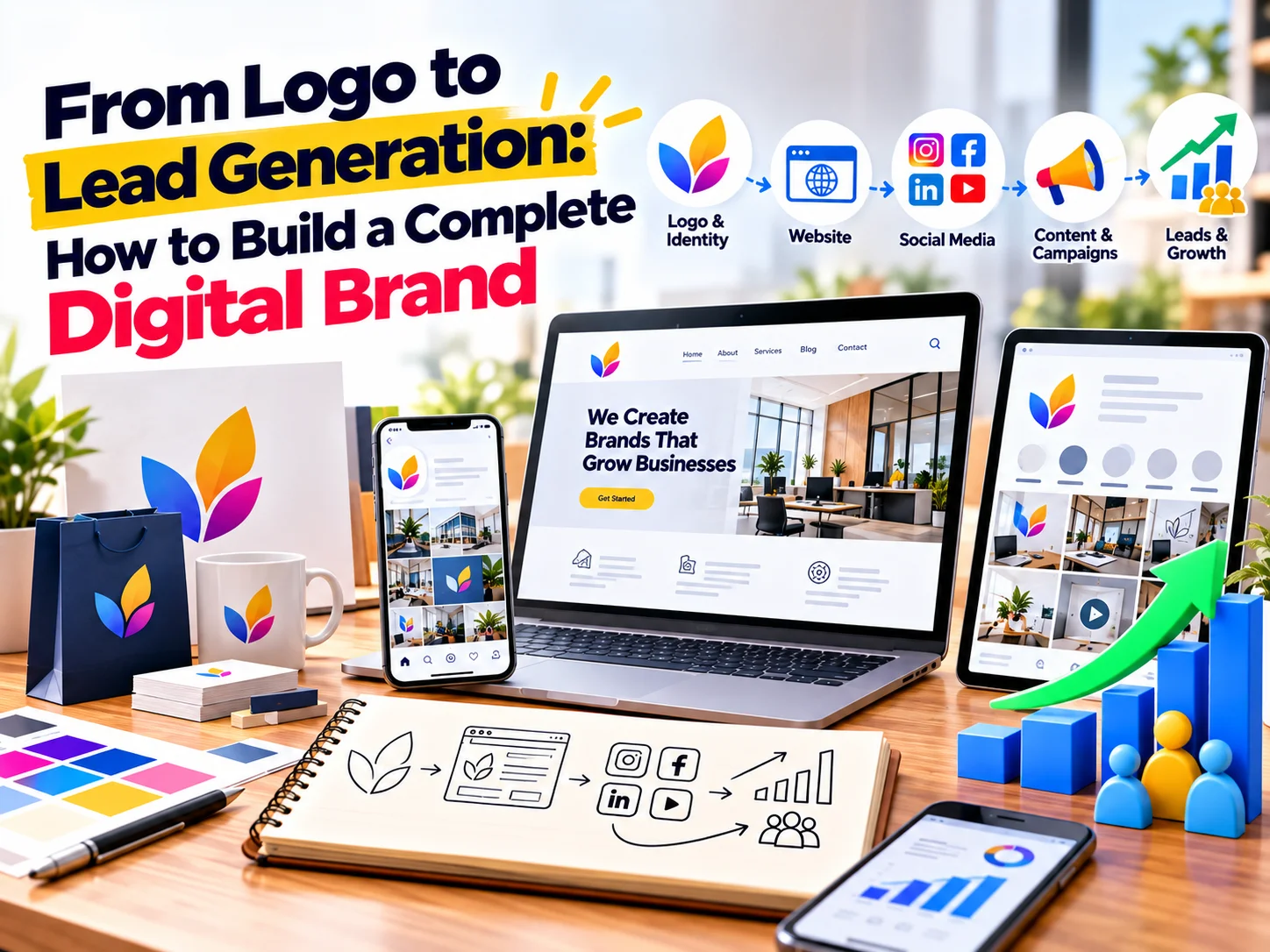
A logo is often the first thing people associate with a business. However, a strong digital brand goes far beyond a logo.
Your brand appears in your website, social media posts, advertisements, videos, search results, landing pages, emails, and customer interactions.
More importantly, these digital touchpoints should work together to create recognition, trust, and action.
That is why growing businesses need to think beyond logo design and build a complete digital brand.
In this guide, we explain how businesses can move from a visual identity to a connected digital brand that supports visibility, engagement, and lead generation.
What Is a Digital Brand?
A digital brand is how your business is represented, experienced, and recognised across digital channels.
It includes both visual and strategic elements such as:
- Logo
- Brand colours
- Typography
- Brand voice
- Website
- Social media
- Content
- SEO
- Videos
- Online advertising
- Landing pages
- Customer reviews
- Digital experiences
Therefore, a digital brand is not simply a collection of attractive designs.
It is a consistent system that communicates who you are, what you offer, who you serve, and why customers should trust you.
Logo vs Digital Brand: What's the Difference?
A logo is an important brand asset, but it represents only one part of your identity.
Logo | Complete Digital Brand |
Visual identifier | Complete digital experience |
Represents the business | Communicates the business |
Usually one graphic asset | Multiple connected assets |
Builds recognition | Builds recognition and trust |
Used across platforms | Shapes the entire customer journey |
Primarily visual | Visual + content + experience + strategy |
For example, a business may have an excellent logo but still struggle with an outdated website, inconsistent social media graphics, unclear messaging, or weak lead-generation systems.
Therefore, the goal should not be to choose between a logo and digital marketing.
Instead, build them as connected parts of the same brand.
Why a Complete Digital Brand Matters
Customers rarely interact with only one part of your business.
A potential customer might:
See an Instagram post → Search Google → Visit your website → Read reviews → Watch a video → Submit an enquiry.
Each interaction shapes their perception of your business.
If every touchpoint looks and sounds different, the experience can feel disconnected.
On the other hand, consistent branding can make your business easier to recognise and understand.
1. Build Brand Recognition
Consistent colours, typography, imagery, messaging, and design help customers recognise your business across different channels.
2. Build Trust
A professional and consistent digital presence can make your business easier to evaluate.
Your website, social media, content, reviews, and other assets should support the same overall message.
3. Communicate Your Positioning
Your brand should quickly communicate what makes your business relevant to its target audience.
Clear positioning helps customers understand why they should consider your product or service.
4. Support Lead Generation
Branding and lead generation are not separate activities.
When your messaging, website, content, and calls to action work together, your brand can guide visitors toward meaningful actions.
Step 1: Define Your Brand Strategy
Before designing anything, clarify the foundation of your brand.
Answer questions such as:
- Who is your target audience?
- What problem do you solve?
- What products or services do you offer?
- What makes your business different?
- Why should customers trust you?
- What type of experience do you want to create?
- What should people remember about your brand?
These answers influence your visual identity, website content, social media strategy, advertising, and lead-generation approach.
Define Your Brand Positioning
A simple positioning statement can help:
We help [target audience] achieve [desired result] through [product/service].
For example:
We help growing businesses build stronger digital visibility through websites, SEO, creative design, and digital marketing.
The exact positioning should reflect your actual business.
Step 2: Build a Strong Visual Identity
Once your strategy is clear, develop a visual system.
Your visual identity can include:
Logo
Create a logo that works across:
- Website
- Social media
- Mobile screens
- Presentations
- Videos
- Advertisements
- Printed materials
Colour Palette
Choose primary and supporting colours that reflect your brand personality.
Then document where and how each colour should be used.
Typography
Select fonts for:
- Headings
- Body text
- Buttons
- Social media graphics
- Presentations
Use typography consistently across platforms.
Imagery
Define your preferred:
- Photography style
- Illustrations
- Icons
- Graphics
- Video style
- Background treatments
Together, these elements create a recognisable visual language.
Step 3: Create Brand Guidelines
A growing business should not depend on one designer remembering how the brand should look.
Create a simple brand guideline document that explains:
- Logo usage
- Colour codes
- Typography
- Image style
- Icon style
- Social media design
- Tone of voice
- Layout principles
- Brand do’s and don’ts
This makes it easier for employees, designers, marketers, and external agencies to maintain consistency.
Step 4: Build a Website That Represents the Brand
Your website is often the most important digital brand asset.
It should combine your visual identity with useful information and a clear customer journey.
A strong brand website should have:
- Clear homepage messaging
- Professional visual design
- Consistent brand colours
- Consistent typography
- Strong service pages
- About page
- Portfolio or case studies
- Testimonials
- FAQs
- Clear CTAs
- Contact options
- Mobile-friendly design
- Fast performance
- SEO-friendly structure
Most importantly, your website should communicate your value within seconds.
A beautiful design cannot compensate for unclear messaging.
Step 5: Develop a Consistent Brand Voice
Your brand also has a personality.
Decide how your business communicates.
For example, your brand voice could be:
- Professional
- Friendly
- Confident
- Helpful
- Simple
- Educational
- Conversational
Then apply that voice consistently across:
- Website copy
- Social media
- Blog articles
- Emails
- Advertisements
- Videos
- Customer communication
A consistent voice helps your brand feel more recognisable.
Step 6: Build Your Social Media Brand
Social media should feel like an extension of your website.
Use consistent:
- Profile images
- Colours
- Fonts
- Templates
- Photography
- Video styles
- Captions
- Brand voice
However, consistency does not mean posting identical content everywhere.
Adapt the content to each platform while keeping the underlying brand identity consistent.
Step 7: Create Content That Demonstrates Expertise
A complete digital brand needs useful content.
Content gives your audience reasons to discover and engage with your business.
Create content around:
- Customer questions
- Industry problems
- How-to topics
- Common mistakes
- Product information
- Service explanations
- Case studies
- Customer stories
- Industry trends
- Expert insights
For example, a website development company can create content around:
“Why Your Website Gets Traffic but No Leads”
This type of content can attract people who are already experiencing a relevant problem.
Step 8: Make SEO Part of Your Brand Strategy
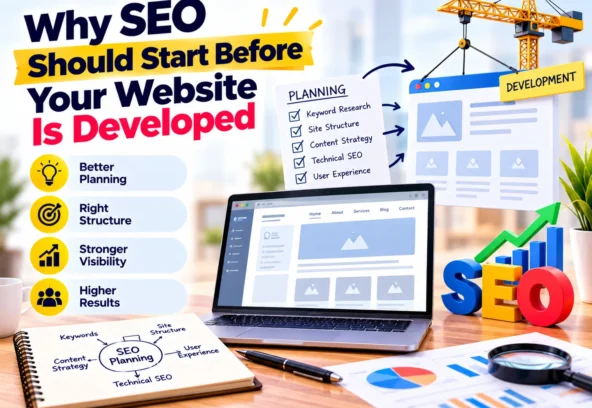
SEO should not be treated as something added after your website is finished.
Your brand should be discoverable when people search for problems, products, services, and solutions related to your business.
A strong SEO foundation includes:
- Keyword research
- Search intent
- Optimised service pages
- Helpful blog content
- Internal linking
- Technical SEO
- Local SEO where relevant
- Structured data
- Optimised images
- Clear page structure
Most importantly, create content for people first.
Search engines and AI systems need clear information, but customers need useful answers.
Step 9: Prepare Your Brand for AI Search
Digital discovery is also becoming more conversational.
People may ask AI-powered search tools questions such as:
“Which website development company can help a small business build a lead-generating website?”
Your brand needs useful, structured information that makes it easier for search systems to understand your business.
Consider creating:
- Detailed service pages
- FAQ content
- Comparison guides
- Industry-specific pages
- Location-specific content
- Case studies
- Authoritative educational articles
- Clear About information
- Original examples and insights
Avoid creating large amounts of generic AI-generated content.
Instead, add real experience, examples, expertise, and useful information.
Step 10: Connect Branding With Lead Generation
This is where a digital brand becomes more than visual identity.
Your website and content should guide visitors toward appropriate next steps.
For example:
Social Media Post → Blog → Service Page → Landing Page → Enquiry
Or:
Google Search → SEO Page → Case Study → Consultation
Or:
Google Ad → Landing Page → Form → Sales Follow-Up
Every stage should feel connected.
Step 11: Create Conversion-Focused Landing Pages
Your landing pages should match the message that brought visitors there.
For example:
Ad:
“Professional Website Development for Growing Businesses”
Landing Page:
“Website Development Designed to Turn Visitors Into Enquiries”
The visitor should immediately understand that they are in the right place.
A strong landing page can include:
- Clear headline
- Supporting message
- Benefits
- Services or features
- Portfolio
- Testimonials
- Process
- FAQs
- CTA
- Contact form
Step 12: Use Content to Build Trust Before the Sales Conversation
Not every visitor is ready to contact you immediately.
Some people need more information first.
Content can help move them through the buying journey.
Awareness
Create:
- Educational blogs
- Social posts
- Videos
- Infographics
Consideration
Create:
- Case studies
- Service pages
- Comparisons
- Guides
- Testimonials
Decision
Provide:
- Consultation
- Quote request
- Demo
- Product information
- Contact options
This creates a connected content funnel.
Step 13: Add Social Proof
People want evidence before making decisions.
Add genuine proof throughout your digital presence.
Useful examples include:
- Customer testimonials
- Google reviews
- Case studies
- Portfolio projects
- Client logos where permitted
- Awards
- Certifications
- Results and measurable outcomes where accurately documented
Place relevant proof near important conversion points.
Step 14: Use Video to Humanise the Brand
Video can communicate information and personality at the same time.
Businesses can create:
- Founder videos
- Service explainers
- Customer testimonials
- Product demonstrations
- Behind-the-scenes videos
- Educational videos
- Short-form videos
- Case study videos
One long-form video can also be repurposed into multiple content assets.
For example:
1 video → 3 Reels → 1 blog → 1 carousel → 2 social posts → 1 email → 2 quote graphics
This helps businesses get more value from their video production.
Step 15: Measure Brand and Lead Generation Performance
A complete digital brand should be measurable.
Track metrics such as:
Visibility
- Organic traffic
- Search impressions
- Social reach
- Video views
Engagement
- Time on page
- Social engagement
- Video watch time
- Content interactions
Leads
- Form submissions
- Calls
- WhatsApp enquiries
- Consultation bookings
- Quote requests
Business Results
- Qualified leads
- Sales
- Customer acquisition cost
- Revenue
The exact metrics will depend on your business model.
The key is to connect marketing activity with actual business outcomes.
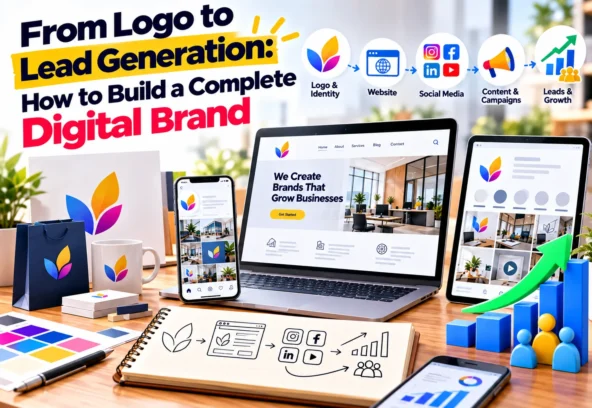
From Logo to Lead: The Complete Digital Brand Journey
A strong digital brand can follow this structure:
Brand Strategy
↓
Logo & Visual Identity
↓
Brand Guidelines
↓
Website
↓
SEO & Content
↓
Social Media
↓
Paid Advertising
↓
Landing Pages
↓
Lead Generation
↓
Sales & Customer Experience
This approach creates a connected digital ecosystem rather than a collection of unrelated marketing activities.
Common Digital Branding Mistakes
Treating the Logo as the Entire Brand
A logo creates recognition, but it does not communicate everything about your business.
Using Different Designs Everywhere
Inconsistent colours, fonts, and templates can weaken brand recognition.
Focusing Only on Appearance
A visually attractive website still needs clear messaging, useful content, good UX, and strong conversion paths.
Ignoring the Customer Journey
Your customer should be able to move naturally from discovering your brand to understanding your offer and taking action.
Creating Content Without a Strategy
Posting frequently without understanding your audience or business goals can waste resources.
Running Ads Before Fixing the Website
Paid traffic cannot solve every website or conversion problem.
Before scaling advertising, make sure your landing pages and lead-generation process are ready.
Forgetting Brand Voice
Visual consistency matters, but written communication should also sound like the same brand.
Complete Digital Brand Checklist
Use this quick checklist to evaluate your brand:
- Clear brand positioning
- Professional logo
- Consistent colour palette
- Consistent typography
- Brand guidelines
- Defined brand voice
- Professional website
- Dedicated service pages
- Conversion-focused CTAs
- Mobile-friendly website
- SEO strategy
- AI-search-friendly content
- Google Business Profile where relevant
- Consistent social media profiles
- Content strategy
- Video strategy
- Customer testimonials
- Case studies
- Landing pages
- Lead-generation forms
- Analytics and conversion tracking
- Paid advertising strategy
- Regular brand audits
Frequently Asked Questions
Q. Is a logo enough to build a strong brand?
A. No. A logo is an important part of a visual identity, but a complete brand also includes messaging, design systems, customer experience, website, content, social media, and other digital touchpoints.
Q. What is a complete digital brand?
A. A complete digital brand is a consistent combination of brand identity, messaging, website, content, SEO, social media, advertising, customer experience, and lead-generation systems.
Q. How does branding help generate leads?
A. Strong branding can help customers recognise and understand your business. When branding connects with clear messaging, useful content, trust signals, and conversion-focused website experiences, it can support the customer journey from discovery to enquiry.
Q. Should SEO be part of branding?
A. Yes. Search visibility is part of how customers discover your brand. SEO can help your business appear when people search for relevant products, services, problems, and solutions.
Q. How can a small business build a digital brand?
A. Start with a clear brand strategy and visual identity. Then build a professional website, create consistent social profiles, publish useful content, establish SEO foundations, collect genuine reviews, and add lead-generation systems.
Q. How often should a business update its brand?
A. There is no fixed schedule. Businesses should maintain consistency while updating their brand when their positioning, audience, services, market, or business goals change.
Final Takeaway
A logo can help people recognise your business.
A complete digital brand helps people discover, understand, trust, remember, and contact your business.
That journey requires more than graphic design.
It requires a connected approach to brand identity, website development, SEO, content, social media, video, advertising, landing pages, and lead generation.
When these elements work together, your digital presence becomes more than a collection of marketing assets. It becomes a system that supports business growth.
Build Your Complete Digital Brand With CreativeKatta
CreativeKatta helps businesses build connected digital experiences through brand identity design, website development, SEO, social media marketing, creative design, video editing, package design, and Google Ads/PPC.
From creating your visual identity to building a website that generates enquiries, every part of your digital presence should work toward the same business goal.
Ready to move from a logo to a complete digital brand? Talk to CreativeKatta about building a stronger, more consistent online presence.