
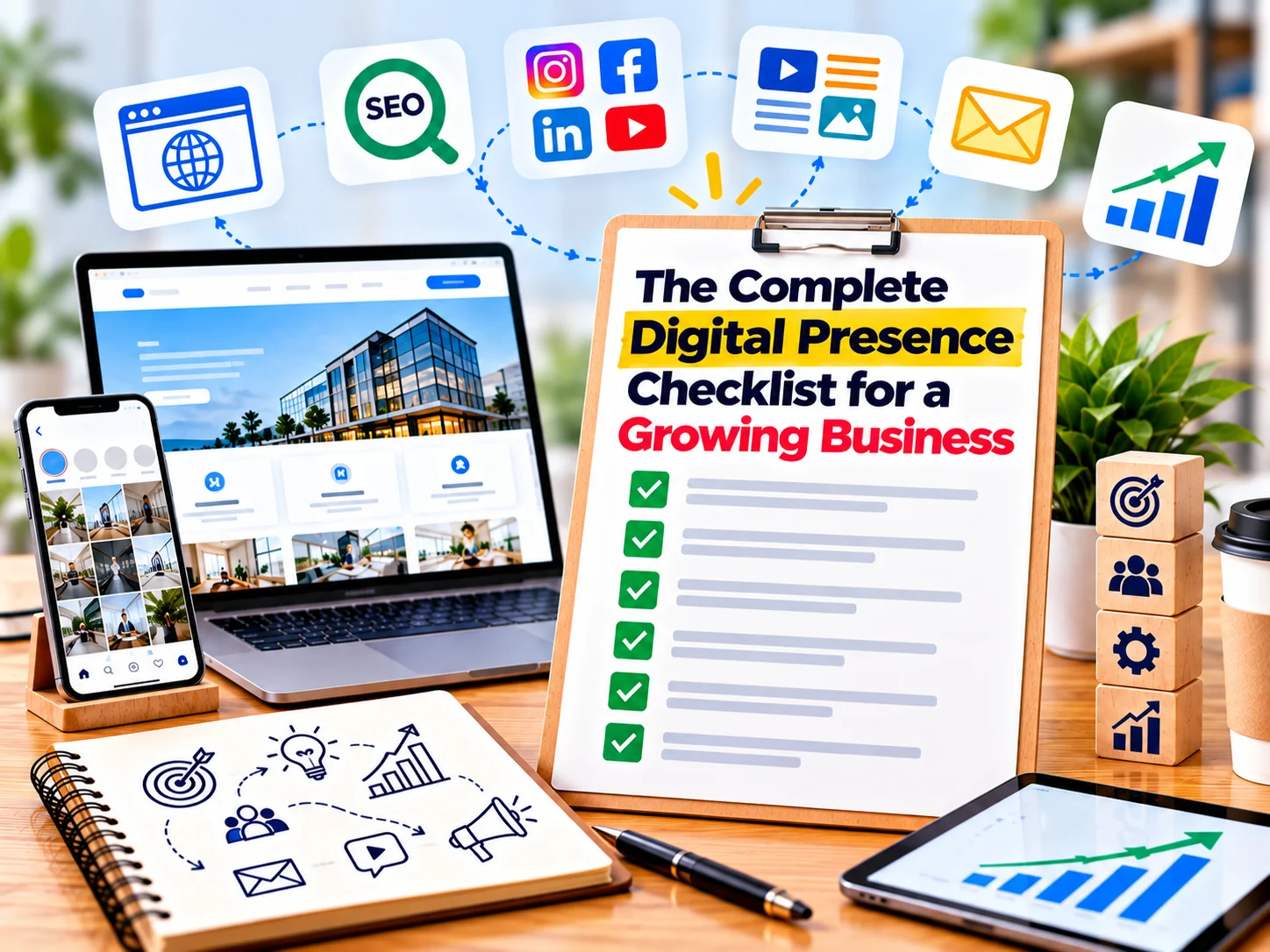
A growing business needs more than a good website.
Today, customers may discover your brand through Google, social media, online reviews, videos, paid advertisements, business directories, or AI-powered search.
As a result, every digital touchpoint contributes to how people discover, evaluate, and remember your business.
That is why businesses need a strong and consistent digital presence.
But what does a complete digital presence actually include?
This checklist covers the essential digital assets, channels, content, SEO elements, branding, and conversion tools a growing business should review.
What Is a Digital Presence?
A digital presence is the collection of online channels and assets that represent your business.
It can include:
- Business website
- Google Business Profile
- Search engine visibility
- Social media profiles
- Online reviews
- Business directories
- Video content
- Email marketing
- Paid advertising
- Brand identity
- Online content
- Landing pages
- Customer enquiry channels
These elements work together.
For example, someone might discover your business through Google, visit your website, check your Instagram profile, read reviews, watch a video, and then contact you through WhatsApp.
Therefore, your digital presence should provide a consistent experience at every stage.
The Complete Digital Presence Checklist
Use the following checklist to review your business’s current online presence.
1. Website Checklist
Your website is often the central hub of your digital presence.
Make sure it answers three important questions quickly:
Who are you?
What do you offer?
Why should someone choose you?
Website Essentials
- Professional domain name
- Secure HTTPS connection
- Mobile-responsive design
- Fast-loading pages
- Clear navigation
- Professional homepage
- Dedicated service or product pages
- About Us page
- Contact page
- Clear calls to action
- Working enquiry forms
- Click-to-call functionality
- WhatsApp or other relevant contact option
- Social media links
- Privacy policy
- Terms and conditions where required
- Cookie or consent requirements where applicable
- Updated business information
A website should not only look professional.
It should also help visitors take the next step.
2. Website Conversion Checklist
Getting website visitors is only one part of digital marketing.
Your website should also convert relevant visitors into enquiries, bookings, calls, or purchases.
Check whether your website has:
- Clear primary CTA
- Visible contact details
- Simple enquiry forms
- Relevant service information
- Benefits explained clearly
- Customer testimonials
- Case studies or portfolio
- Trust signals
- FAQs
- Strong headlines
- Easy-to-find pricing information where appropriate
- Clear next steps
- Mobile-friendly forms
For example, instead of using a generic button such as “Submit”, consider a CTA that explains the action:
Get a Free Consultation
or
Request a Project Quote
The best CTA depends on your business and customer journey.
3. SEO Checklist
A website cannot generate consistent organic visibility if search engines cannot understand its content.
Your basic SEO checklist should include:
- Keyword research
- Search intent analysis
- SEO-friendly page titles
- Meta descriptions
- Proper H1, H2, and H3 structure
- Descriptive URLs
- Optimized service pages
- Internal linking
- Image alt text
- Optimized images
- XML sitemap
- Robots.txt
- Canonical URLs where appropriate
- Search Console setup
- Analytics setup
- Broken-link monitoring
- Regular content updates
However, SEO is no longer only about adding keywords.
Your content should answer real customer questions and demonstrate useful expertise.
4. AI Search and LLM Visibility Checklist
Search behaviour is changing.
People increasingly use conversational search and AI tools to discover businesses, compare services, and find answers.
Therefore, businesses should also create content that is easy for search engines and AI systems to understand.
Consider whether your website has:
- Clearly structured content
- Direct answers to customer questions
- Detailed service pages
- FAQ sections
- Helpful supporting articles
- Consistent business information
- Author or company expertise information
- Relevant structured data
- Strong internal linking
- Original examples and insights
- Location-specific information where relevant
Instead of writing content only around individual keywords, build topic depth around the questions your customers actually ask.
5. Google Business Profile Checklist
For local businesses, Google Business Profile is an important part of online visibility.
Review the profile regularly.
- Business name is accurate
- Correct business category
- Address is accurate where applicable
- Phone number is correct
- Website URL is correct
- Business hours are updated
- Holiday hours are updated
- Services are listed
- Products are added where relevant
- Business description is complete
- High-quality photos are uploaded
- Reviews are monitored
- Customer questions are answered
- Business updates are posted where useful
Most importantly, keep your business information consistent across your website and other important platforms.
6. Social Media Checklist
You do not necessarily need to be active on every social media platform.
Instead, focus on the platforms where your target customers spend time.
Social Media Profile Checklist
- Correct username
- Consistent profile image
- Professional bio
- Website link
- Contact information
- Clear description of services
- Consistent branding
- Updated profile information
- Relevant highlights or pinned content
- Regular content publishing
- Community engagement
- Comment and message monitoring
Your social media profile should make it easy for someone to understand your business within seconds.
7. Social Media Content Checklist
A strong social media presence needs more than promotional posts.
Create a content mix that includes:
- Educational content
- Product or service information
- Customer stories
- Testimonials
- Behind-the-scenes content
- Industry insights
- Short-form videos
- Tips and tutorials
- FAQs
- Company updates
- Team content
- Case studies
- Offers when relevant
Most importantly, maintain a consistent visual identity.
Your posts should feel like they belong to the same brand.
8. Brand Identity Checklist
Your digital presence should look consistent across platforms.
Review:
- Logo
- Primary colours
- Secondary colours
- Typography
- Brand imagery
- Graphic style
- Icon style
- Social media templates
- Presentation templates
- Email signatures
- Brand guidelines
A consistent brand identity helps customers recognise your business more easily.
However, branding goes beyond the logo.
Your messaging, tone, visuals, customer experience, and content should also communicate a consistent identity.
9. Online Reputation Checklist
Customers often check reviews before contacting a business.
Therefore, reputation management should be part of your digital strategy.
- Monitor Google reviews
- Respond to genuine reviews
- Monitor social media mentions
- Track important directory listings
- Encourage genuine customer feedback
- Showcase relevant testimonials
- Address legitimate complaints professionally
- Keep business information consistent
Do not create fake reviews or manipulate customer feedback.
Instead, build your reputation through genuine customer experiences.
10. Content Marketing Checklist
Content helps businesses demonstrate expertise and answer customer questions before a sales conversation.
Your content strategy can include:
- Blog articles
- Guides
- FAQs
- Case studies
- Videos
- Infographics
- Social media posts
- Checklists
- Industry insights
- Customer stories
Choose topics based on customer problems, search behaviour, and your expertise.
For example, a website development company could create content around:
- Website development costs
- Website redesign
- Website conversion
- Mobile-friendly websites
- SEO-friendly website development
- Common website mistakes
- Website maintenance
This approach creates useful content while supporting organic search visibility.
11. Video Marketing Checklist
Video can help businesses explain complex ideas quickly.
Your video strategy could include:
- Brand introduction videos
- Service explanation videos
- Product demonstrations
- Customer testimonials
- Educational videos
- Short-form videos
- Behind-the-scenes videos
- Case study videos
- FAQ videos
- YouTube content
One long-form video can also become multiple pieces of content.
For example, a single video could become:
1 YouTube video + 3 Shorts + 1 blog + 1 LinkedIn post + 1 carousel + 2 quote graphics + 1 email = 10 content assets.
This makes video content more efficient for growing businesses.
12. Paid Advertising Checklist
Organic visibility takes time.
Paid advertising can help businesses reach relevant audiences more quickly when campaigns are properly planned.
Review your:
- Google Ads account
- Campaign structure
- Keyword targeting
- Negative keywords
- Ad copy
- Landing pages
- Conversion tracking
- Audience targeting
- Location targeting
- Budget allocation
- Lead quality
- Cost per lead
- Sales outcomes
Do not judge an advertising campaign only by clicks.
The important question is whether relevant traffic turns into meaningful business results.
13. Analytics and Tracking Checklist
You cannot improve what you cannot measure.
Make sure your business can track important actions.
- Google Analytics or equivalent analytics platform
- Google Search Console
- Form submissions
- Phone calls where possible
- WhatsApp or chat enquiries where possible
- E-commerce purchases where applicable
- Campaign conversions
- Landing page performance
- Traffic sources
- Search queries
- Lead sources
Track metrics that connect digital activity with business goals.
For example:
Traffic → Leads → Qualified Leads → Customers → Revenue
This gives you a more useful view than traffic alone.
14. Local SEO Checklist
If your business serves a specific city or region, local SEO can help potential customers discover you.
Review:
- Google Business Profile
- Location pages
- Consistent NAP information
- Local keywords
- Local testimonials
- Location-specific service content
- Relevant local directories
- Local backlinks
- Customer reviews
- Embedded maps where useful
Avoid creating low-quality location pages simply to target different cities.
Each location page should provide genuine value.
15. Lead Generation Checklist
Your digital presence should make it easy for interested customers to contact you.
Provide multiple relevant options such as:
- Contact form
- Phone
- Appointment booking
- Quote request
- Consultation booking
- Demo request
However, offering too many options can also create confusion.
Choose the conversion methods that match your audience and sales process.
16. Security and Maintenance Checklist
Digital presence also requires ongoing maintenance.
Check:
- SSL certificate
- Website backups
- WordPress/plugin updates where applicable
- Security monitoring
- Broken links
- Expired domains
- Form functionality
- Contact details
- Software integrations
- Tracking codes
- Website performance
A website that works today can still develop problems later.
Regular maintenance helps prevent avoidable issues.
17. Digital Presence Consistency Checklist
Finally, compare your information across platforms.
Check whether your:
- Business name
- Logo
- Phone number
- Email address
- Website
- Address
- Business description
- Services
- Brand colours
- Social media handles
are consistent.
For example, if your website says one service is available but your social media profile contains outdated information, customers may become confused.
Consistency builds trust.
How to Prioritise Your Digital Presence
You do not have to fix everything at once.
A growing business can use a simple three-stage approach.
Stage 1: Build the Foundation
Focus on:
- Professional website
- Brand identity
- Google Business Profile
- Basic SEO
- Social media profiles
- Contact and lead-generation systems
- Analytics
Stage 2: Build Visibility
Then expand into:
- SEO content
- Social media marketing
- Video marketing
- Local SEO
- Reviews
- Email marketing
- Content repurposing
Stage 3: Scale
Once the foundation works, consider:
- Google Ads
- Advanced SEO
- Conversion optimization
- Marketing automation
- CRM integration
- Advanced analytics
- Retargeting
- Larger content campaigns
This approach helps businesses invest according to their current stage instead of trying to do everything simultaneously.
The 30-Point Digital Presence Checklist
For a quick review, ask whether your business has:
- Professional website
- Mobile-friendly design
- Fast website
- Clear CTAs
- Dedicated service pages
- SEO strategy
- Search Console
- Analytics
- Google Business Profile
- Consistent business information
- Active social profiles
- Consistent brand identity
- Regular content
- Video content
- Customer testimonials
- Online reviews
- Case studies
- FAQ content
- Local SEO
- Lead-generation forms
- WhatsApp/contact options
- Conversion tracking
- Paid advertising strategy
- Landing pages
- Email marketing
- Website security
- Regular backups
- Website maintenance
- AI-search-friendly content
- Regular performance reviews
If several boxes remain unchecked, those areas can become priorities for your next digital marketing phase.
Frequently Asked Questions
Q. What should a growing business have in its digital presence?
A. A growing business should generally have a professional website, search visibility, Google Business Profile where relevant, social media profiles, consistent branding, useful content, online reviews, lead-generation channels, analytics, and a plan for ongoing digital marketing.
Q. Why is a website important for digital presence?
A. A website gives customers a central place to understand your business, explore your services, verify your credibility, and take action. It can also support SEO, content marketing, advertising, and lead generation.
Q. Is social media enough for a business’s online presence?
A. Social media can be valuable, but it should not necessarily be your entire digital presence. A business website provides more control over your information, customer journey, content, SEO, and conversion experience.
Q. How important is SEO for a growing business?
A. SEO can help businesses attract people who are actively searching for relevant products, services, or information. A strong SEO strategy can support long-term organic visibility.
Q. How can businesses improve their visibility in AI search?
A. Create clear, useful, well-structured content that answers customer questions directly. Build topic depth, maintain accurate business information, use relevant structured data, and demonstrate genuine expertise through original content and examples.
Q. How often should a business update its digital presence?
A. Review your digital presence regularly. Business information should be updated whenever it changes, while website content, SEO performance, social media, reviews, security, and campaigns should be reviewed according to their individual needs.
Final Takeaway
A strong digital presence is not one website, one social media page, or one advertising campaign.
It is a connected system.
Your website, SEO, Google Business Profile, social media, branding, content, video, advertising, reviews, analytics, and lead-generation channels should work together.
Most importantly, build the foundation first.
Then create useful content, improve visibility, measure performance, and scale the channels that contribute to your business goals.
A consistent digital presence does more than make your business look professional. It helps potential customers discover your brand, understand your value, trust your business, and take action.
Build a Stronger Digital Presence With CreativeKatta
CreativeKatta helps businesses build and strengthen their digital presence through website development, SEO, social media marketing, brand identity design, creative design, video editing, package design, and Google Ads/PPC.
Instead of managing disconnected digital activities, build a strategy where your website, content, branding, search visibility, and advertising support each other.
Ready to strengthen your business’s digital presence? Talk to CreativeKatta and build a digital strategy designed for your next stage of growth.