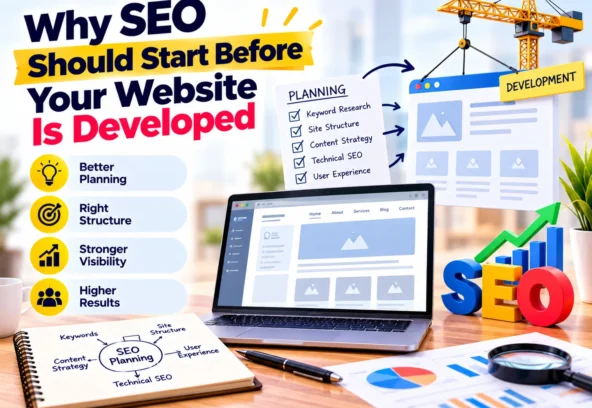

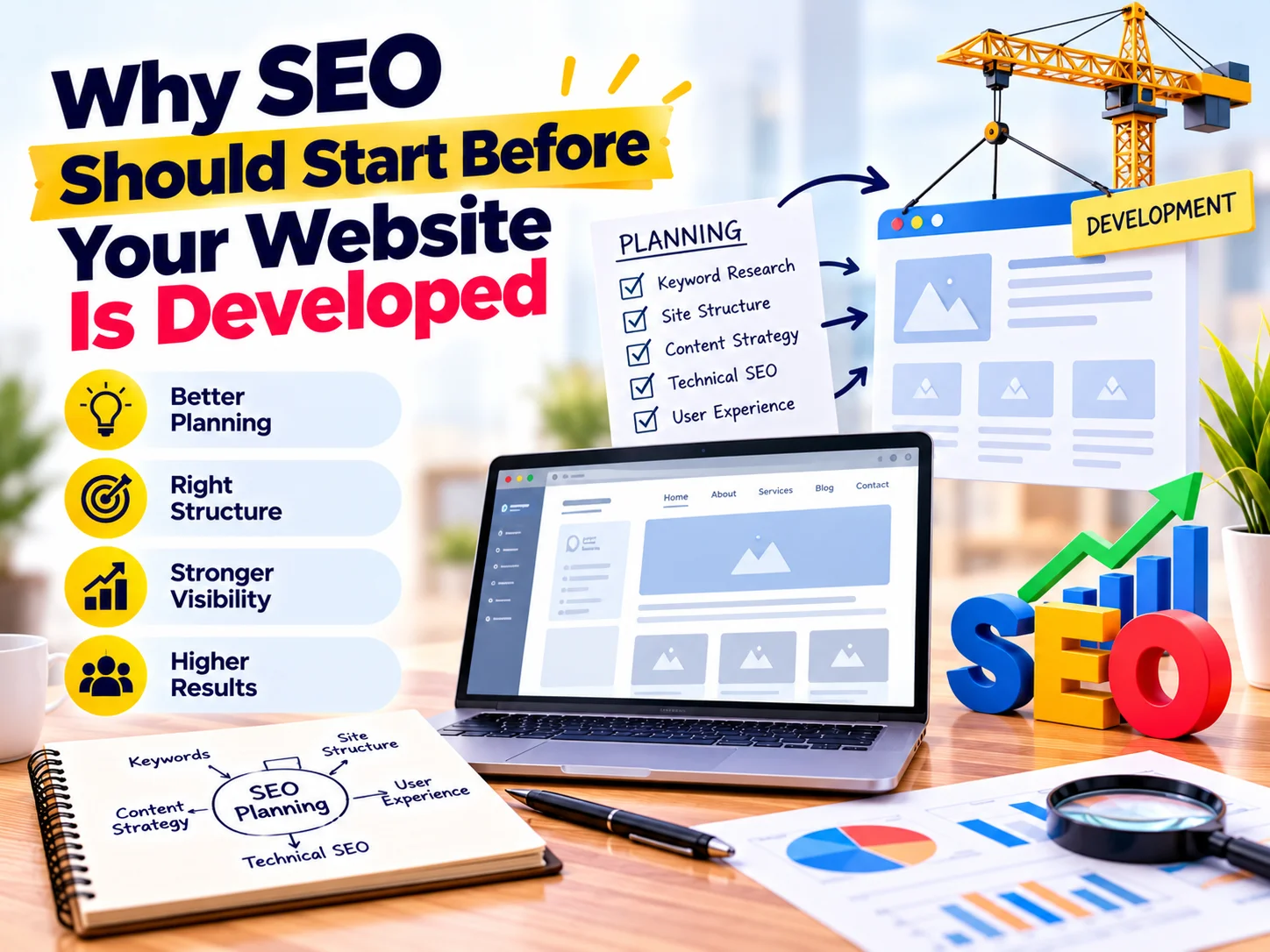
Many businesses treat SEO as something they do after launching a website.
First, they choose a design. Then, developers build the pages. Finally, they add SEO titles, keywords, and content.
However, this approach can create unnecessary problems.
SEO should start before your website is developed.
When SEO becomes part of the website planning process, businesses can build a site with the right structure, content, user experience, and technical foundation from the beginning.
As a result, the website has a stronger opportunity to attract relevant organic traffic after launch.
In this guide, we explain why SEO should begin before website development and how an SEO-first approach can create a stronger website foundation.
What Does SEO Before Website Development Mean?
SEO before development means considering search visibility while planning the website rather than treating it as a final step.
This process can include:
- Keyword research
- Search intent analysis
- Competitor research
- Website structure planning
- URL planning
- Content planning
- Internal linking strategy
- Page hierarchy
- Technical SEO requirements
- Mobile usability
- Core Web Vitals considerations
- Schema planning
- Image optimisation
Instead of asking, “How can we optimise this website after it is built?”, an SEO-first approach asks:
“How should we build this website so it can perform well in search from the beginning?”
Why Should SEO Start Before Website Development?
SEO affects many parts of a website.
For example, keyword research can influence page structure. Search intent can influence content. Technical requirements can influence development decisions. Internal linking can influence navigation.
Therefore, delaying SEO can result in expensive changes later.
1. Keyword Research Can Shape the Website Structure
Keyword research does more than identify phrases to add to content.
It can help determine which pages your website actually needs.
For example, a web development company may discover search demand around:
- Website development
- WordPress development
- E-commerce website development
- Business website development
- Website redesign
- Custom website development
Instead of putting all these services on one page, the business may create dedicated pages for relevant services.
This creates a clearer structure for both users and search engines.
2. SEO Helps Identify the Right Website Pages
A website should answer the questions your potential customers are already searching for.
Before development starts, SEO research can identify opportunities for:
- Service pages
- Product pages
- Location pages
- Industry pages
- Case studies
- Resource pages
- FAQ sections
- Blog content
Consequently, the development team can build the navigation and page hierarchy around actual business and search requirements.
3. Search Intent Can Improve Page Planning
Not every keyword represents the same type of search.
For example:
“What is SEO?” suggests informational intent.
“SEO agency in Bangalore” suggests a local service search.
“SEO services for small business” may indicate commercial investigation.
These searches require different types of content.
Therefore, understanding search intent before development helps you create pages that match what users expect to find.
4. SEO Can Improve Website Architecture
Website architecture determines how pages connect with each other.
A clear structure can make it easier for users and search engines to discover important content.
For example:
Home → Services → Website Development → WordPress Development
This structure creates logical relationships between pages.
It also provides opportunities for internal links between related content.
Therefore, SEO planning should influence the website hierarchy before development begins.
5. URL Structure Should Be Planned Early
Changing URLs after launch can create unnecessary complications.
Before development, define a logical URL structure.
For example:
/website-development/
/website-development/wordpress-development/
/website-development/ecommerce-development/
Keep URLs:
- Short
- Descriptive
- Relevant
- Easy to understand
- Consistent
Avoid creating unnecessary URL parameters, random page IDs, or complicated structures.
6. Content Planning Should Happen Before Design
Many websites start with visual design and add content later.
However, this can create problems.
For example, a designer may create a beautiful service page with space for only a small amount of text. Later, the SEO team may recommend more detailed content to address customer questions and search intent.
Now the design needs changes.
Instead, SEO, content, UX, and development teams should work together from the beginning.
This approach creates layouts that support both visual communication and useful content.
7. SEO Can Influence Website Navigation
Navigation is important for both users and search engines.
Before development, identify the most important pages and organise them logically.
For example:
Home
→ About
→ Services
→ Industries
→ Portfolio
→ Blog
→ Contact
Depending on the business, the structure may also include location or product categories.
A well-planned navigation system helps visitors find information without unnecessary clicks.
8. Technical SEO Requirements Can Be Built Into Development
Technical SEO should not always become a post-launch checklist.
Developers can consider important requirements while building the website.
These may include:
- Responsive design
- Fast page loading
- Clean HTML structure
- Proper heading hierarchy
- Crawlable links
- XML sitemap support
- Canonical URL handling
- Redirect management
- Image optimisation
- Mobile usability
- Structured data
- HTTPS
- Accessibility considerations
Building these foundations early can reduce the need for major technical corrections later.
9. Website Speed Starts With Development Decisions
Website performance depends on more than caching plugins.
Development choices can affect loading speed.
For example:
- Large images can increase page weight.
- Unnecessary scripts can slow pages down.
- Excessive animations can affect performance.
- Poorly optimised code can increase loading time.
- Heavy third-party integrations can add additional requests.
Therefore, performance should become part of the development process rather than a post-launch fix.
10. Mobile SEO Should Be Considered From the Beginning
Many users access websites through smartphones.
Therefore, mobile usability should influence design and development decisions from the start.
Check:
- Font sizes
- Button sizes
- Navigation
- Image scaling
- Spacing
- Forms
- Page speed
- Content visibility
- Mobile interactions
A website should not simply shrink the desktop version.
Instead, it should provide a practical experience across different screen sizes.
11. Internal Linking Can Be Planned Early
Internal links connect related pages on your website.
For example, a blog about website development could link to your:
- Website development service
- WordPress development service
- Portfolio
- Contact page
- Related blogs
Planning these relationships early helps create a connected website rather than a collection of isolated pages.
12. Schema Markup Can Be Considered During Development
Structured data can help search engines understand certain types of website information.
Depending on the business, developers and SEO specialists may consider relevant schema types such as:
- Organization
- LocalBusiness
- Service
- Product
- Article
- BreadcrumbList
- FAQPage
Schema should match the actual content on the page and follow current search engine guidelines.
13. SEO Helps Create Better Landing Pages
SEO research can reveal what potential customers want to know before contacting a business.
For example, a service page may need information about:
- What the service includes
- Who it is for
- Benefits
- Process
- Pricing factors
- FAQs
- Previous work
- Service areas
- Contact options
Including relevant information can make the page more useful while also supporting search visibility.
14. SEO Can Reduce Expensive Website Changes
One of the biggest advantages of starting SEO early is avoiding unnecessary rework.
Consider this common situation:
- The website gets designed.
- Developers build it.
- The site launches.
- SEO research identifies missing service pages.
- New URLs are created.
- Navigation changes.
- Content needs additional sections.
- Internal links need restructuring.
This process can take additional time and resources.
Instead, early SEO planning allows these requirements to become part of the original website scope.
SEO-First Website Development Process
A practical SEO-first process can look like this:
Step 1: Business & Audience Research
Understand the business, target audience, services, locations, and customer journey.
Step 2: Keyword Research
Identify relevant keywords based on search demand, competition, business relevance, and search intent.
Step 3: Competitor Research
Analyse competing websites to identify content gaps, page structures, service categories, and useful content opportunities.
Step 4: Website Architecture
Create the sitemap, navigation structure, page hierarchy, and URL structure.
Step 5: Content Planning
Define the primary topic, supporting keywords, search intent, headings, FAQs, and internal links for important pages.
Step 6: UX & UI Design
Create page layouts that support both user experience and content requirements.
Step 7: Development
Build the website with technical SEO, responsive design, performance, accessibility, and structured data requirements in mind.
Step 8: SEO Implementation
Optimise titles, meta descriptions, headings, images, internal links, URLs, schema, and other relevant elements.
Step 9: Testing
Check mobile usability, page speed, broken links, redirects, indexing controls, forms, navigation, and technical issues.
Step 10: Launch & Monitor
After launch, monitor search performance, indexing, rankings, organic traffic, and user behaviour.
Then, continue improving the website based on actual data.
SEO After Website Development vs SEO Before Development
SEO After Development | SEO Before Development |
SEO becomes a later task | SEO becomes part of planning |
May require structural changes | Structure can support SEO from the beginning |
Content may not fit the design | Design can accommodate content |
URLs may need restructuring | URLs can be planned early |
Technical issues may require fixes | Technical requirements can enter development |
Internal links may be added later | Internal linking can be planned |
SEO can become reactive | SEO becomes part of the strategy |
The goal is not to choose between development and SEO.
Instead, SEO and website development should work together from the beginning.
Common Mistakes to Avoid
Treating SEO as an Add-On
SEO should not simply mean adding keywords after the website launches.
Designing Before Understanding Content
Designing layouts without considering content requirements can create limitations later.
Ignoring Search Intent
Ranking for a keyword is less useful if the page does not satisfy what users expect.
Creating Too Many Pages
SEO does not mean creating a separate page for every keyword variation.
Instead, build useful pages around meaningful topics and customer needs.
Forgetting Existing SEO Assets
When redesigning an existing website, review current URLs, rankings, backlinks, traffic, and important pages before making structural changes.
Launching Without Testing
A website may look complete while still containing broken links, indexing issues, slow pages, or missing metadata.
A proper pre-launch SEO check can identify these issues before they affect organic visibility.
SEO-First Website Launch Checklist
Before launching your new website, check:
- Keyword research completed
- Search intent reviewed
- Sitemap planned
- URLs reviewed
- Page titles written
- Meta descriptions written
- Heading hierarchy checked
- Content reviewed
- Internal links added
- Images optimised
- Alt text added where appropriate
- Mobile responsiveness tested
- Page speed checked
- XML sitemap configured
- Robots.txt reviewed
- Canonical URLs checked
- Redirects planned
- Structured data reviewed
- Broken links checked
- Analytics configured
- Google Search Console configured
- Indexing settings checked
This checklist can help your website launch with a stronger technical and content foundation.
Final Thoughts
SEO should not begin after your website goes live.
Instead, it should start during the website planning stage.
Keyword research can influence your site structure. Search intent can shape your content. Technical SEO can influence development. Internal linking can influence navigation. Meanwhile, performance and mobile usability can become part of the design and development process.
When SEO, UX, content, design, and development work together, businesses can create websites that are not only attractive but also easier to understand, navigate, crawl, and discover.
The best time to plan SEO for a new website is before development begins.
Build an SEO-Ready Website With CreativeKatta
A website should do more than look professional. It should help your business get discovered, communicate value, and turn visitors into enquiries.
CreativeKatta combines website development, SEO, creative design, brand identity, social media marketing, video editing, and Google Ads to help businesses build a stronger digital presence.
From keyword research and website structure to content, design, development, and SEO implementation, we can help create a website with search visibility in mind from the beginning.
Planning a new website or redesigning your existing one? Talk to CreativeKatta and build your website with SEO from day one.
CTA: Build Your SEO-Ready Website With CreativeKatta →
FAQ
Q. Why should SEO start before website development?
A. Starting SEO early allows keyword research, search intent, website architecture, URLs, content, internal linking, and technical SEO requirements to influence the website before development begins.
Q. Can SEO be added after a website is developed?
A. Yes. However, implementing SEO after development may require changes to page structure, URLs, content, navigation, and technical elements.
Q. What should SEO teams do before website development?
A. They can conduct keyword research, analyse search intent and competitors, plan the sitemap, define URLs, identify important pages, create a content strategy, and document technical SEO requirements.
Q. How does SEO affect website design?
A. SEO can influence content space, heading structure, navigation, page hierarchy, internal linking, mobile usability, page speed, and other elements that affect the user and search experience.
Q. What is an SEO-first website?
A. An SEO-first website incorporates search visibility, content structure, technical requirements, user experience, and search intent into the planning and development process rather than treating SEO as a post-launch task.